Who can precept a Gonzaga nurse practitioner student
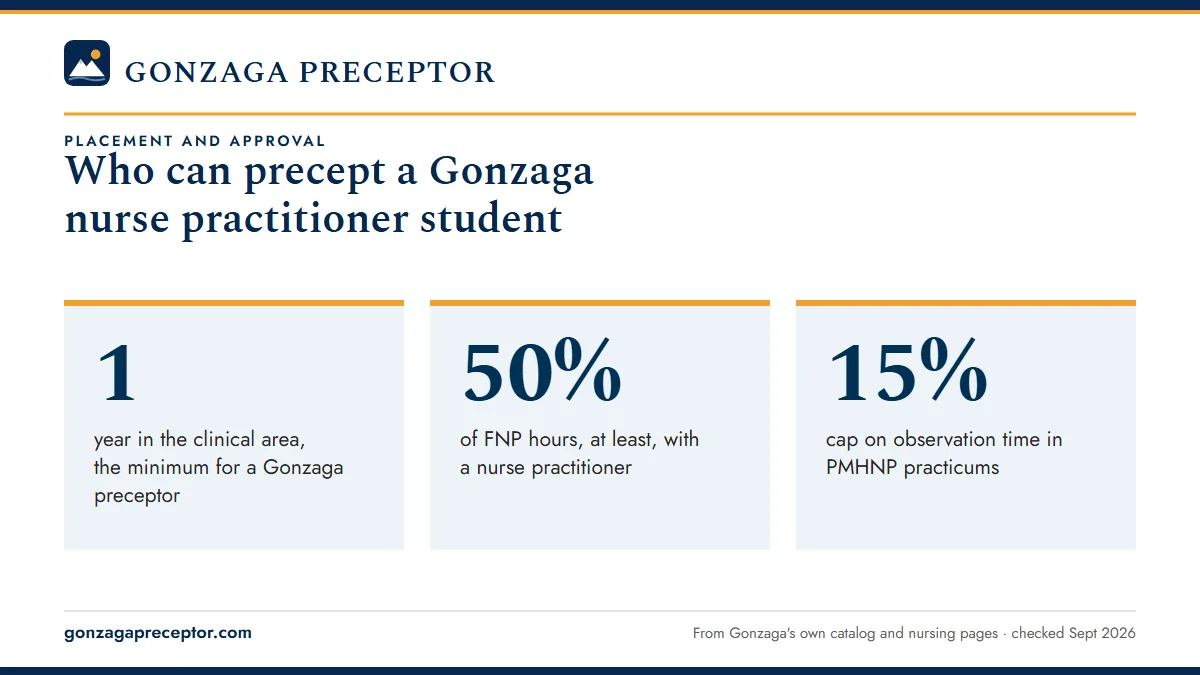
Gonzaga accepts practicing ARNPs, MDs, DOs and, in certain states, PAs as preceptors, provided they bring at least twelve months of experience in the area they will teach, hold an unencumbered license where you train, and can document licensure and national certification. Each track then adds its own rules: FNP hours lean on nurse practitioners, PMHNP hours on mental health professionals, and DNP projects on an agency liaison.
Get your placement plan
Tell us your Gonzaga program and where you live. A placement advisor replies with the preceptor and site options that fit your Gonzaga course.
Gonzaga's baseline criteria, in its own words
Gonzaga's Preceptor Portal lists four requirements for anyone precepting a Gonzaga nursing student. A preceptor must:
- "Currently practice as an ARNP, MD, DO or PA, in certain states; additionally practicing interdisciplinary healthcare providers may also be accepted"
- "Have a minimum of 1 year of experience in the clinical area you will be precepting"
- "Hold an unencumbered, active license for the state in which the student will be precepted"
- "Provide documentation of licensure and national board certification"
Faculty apply these criteria when your Practicum Site Placement Request comes up for review, and the final say belongs to course or program faculty. Note that the experience is measured in the clinical area being precepted, not in total years of practice, so a clinician new to primary care may not yet qualify for an FNP rotation there.
The state license and the "certain states" clause
The license has to match where you train, not where the preceptor trained or where Gonzaga sits. NP students precept in the state where they hold their RN license, inside Gonzaga's ten western admission states, so the preceptor needs an active, unencumbered license in that same state. Some states add conditions of their own: Utah expects the preceptors an out-of-state program uses there to hold a Utah or compact license, and California requires a valid California license in the preceptor's profession.
The phrase "in certain states" attached to PAs reflects that states differ on who may precept an NP student. Washington's rule for in-state programs, WAC 246-840-533, allows an interdisciplinary preceptor such as an MD, DO or PA, provided they are licensed and have a year of experience suited to the learning objectives. Alaska's Board, on its student registration form, looks for a preceptor licensed to practice as an APRN or physician. Where a PA is in the picture, confirm with course faculty before you plan a semester around them.
FNP preceptors
For the FNP practicums, the catalog's list is NP, physician or PA, with an exception for states that limit preceptors to MDs and NPs. Two further rules shape the mix. Nurse practitioners must supervise no less than half of the FNP hours you log, and no more than two approved preceptors may supervise you in a semester. Physicians may be MDs or DOs, since the Preceptor Portal lists both, and each preceptor must be approved before you log a single hour with them.
For NURS 601, the health assessment practicum, the catalog lists a nurse practitioner or physician while Gonzaga's program page adds PAs, so check the current syllabus if you plan a PA for that course. All FNP practicums are in primary care. The FNP nurse practitioner rule shows how to plan the split, and the two-preceptor limit explains the cap.
PMHNP preceptors
Gonzaga's PMHNP materials accept a wider circle. The PMHNP course objectives page and preceptor packet describe preceptors as qualified mental health professionals, naming advanced practice nurses, psychiatrists, psychologists, social workers and licensed therapists. That breadth lets PMHNP students gain psychotherapy experience with therapists alongside prescribing experience with psychiatric NPs and psychiatrists.
The catalog is narrower for NURS 683M, the extension course, naming a psychiatric nurse practitioner or psychiatrist, while the program web page uses the NP, physician or PA wording. When the sources differ, the course syllabus and course faculty decide, so confirm each preceptor's license type against the specific course before you submit. PMHNP students also work under an observation cap: no more than 15% of practicum time spent observing. See what counts as clinical hours.
DNP agency liaisons and BSN capstone preceptors
Post-Master's DNP students do not need a direct-care preceptor, because their hours are indirect and tied to the DNP project. They work with an agency liaison, who completes Gonzaga's online DNP Agency Liaison Checklist. The liaison attests to having no family tie, friendship or reporting line with the student, agrees to at least three contacts from Gonzaga during the semester, and fills out an evaluation when the course ends. The agency liaison guide covers the role.
In the BSN, the capstone practicum pairs each student with an experienced registered nurse preceptor in a setting the student requests, with faculty review deciding the final placement. That capstone is NURS 495 in the current plan of study and NURS 468 for students still on the legacy curriculum.
Relationships that rule a preceptor out
On every track, your preceptor cannot be your direct supervisor. Gonzaga follows Washington's WAC 246-840-533, which also excludes immediate family and anyone whose financial, business or professional ties to you could undermine impartial grading. In practice, that rules out:
- Your manager or anyone you report to at work
- A spouse, parent, sibling or other immediate family member
- A business partner or anyone with a financial stake in your work
- A preceptor already supervising two students at the same time, the most Washington's rule allows
Working for the same organization is not automatically a problem; the workplace practicum rules set out when it is allowed. If you are unsure whether a relationship counts, disclose it on the request and let faculty decide.
Why Gonzaga students choose us to find qualified preceptors
Qualifying a preceptor takes more than a willing clinician. Our placement desk checks each candidate against Gonzaga's criteria before you ever hear the name: the license in your state, national board certification, at least a year's experience in the specialty, the right credential for your track and course, and no supervisory or family ties to you.
For FNP students we build around nurse practitioners so the half-NP rule is covered from the start; for PMHNP students we match the preceptor type to the course and the psychotherapy or prescribing experience it needs. Gonzaga's faculty give the final approval, and what we send toward them is complete and checked. Gonzaga's own offer to preceptors, from adjunct faculty opportunities to recognition, is in the Preceptor Portal guide. Start with the form below.
Questions Gonzaga students ask
Can a physician assistant precept a Gonzaga FNP student?
Usually, yes. Gonzaga's catalog lets NPs, physicians and PAs supervise the FNP practicums, except in states that insist on an MD or NP, and the Preceptor Portal lists PAs in certain states. Because NPs have to cover half or more of your FNP hours, a PA works best as one of your two preceptors rather than the only one.
Can a psychologist or licensed therapist precept Gonzaga PMHNP hours?
Gonzaga's PMHNP packet and course objectives page include psychologists, social workers and licensed therapists among qualified mental health professionals, alongside advanced practice nurses and psychiatrists. The catalog's wording for the extension course is narrower, so confirm the preceptor type for each course with course faculty before you submit the request.
Does my preceptor need a license in my state or theirs?
In yours, meaning the state where the practicum happens. Gonzaga's portal ties the preceptor's license to the practicum's location, not to the provider's home base. A provider licensed only in a neighboring state would need a license valid in your state before precepting you there, which matters most for students who live near a state line.
Does Gonzaga pay its preceptors?
No. Gonzaga's Preceptor Portal says the university is currently unable to pay preceptors. In place of payment it lists teaching and recognition benefits: the chance to become Gonzaga adjunct faculty, an hours certificate usable for board or licensure recertification, DynaMed Plus access, and monthly and annual preceptor awards.
Can a newly certified nurse practitioner precept me?
Only once they have twelve months of practice in the clinical area they would teach, which is Gonzaga's floor. Washington's rule for nursing preceptors asks for a year at the level the student is preparing for, so RN years before NP certification do not count toward it. A newer NP can still be a strong choice once that year is behind them.
Related pages
Last checked 2026-09-25
We check these pages against Gonzaga's catalog, FAQs, preceptor packets and Department of Nursing pages. Your course, the Graduate Nursing Student Handbook and Gonzaga's Clinical Placement Team have the final word.
- Gonzaga University Department of Nursing, Preceptor Portal
- Gonzaga University Graduate Catalog, Master of Science in Nursing
- Gonzaga University Preceptor Portal, PMHNP Course Objectives
- Gonzaga University Preceptor Portal, DNP Agency Liaison Checklist
- Washington State Board of Nursing, Nursing Education Rules (WAC 246-840-533)
Gonzaga asks you to find local preceptors first. Let us run that search.
Tell us your Gonzaga program, your practicum course and where you live and can travel. We find preceptors who fit the course and prepare the license, certification and site details your Practicum Site Placement Request needs, early in the semester before.
- Preceptors matched to the course: primary care across the lifespan for
NURS 661PtoNURS 664P, psychiatric care forNURS 661MtoNURS 663M, an agency liaison for the DNP - Credentials, license, board certification and site contact ready for your site request
- In Spokane, across Washington or wherever in the ten western states you are licensed
Start your placement plan
Your program, city and next practicum term is all we need to begin.