Engaging local providers: Gonzaga's first placement step
Gonzaga hands graduate nursing students the opening move. Its FAQ says: "As an initial step in the process, students will proactively engage with their local providers to identify potential preceptors." In practice that means finding qualified providers in the state that issued your nursing license, confirming they fit your course, and arriving at the first conversation with everything they need to say yes.
Get your placement plan
Tell us your Gonzaga program and where you live. A placement advisor replies with the preceptor and site options that fit your Gonzaga course.
What the first step asks of you
The FAQ line is short, but it sets the division of labor. You identify candidates; the Clinical Placement Team then works with you to finalize the placement and process the contract. The PMHNP preceptor packet frames it the same way: "Students are asked to recommend preceptors they believe can serve as a positive role model and facilitate their clinical growth."
Recommending is more than forwarding a name. Faculty review each preceptor and site before approving them, so the providers you bring forward should already meet Gonzaga's criteria and practice in a setting that suits the course. A strong candidate saves a round of back-and-forth with faculty and gets the agreement paperwork moving sooner.
Local has a specific meaning here. Gonzaga's NP practicums happen at approved sites inside the state that licensed you, and the MSN NP tracks admit residents of ten western states, so your search stays inside your own state. The ten-state rule explains the limits.
Who to approach for each track
Start with the provider types Gonzaga accepts for your practicum, then narrow to the setting the course calls for.
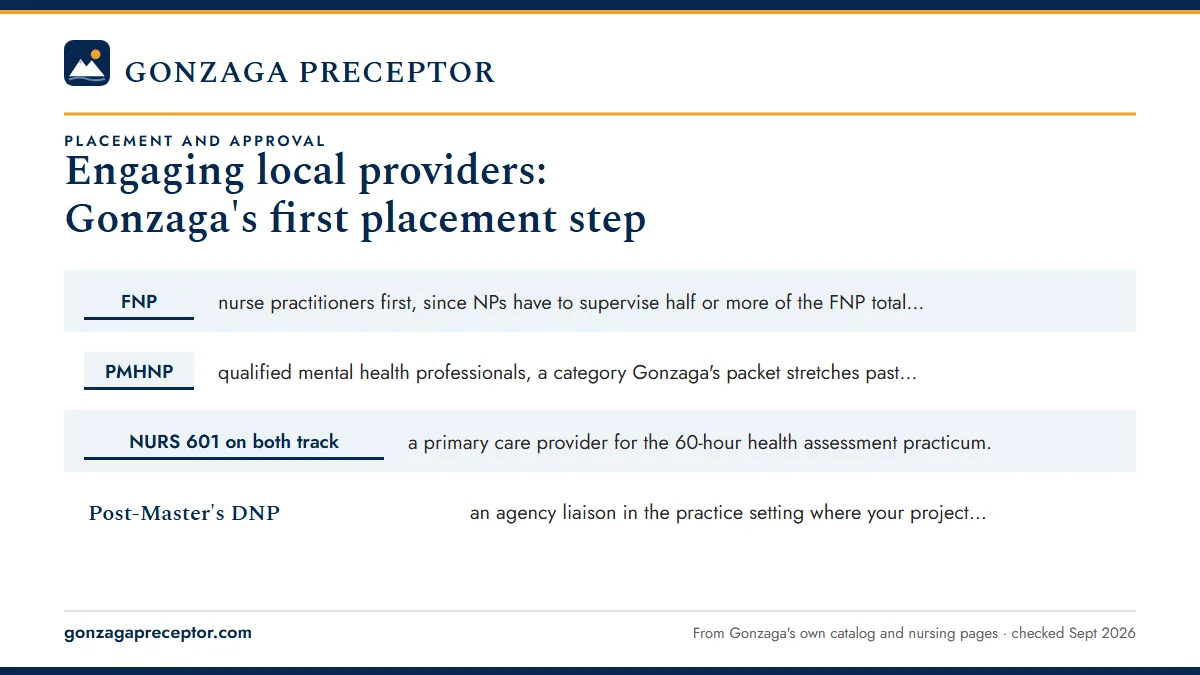
- FNP: nurse practitioners first, since NPs have to supervise half or more of the FNP total, then physicians and physician assistants where your state allows them. Every FNP practicum sits in primary care, and the pediatric practicum,
NURS 662P, covers infants, children and adolescents. - PMHNP: qualified mental health professionals, a category Gonzaga's packet stretches past prescribers to take in psychologists, therapists holding a license, and social workers. The catalog's wording for
NURS 683Mnames a psychiatric nurse practitioner or psychiatrist, so check with faculty before planning a term around other roles. NURS 601on both tracks: a primary care provider for the 60-hour health assessment practicum.- Post-Master's DNP: an agency liaison in the practice setting where your project will run, in place of a direct-care preceptor.
The preceptor requirements guide sets out the license and experience rules, and the FNP nurse practitioner rule covers how to plan the NP share.
Where local providers are found
Begin with people who already know your work: providers you have collaborated with as an RN, colleagues at other facilities, and clinicians in your community. A Gonzaga alumna quoted on the Preceptor Portal put it simply: "I could arrange my practicums in my community." Precepting at your own employer is possible with faculty approval, provided the preceptor is not your direct supervisor and the hours happen on a different unit; the workplace practicum rules spell out the conditions.
Beyond your network, look at independent primary care and psychiatric practices, community health centers and rural clinics. Larger systems usually route students through a central office. Providence arranges its Inland Northwest rotations through a Professional Development Coordinator, St. Luke's in Boise asks NP students to apply before a rotation request, and OHSU asks schools to contact its Clinical Placement Coordinator first. A clinician's personal yes at those systems still depends on the system's process and an agreement with Gonzaga. For Spokane and the Inland Northwest, see Spokane NP preceptors.
What to bring to the first conversation
Busy clinicians decide quickly. Give them a clear picture of the commitment in one short package.
- Your CV or resume, which Gonzaga's preceptor guides expect the preceptor to have before day one.
- The course number, its setting and its hour range, for example
NURS 663P, adult and gerontology primary care, at least 180 hours. - The semester dates. Fall 2026 online graduate courses run September 1 to December 18.
- Written learning goals for the semester, with week-by-week objectives if you are an FNP student.
- What Gonzaga asks of the preceptor: orientation to the course objectives, three short points of contact with clinical faculty, a mid-semester site visit and an end-of-semester evaluation.
- What Gonzaga offers in return: a path to adjunct faculty work, a signed hours certificate that helps with recertification, DynaMed Plus access and awards.
Gonzaga's portal is clear that the university cannot pay preceptors, so lead with the teaching, recognition and recertification value. The Preceptor Portal guide summarizes the materials preceptors see.
Questions to settle before you put a name forward
A few direct questions in the first call spare you a returned request later.
- Does the provider hold an active, unencumbered license in your state, with twelve months or more in the specialty?
- Can they document national board certification?
- Are they clear of conflicts: not your direct supervisor, not immediate family and not in a business relationship with you?
- Does the site already have an affiliation agreement with Gonzaga, and if not, who handles student contracts there?
- Does the site require its own onboarding, such as CPNW clearance or a system portal?
- How many students are they precepting that term? Washington's rule allows two at a time.
- Can their clinic schedule deliver your hours inside the semester, at their availability rather than yours?
A provider who says yes is a candidate, not a placement. Faculty approval and an active agreement come first.
Why Gonzaga students hand this step to us
The first step is where most of the time goes: calls to clinics, unanswered messages, providers who qualify on paper but already have a full student roster. Our placement desk does that outreach in your state, in person, and brings you preceptors who have already agreed to the course, the dates and Gonzaga's expectations. You spend your time on coursework while the search runs.
Each match arrives with what your request needs: proof of license and certification, the preceptor's experience in the specialty, the name of whoever handles contracts at the site, and clinic days that cover the term. If a preceptor withdraws later, we begin a replacement search at once. Tell us your track and course with the form below, or read how it works.
Questions Gonzaga students ask
Does Gonzaga give students a list of preceptors?
Gonzaga's public pages do not post a preceptor list. Gonzaga's nursing department has signed agreements with many facilities across the western U.S., and the Clinical Placement Team works with students to finalize placements, so ask the team whether any agreement sites near you take NP students. Students report that earlier cohorts received lists of past sites, but that is not published policy.
Can my preceptor be in a different state from the one I live in?
Plan on your own state. Gonzaga's PMHNP packet places students at approved sites in the state where they are licensed to practice, and the NP tracks admit residents of ten western states only. If you hold licenses in two of those states, confirm with the Clinical Placement Team before approaching providers across the border.
When should I start contacting local providers?
Well before your first practicum. For most MSN students NURS 601 arrives in year two, and PMHNP specialty practicums begin in year three. Gonzaga posts no request deadline publicly, and any site without a Gonzaga contract has to get one first, so beginning your outreach several months ahead leaves room for a second choice.
Can a friend or coworker be my preceptor?
Washington's WAC 246-840-533, which Gonzaga follows, rules out immediate family and anyone whose money, business or work ties to you could color an honest evaluation. Gonzaga also rules out your direct supervisor. A coworker on another unit may be possible with faculty approval.
What if a provider asks about payment?
Be direct. Gonzaga's Preceptor Portal explains that the university cannot currently pay preceptors and offers adjunct faculty opportunities, an hours certificate, DynaMed Plus access and awards instead. Nurse preceptors in Washington can also look at the state's student nurse preceptorship grant, which WABON runs for licensed nurses precepting students of in-state programs.
Related pages
Last checked 2026-09-25
We check these pages against Gonzaga's catalog, FAQs, preceptor packets and Department of Nursing pages. Your course, the Graduate Nursing Student Handbook and Gonzaga's Clinical Placement Team have the final word.
Gonzaga asks you to find local preceptors first. Let us run that search.
Tell us your Gonzaga program, your practicum course and where you live and can travel. We find preceptors who fit the course and prepare the license, certification and site details your Practicum Site Placement Request needs, early in the semester before.
- Preceptors matched to the course: primary care across the lifespan for
NURS 661PtoNURS 664P, psychiatric care forNURS 661MtoNURS 663M, an agency liaison for the DNP - Credentials, license, board certification and site contact ready for your site request
- In Spokane, across Washington or wherever in the ten western states you are licensed
Start your placement plan
Your program, city and next practicum term is all we need to begin.