Finding your own preceptor, Gonzaga's help, or a placement service
Every Gonzaga practicum ends at the same gate: a Practicum Site Placement Request, faculty approval, an active affiliation agreement and CPNW clearance. What differs is who does the searching before that. Here is how the three routes compare, and how students combine them.
Get your placement plan
Tell us your Gonzaga program and where you live. A placement advisor replies with the preceptor and site options that fit your Gonzaga course.
Where every route ends up
Gonzaga's graduate FAQ spreads placement across staff, program directors, faculty, clinical agencies and students. Its Clinical Placement Team helps secure sites and preceptors and processes the contract and legal documents that clear you for a site, and the Department of Nursing holds affiliation agreements with facilities across the western U.S. The opening move, contacting local providers who might precept, belongs to the student.
So the real question is not whether Gonzaga gets involved. It always does, and its faculty give the final approval. The question is how you get from a blank list to a strong request, and how much of that searching you want to carry alongside coursework, immersions and a job. The same review applies to every name, however it was found.
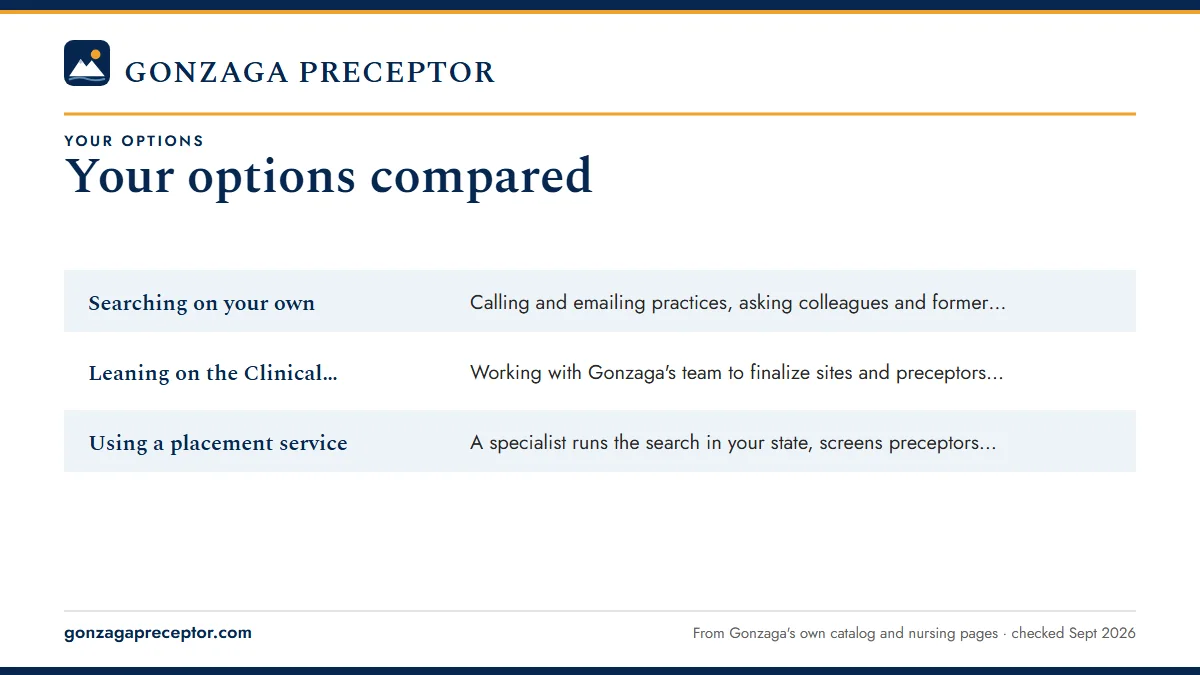
The three routes side by side
Each route can lead to an approved placement. They differ in time, reach and how much of the legwork sits with you.
| Route | What it involves | Fits best when |
|---|---|---|
| Searching on your own | Calling and emailing practices, asking colleagues and former instructors, checking each preceptor against Gonzaga's criteria, then gathering credentials for the request | You have strong local contacts, a flexible schedule and a term or more before the practicum |
| Leaning on the Clinical Placement Team | Working with Gonzaga's team to finalize sites and preceptors and to process the affiliation agreement once you have leads | You have leads and need help turning one into an approved, contracted placement |
| Using a placement service | A specialist runs the search in your state, screens preceptors against Gonzaga's rules and prepares the request details | Time is short, your area is rural, you need psychiatric preceptors, or a preceptor has already left |
What searching on your own really takes
Doing it yourself means building a list of clinics and practices within driving distance, reaching the clinician or practice manager, and explaining the course, the hours and the dates. Gonzaga expects students to fit the preceptor's schedule, not the reverse, so availability matters as much as willingness.
Then each yes has to be checked. The preceptor needs at least a year in the clinical area, an unencumbered license in your state and documented national certification, as the preceptor requirements page sets out. FNP students need at least half their hours with a nurse practitioner. In Washington a preceptor can take no more than two students at once, and you are competing with other programs, including WSU in Spokane and several Puget Sound schools. Students report that many classmates found this step a real challenge. The identifying local preceptors page walks through it.
What Gonzaga's Clinical Placement Team adds
The Clinical Placement Team is Gonzaga's own staff for this work, led by the Director of Clinical Placement and supported by clinical placement coordinators. Gonzaga describes its role as helping students secure sites and preceptors and processing the contract and legal paperwork. Once you bring potential preceptors, the team works with you to finalize a placement that meets the course requirements.
Lean on the team for agreements, clearance and whether a site already has an active agreement. Expect it to start from the names you bring, since Gonzaga calls contacting local providers the initial step. The Director of Clinical Placement is also the contact for CastleBranch questions. The Clinical Placement Team page explains who does what inside the department.
When a placement service is the right call
A service makes the most sense when the search, not the approval, stands between you and your hours.
- Your first practicum,
NURS 601, is a term away and you have no names yet - You live in a rural county where the nearest primary care NP already has a student
- You are in the PMHNP track and need psychiatric preceptors for three different populations
- You are licensed in a state with extra steps, such as California or Alaska
- A preceptor withdrew and the semester is already running
- Your work schedule leaves little room for weeks of calls and follow-up
Gonzaga's faculty recommend working no more than 20 hours a week once clinicals start. Handing the search to a specialist protects the hours you have for study and patients. See how it works for our steps.
Combining the routes
Most students mix them. You might bring a family practice NP you met as an RN for NURS 662P, ask us to find adult and gerontology preceptors for NURS 663P and NURS 664P, and rely on the Clinical Placement Team to complete each agreement. Every name, from any route, goes through the same faculty review. Mixing works best when one person keeps the whole semester plan in view.
Why Gonzaga students choose us for their share of the work: we know the course-by-course preceptor rules, we search in the state where you are licensed, and the request packet we prepare is complete before it reaches faculty. If a preceptor steps away mid-term, we start the replacement search right away and plan it around the two-preceptor limit.
Questions Gonzaga students ask
Will Gonzaga find a preceptor for me if my own search fails?
Gonzaga's Clinical Placement Team helps students secure sites and preceptors and finalizes placements, but its published process begins with students identifying potential preceptors among local providers. If your search stalls, tell the team and your course faculty early. Many students also bring in a placement service at that point. See can't find a preceptor.
Does using a placement service fit Gonzaga's process?
Gonzaga's process asks you to identify potential preceptors, submit a site request and then wait for faculty approval, the agreement and clearance. A service helps with the identifying and the paperwork. Every preceptor it finds goes through the same faculty review, so the approval steps stay exactly where Gonzaga puts them.
Can I use a service and still work with the Clinical Placement Team?
Yes. The two cover different pieces. A service finds and screens the preceptor and prepares the request details; Gonzaga's team handles the affiliation agreement and contract paperwork with the site; faculty give final approval. You stay the link between them, submitting the request through Gonzaga's own process.
How early should I pick a route?
At least a term before the practicum. Some health systems want onboarding documents weeks before a start date, a new site may need an affiliation agreement, and no hour counts until CPNW clearance is complete. Deciding early also leaves room to switch routes if your own search comes up short.
What does a preceptor agree to when taking a Gonzaga student?
Supervising and teaching you for the course hours on their own schedule, joining three short check-ins with Gonzaga clinical faculty that include a site visit, and completing an evaluation at the end of the semester. Gonzaga's Preceptor Portal gives preceptors the guides and course objectives for each track.
Related pages
Last checked 2026-09-25
We check these pages against Gonzaga's catalog, FAQs, preceptor packets and Department of Nursing pages. Your course, the Graduate Nursing Student Handbook and Gonzaga's Clinical Placement Team have the final word.
Gonzaga asks you to find local preceptors first. Let us run that search.
Tell us your Gonzaga program, your practicum course and where you live and can travel. We find preceptors who fit the course and prepare the license, certification and site details your Practicum Site Placement Request needs, early in the semester before.
- Preceptors matched to the course: primary care across the lifespan for
NURS 661PtoNURS 664P, psychiatric care forNURS 661MtoNURS 663M, an agency liaison for the DNP - Credentials, license, board certification and site contact ready for your site request
- In Spokane, across Washington or wherever in the ten western states you are licensed
Start your placement plan
Your program, city and next practicum term is all we need to begin.