What counts as a clinical hour at Gonzaga
At Gonzaga, a clinical hour is time spent doing the work of the practicum with your approved preceptor: seeing patients, documenting, consulting with the preceptor and preparing in the clinic. PMHNP students carry one extra limit, a 15% ceiling on observation. And every hour has to fit the preceptor's calendar rather than yours.
Get your placement plan
Tell us your Gonzaga program and where you live. A placement advisor replies with the preceptor and site options that fit your Gonzaga course.
The FNP definition, in Gonzaga's words
Gonzaga's FNP guidance defines a practicum hour as "face to face time with patients, documentation, consult time spent with the preceptor and any preparation work needed in the clinic prior to seeing the patient." That is four activities, each tied to the clinic and to the patients you are seeing there.
Read closely, the definition is generous about the work around a visit and specific about where it happens. Writing up the encounter counts. So does the conversation where you present a patient and talk through the plan, and the chart review you do in clinic before walking into the room. Because the wording centers on the clinic, reading at home the night before is study time rather than practicum time unless your syllabus says otherwise.
FNP hours also have to come from the right settings and people. Every FNP practicum sits in primary care, NURS 664P and NURS 683P add other settings, and the pediatric course expects patients from every age group. At least half your total FNP hours must be with a nurse practitioner, which the NP hours rule page explains.
The PMHNP definition
For psychiatric-mental health students, Gonzaga counts the work of psychiatric care: "assessment, differential diagnoses, creating a plan of care and/or implementing psychopharmacology and psychotherapy treatments," together with patient presentation and documentation. Presenting to your preceptor and writing the note belong to the hour, exactly as they do for FNP students.
The populations change as the sequence moves on: diagnosis first, then adult treatment with medication management and individual and group psychotherapy, then child, adolescent and older-adult clients. Your preceptor can come from a range of qualified mental health professions Gonzaga approves, among them advanced practice nurses, psychiatrists, psychologists, social workers and licensed therapists. Each course is covered on the PMHNP practicum courses page.
The 15% observation cap for PMHNP students
The PMHNP Preceptor Guide sets a firm ceiling: "PMH students can spend only 15% of their time, at most, in the clinical setting doing any kind of observation." The words any kind are broad. Sitting in on a therapy session you take no part in, watching an intake from the corner or shadowing medication checks all read as observation.
Do the arithmetic at the start of each course. In a 120-hour practicum, 15% is 18 hours; in a 240-hour practicum it is 36. Orientation days and first-week shadowing can use that allowance fast, so agree with your preceptor early on when you will begin seeing patients with them rather than behind them.
A preceptor who usually hosts students for shadowing needs to hear this rule before the term starts, not in week five. Share it at the first point of contact along with your goals, and track observation time separately in your log so the share is easy to show.
Past 15%, observation time breaks the PMHNP rule, so track it week by week instead of discovering the total at the end of the term.
Your hours run on the preceptor's calendar
Gonzaga's faculty packet is direct about scheduling: "The student must accomplish clinical hours at the availability of the preceptor." It adds that students are not to ask preceptors to reshape their schedule around a student's personal or job commitments. Your preceptor's clinic days set the shape of your semester.
That rule is the reason behind Gonzaga's advice to cap paid work at 20 hours a week during clinical semesters. A preceptor who works three long clinic days can carry a heavy course, but only if you can be there on those days. Settle the pattern before the term, then confirm it again about two weeks before the rotation starts, as the preceptor guides ask.
Hours also count only with your approved preceptor, and Gonzaga allows at most two preceptors in a semester. A colleague in the same clinic who is not on your approved request adds nothing to your total, however helpful the day. The two-preceptor rule page covers how to plan inside that limit.
Time that sits outside the count
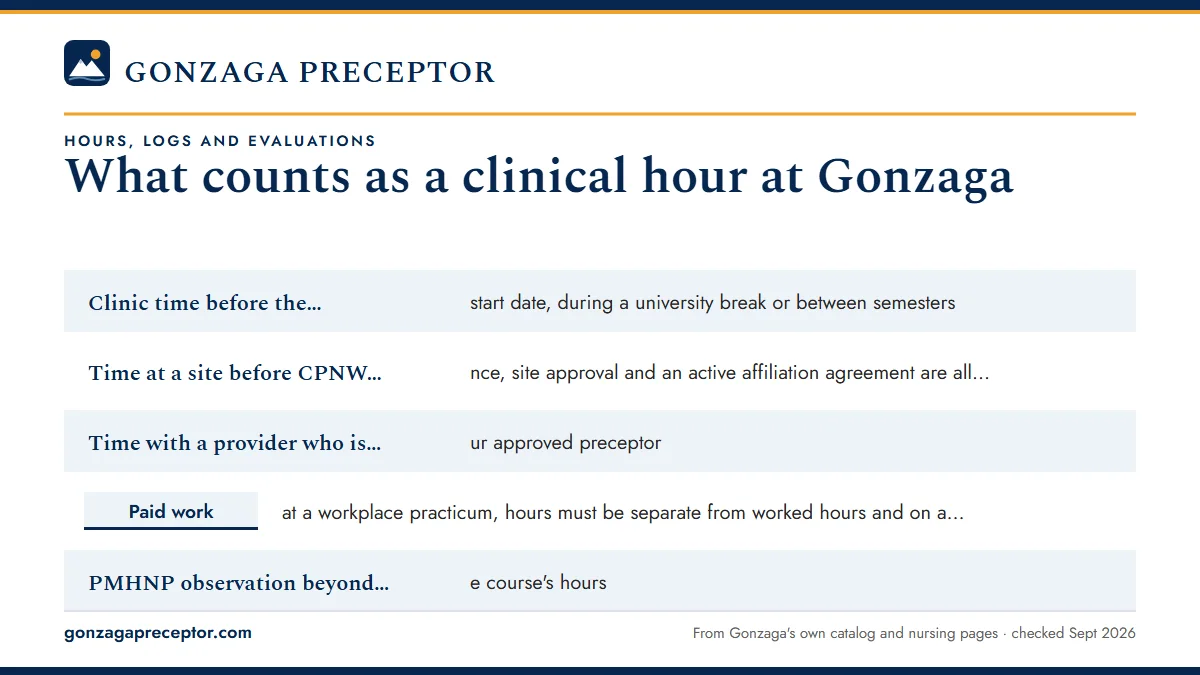
Time that does not become a practicum hour under Gonzaga's published rules
- Clinic time before the semester's start date, during a university break or between semesters
- Time at a site before CPNW compliance, site approval and an active affiliation agreement are all confirmed
- Time with a provider who is not your approved preceptor
- Paid work: at a workplace practicum, hours must be separate from worked hours and on a different unit
- PMHNP observation beyond 15% of the course's hours
- Clinic days after the course end date, unless course faculty approve an extension
Gonzaga's packet warns that hours outside its rules may not count and can put a student's place in the program at risk. The accrual rules page covers the timing gates in full, and the workplace practicum rules cover hours at your own employer.
DNP hours are a different kind of hour
Post-Master's DNP students log something else entirely. The DNP FAQ says practice hours in that program "are not direct care hours; rather, they are considered indirect care hours that are completed as part of the student's DNP project." They are earned in a practice setting with an agency liaison, may be at your current employer but outside your own area and off paid time, and count toward a 1,000-hour post-baccalaureate total that includes your MSN hours. The DNP practicum courses page lays out the sequence.
Placements where every hour counts
The easiest hour to lose is one logged under the wrong conditions. We match you with preceptors in your own state whose clinic days can carry your course's hours, and we check the fit with Gonzaga's rules before anything is submitted: an NP for at least half of FNP time, a qualified mental health professional for PMHNP time, and a patient flow that lets you do the work rather than watch it.
We gather the preceptor's CV, license and board certification, the details of the site and who signs its agreement, and a schedule built on the preceptor's calendar, so the Practicum Site Placement Request reaches faculty complete. Your placement advisor remains reachable all semester. Send your program and course through the form below, or see how it works first.
Questions Gonzaga students ask
Does charting count toward Gonzaga clinical hours?
Yes. Gonzaga's FNP definition names documentation alongside patient contact, and the PMHNP definition includes documentation and patient presentation. Notes written in clinic for patients you saw with your approved preceptor belong in your hours. Enter them in your log on the same day you see those patients.
Can Gonzaga PMHNP students count shadowing?
Only a small share. The PMHNP Preceptor Guide limits observation of any kind to 15% of your clinical time at most. The remaining hours should be assessment, diagnosis, care planning, psychopharmacology or psychotherapy work, plus presentation and documentation, carried out under your preceptor's supervision.
Can I set my own clinical schedule as a Gonzaga student?
Only within your preceptor's availability. Gonzaga's faculty packet says clinical hours happen when the preceptor is available, and students should not ask for a schedule built around personal or employment needs. Agree the days before the semester and reconfirm them about two weeks before the rotation.
Do hours with another provider in my preceptor's clinic count?
Only if that provider is an approved preceptor on your request. Gonzaga limits hours to approved preceptors and allows no more than two in a semester. If a second provider would strengthen your semester, ask course faculty to approve them before you log any time together.
Does preparation at home count as a Gonzaga clinical hour?
Gonzaga's FNP definition counts preparation needed in the clinic before you see the patient, which ties prep time to the clinical setting. Reading and study at home are not named. If your course treats off-site work differently, your syllabus and course faculty will say so.
Related pages
Last checked 2026-09-25
We check these pages against Gonzaga's catalog, FAQs, preceptor packets and Department of Nursing pages. Your course, the Graduate Nursing Student Handbook and Gonzaga's Clinical Placement Team have the final word.
Gonzaga asks you to find local preceptors first. Let us run that search.
Tell us your Gonzaga program, your practicum course and where you live and can travel. We find preceptors who fit the course and prepare the license, certification and site details your Practicum Site Placement Request needs, early in the semester before.
- Preceptors matched to the course: primary care across the lifespan for
NURS 661PtoNURS 664P, psychiatric care forNURS 661MtoNURS 663M, an agency liaison for the DNP - Credentials, license, board certification and site contact ready for your site request
- In Spokane, across Washington or wherever in the ten western states you are licensed
Start your placement plan
Your program, city and next practicum term is all we need to begin.