Gonzaga's two-preceptor limit: planning a semester around it
Gonzaga caps each NP student at two preceptors per semester, and every hour must be logged with a preceptor faculty have approved. A sound plan puts one strong primary preceptor at the center and saves the second slot for a real need: a population the first site lacks, the FNP nurse practitioner share, or a replacement. Settle the pair before the term opens, because a name added late still has to clear approval before any hour counts.
Get your placement plan
Tell us your Gonzaga program and where you live. A placement advisor replies with the preceptor and site options that fit your Gonzaga course.
The rule and where Gonzaga states it
The limit sits in the "Accrual of Clinical Hours" section of Gonzaga's FNP Clinical Faculty Packet: "Students may only complete clinical hours with their approved preceptor and are limited to no more than two preceptors per semester." The same passage sets when hours may begin, so the preceptor cap is one of several conditions that decide whether a logged hour stands.
Two separate ideas are packed into that sentence. First, every preceptor must be approved, which at Gonzaga means named on a site request that course or program faculty have signed off, at a site covered by an active affiliation agreement. Second, the count runs per semester, so each new term starts with two open slots rather than carrying last term's names forward.
The stakes are real. Gonzaga's packet warns that hours logged outside these conditions can be lost and can threaten your standing in the program; the hour accrual guide sets out those consequences. Because the packet is dated 2023-24 and the current Graduate Nursing Student Handbook goes only to enrolled students, confirm the wording for your cohort in the handbook or with course faculty.
When one preceptor is enough, and when a second helps
Gonzaga's FNP Preceptor Guide puts a rotation anywhere from 60 to 240 hours in a semester, with the preceptor and student fixing the schedule before the term opens. A single preceptor with steady clinic days can carry most of those loads. The packet also says the student works to the preceptor's availability, so the real test is whether one preceptor's calendar covers your course's hours inside the term.
Reasons a second preceptor earns its slot
- Hours: your course sits at the top of its range, such as
NURS 663Pat 180 hours or more, and your primary preceptor works part time. - Population:
NURS 663Mspans child and adolescent clients as well as older adults, and one psychiatric practice may see only one of those groups. - Age coverage: FNP course faculty check that your logs cover every age group, so a family practice with few children may need a pediatric partner.
- NP share: an FNP student whose main preceptor is a physician or PA still needs an NP for no less than half of the hours; see the FNP nurse practitioner hours rule.
- State rules: a few states insist on an MD or NP preceptor, which shapes who can fill each slot.
If none of these applies, one preceptor for the whole semester is the simpler path: one schedule, one site, one evaluation, and a spare slot held in reserve if something changes.
Building a two-preceptor semester, step by step
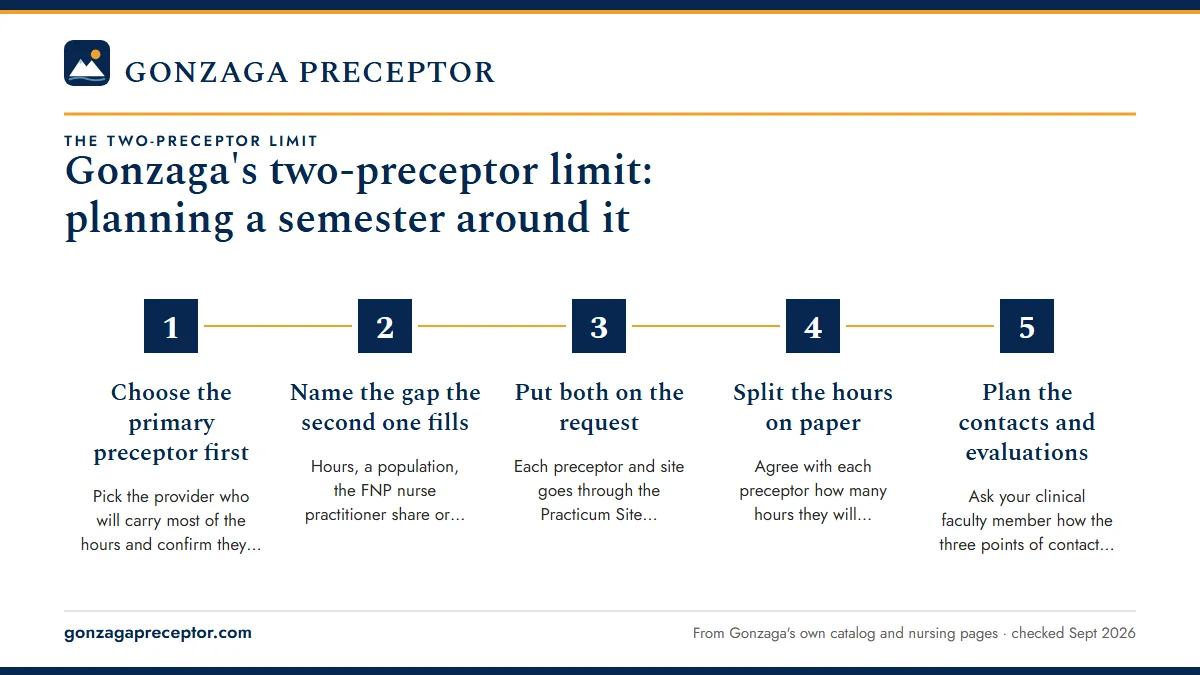
- Choose the primary preceptor firstPick the provider who will carry most of the hours and confirm they meet Gonzaga's preceptor requirements for your track and your state.
- Name the gap the second one fillsHours, a population, the FNP nurse practitioner share or age coverage. Write the reason down; it helps you explain the pairing when faculty review it.
- Put both on the requestEach preceptor and site goes through the Practicum Site Placement Request and faculty review. A second site at a different organization may also need its own affiliation agreement.
- Split the hours on paperAgree with each preceptor how many hours they will supervise and on which days, then confirm both schedules about two weeks before the rotation, as Gonzaga's preceptor guides ask.
- Plan the contacts and evaluationsAsk your clinical faculty member how the three points of contact will run with two preceptors, and expect an end-of-semester evaluation from each of them.
FNP and PMHNP versions of the same limit
For FNP students the cap interacts with the nurse practitioner requirement. Gonzaga's packet asks for at least half of FNP hours with an NP, and it does not spell out whether faculty measure that per course or across the program. Plan any pairing so the NP share holds either way, and decide the split before you ask either preceptor for dates. The catalog accepts an NP, physician or PA unless the state requires an MD or NP, so check your state before pairing.
PMHNP students draw from a wider pool. Gonzaga accepts qualified mental health professionals, from psychiatrists and advanced practice nurses to psychologists, licensed therapists and social workers, while the catalog entry for NURS 683M names a psychiatric NP or psychiatrist. One pairing that suits the NURS 662M focus on medication management and psychotherapy is a psychiatric prescriber alongside a licensed therapist, provided faculty approve both.
PMHNP observation time is also capped, so a second preceptor who mostly lets you watch adds little to your total. The guide to what counts as a clinical hour explains that limit.
When a preceptor leaves partway through
Gonzaga's public pages describe no set procedure for a preceptor who withdraws mid-semester, so the working answer comes from course faculty and the Clinical Placement Team. Tell them as soon as it happens. Gonzaga's FNP guide asks for the Clinical Coordinator to be told when a problem arises. Update your log through the last shared clinic day, in Typhon or in CORE for cohorts that have switched, since those hours were earned with an approved preceptor.
The harder question is the count. If one of your two preceptors leaves, does a replacement become a third? Gonzaga's published sentence counts preceptors per semester and does not address it, so get course faculty's answer in writing before a new name goes on a request.
If a replacement cannot be approved in time, Gonzaga's structure offers cushions: a course-end extension with course faculty approval, the repeatable extension courses NURS 683P and NURS 683M, and a slower progression plan within the five-year limit. Our page on what to do when a preceptor dropped out covers the first days after a loss.
Log no hours with a stand-in until faculty approve them. Hours with an unapproved preceptor are exactly the kind Gonzaga says may not count.
Why Gonzaga students bring us in for the second slot
A second preceptor has to be right the first time, because the rule leaves no third to fall back on. Our search covers your own state and targets the exact gap in your plan, whether that is pediatric volume, a nurse practitioner for the FNP share, or a psychiatric prescriber for a NURS 662M term, and we check that their schedule fits the hours left in your course.
We then assemble the site request details for that preceptor: their license and national certification, time in the specialty, who signs for the site and its agreement, and the dates. Approval belongs to Gonzaga's faculty, and the Clinical Placement Team completes the placement; our job is to hand them a request that is whole and squarely inside the two-preceptor rule from its first submission. If a preceptor drops, the replacement search starts that day. Share your course and state through the form below.
Questions Gonzaga students ask
Can I have two Gonzaga preceptors at the same time in one course?
Gonzaga's rule limits the number of preceptors per semester, not whether they run in parallel or one after the other, so two concurrent preceptors fit the wording when both are approved. Concurrent schedules need care: each preceptor should know their share of the hours, and your log should make clear who supervised each day. Confirm the arrangement with course faculty when you submit the request.
Does the two-preceptor limit apply to DNP students?
The limit comes from Gonzaga's NP practicum rules in the FNP Clinical Faculty Packet. Post-Master's DNP students work with an agency liaison on indirect project hours instead of a clinical preceptor, and their course rules come from the DNP practicum syllabi. The agency liaison guide and your course faculty are the places to check how a DNP term is set up.
Do I need a new affiliation agreement for a second preceptor?
It depends on where the second preceptor works. Gonzaga ties the agreement to the practicum site, and no hours count until the agreement covering that site is confirmed as active. A second preceptor at your existing site falls under the agreement already in place there. One at a different organization means checking whether Gonzaga holds an agreement with it, and a new agreement takes time.
Can a preceptor supervise me and another student in the same term?
Yes, within a limit. WAC 246-840-533, the Washington education rule cited throughout Gonzaga's packets, allows a preceptor no more than two students at any one time. That cap is separate from Gonzaga's own limit of two preceptors per student, so a provider who already supervises two students on overlapping dates is not available to you until one of those rotations ends.
What if my only preceptor leaves in the last weeks of the semester?
Contact course faculty and the Clinical Placement Team the same day, with your log current. Depending on how many hours remain, faculty may approve a replacement, grant a course-end extension, or shift what is left into NURS 683P or NURS 683M, the repeatable extension courses. The decision is theirs; a replacement preceptor with credentials in hand widens the options.
Related pages
Last checked 2026-09-25
We check these pages against Gonzaga's catalog, FAQs, preceptor packets and Department of Nursing pages. Your course, the Graduate Nursing Student Handbook and Gonzaga's Clinical Placement Team have the final word.
- Gonzaga University FNP Clinical Faculty Packet 2023-2024
- Gonzaga University Department of Nursing: FNP Preceptor Guide
- Gonzaga University Department of Nursing: PMHNP Preceptor Guide
- Gonzaga University Graduate Catalog: Master of Science in Nursing
- Washington State Board of Nursing: Nursing Education Rules (WAC 246-840-533)
Gonzaga asks you to find local preceptors first. Let us run that search.
Tell us your Gonzaga program, your practicum course and where you live and can travel. We find preceptors who fit the course and prepare the license, certification and site details your Practicum Site Placement Request needs, early in the semester before.
- Preceptors matched to the course: primary care across the lifespan for
NURS 661PtoNURS 664P, psychiatric care forNURS 661MtoNURS 663M, an agency liaison for the DNP - Credentials, license, board certification and site contact ready for your site request
- In Spokane, across Washington or wherever in the ten western states you are licensed
Start your placement plan
Your program, city and next practicum term is all we need to begin.