Gonzaga's FNP rule: at least half your hours with a nurse practitioner
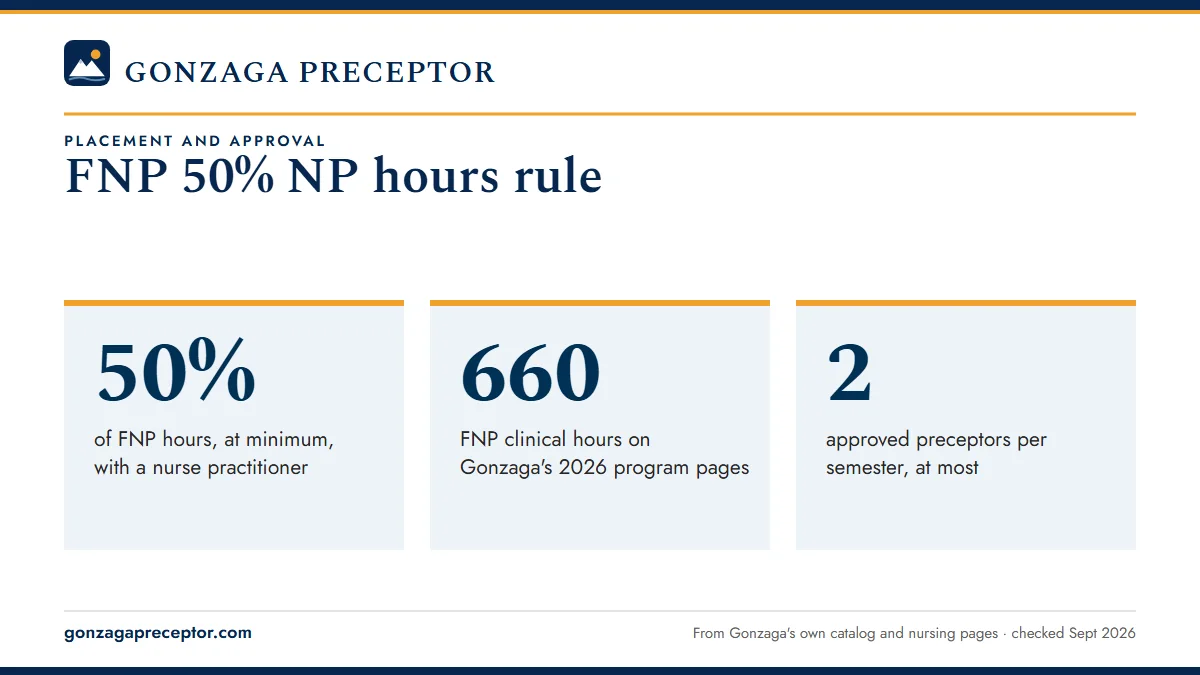
Gonzaga lets FNP students train with nurse practitioners, physicians and physician assistants, but the NP share has a floor: at least 50% of your hours. Some states narrow the field further to MDs and NPs. Planning your preceptor mix around both rules, inside Gonzaga's two-preceptor limit, keeps your hours countable and your progression plan on schedule.
Get your placement plan
Tell us your Gonzaga program and where you live. A placement advisor replies with the preceptor and site options that fit your Gonzaga course.
The rule in Gonzaga's words
Two Gonzaga sources set the terms. The FNP clinical faculty packet states: "A minimum of 50% of the hours must be done with a nurse practitioner." The graduate catalog and the MSN FNP program page describe who may supervise the practicums: "a nurse practitioner, physician, or physician's assistant (unless in a state that requires the preceptor to be either an MD or a NP)."
Taken together, physicians and PAs are welcome preceptors for part of your training, but nurse practitioners carry at least half of it. The practical effect is simple: an NP preceptor anchors your plan, and a physician or PA can cover a share of the hours.
The packet is dated 2023-2024 and sits with Gonzaga's clinical faculty materials, so confirm the current wording in your syllabus and the Graduate Nursing Student Handbook. The full list of who qualifies is in the preceptor requirements guide.
What the half is measured against
Gonzaga's public packet does not say whether the 50% applies course by course or across the whole program, and the two readings plan differently. Across the program, the arithmetic depends on which total you use: at least 330 NP hours against the 660 on Gonzaga's 2026 program pages, or 300 against the catalog's 600 practicum hours. Course by course, each practicum needs its own NP half.
Course faculty audit your logs against the hours you registered, so ask them which reading applies before your first specialty practicum. Until you hear otherwise, planning at least half of every course with an NP satisfies both readings at once.
| Course | Catalog hours | NP hours at half |
|---|---|---|
NURS 662P infant, child, adolescent | 120 (web 120-180) | 60 or more |
NURS 661P gender-based | 60-180 | Half of the hours you register |
NURS 663P adult and gerontology I | At least 180 (web 180-240) | 90 or more |
NURS 664P adult and gerontology II | At least 120 (web 120-240) | 60 or more |
States that call for an MD or NP preceptor
Gonzaga's catalog carves out states that require the preceptor to be an MD or NP but does not name them, and state rules change. In those states, PA hours drop out of the plan and your non-NP time has to come from a physician.
Among the ten western states where Gonzaga NP students train, state materials point in different directions. Alaska requires every visiting APRN student to register a preceptorship, and the Board's form expects that preceptor to hold an APRN or physician license. Washington's own rule for in-state programs allows interdisciplinary preceptors, including PAs, with a license and a year of experience. California requires each preceptor to hold a valid California license and be qualified in the student's NP category.
Before you put a PA on a request, ask course faculty and the Clinical Placement Team whether your state is one of the exceptions. Your state guide links the board's own rules.
Planning your preceptor mix
Gonzaga caps you at two approved preceptors per semester, so the mix comes down to a few clear patterns.
- One NP preceptor for the whole course. The simplest plan: the rule is met automatically, and one preceptor learns your goals and completes your evaluation.
- An NP plus a physician. The NP carries at least half the hours and the physician adds breadth; this works even in states that limit preceptors to MDs and NPs.
- An NP plus a PA. Useful where PAs are accepted, with the NP still at half or more.
- Two NPs. Helpful when one preceptor's clinic days cannot cover the hours alone, such as the 180 or more hours of
NURS 663P.
Hours happen at your preceptor's availability, not yours, so check that the NP's clinic days can really deliver half the hours inside the semester. The two-preceptor rule covers approval of a second preceptor.
Keeping the split visible in your logs
Course faculty review logged hours against the credits you registered and check coverage of age groups and populations. Log weekly in Typhon, or CORE if your cohort has moved, and keep your own running tally of hours by preceptor credential alongside it. Gonzaga expects each day's encounters entered on the day you see the patients, which keeps that tally current without extra work.
Check the tally at midterm, not at the end. If your NP has lost clinic days and the physician or PA has picked up the slack, you still have time to rebalance before the course end date. Hours cannot run past that date without an extension course faculty approve, and an uneven split found in the final week is hard to repair. The Typhon logging guide covers the logging rules.
When your NP preceptor drops out
Losing the NP is the scenario that breaks the rule fastest, because the remaining preceptor may be a physician or PA who cannot carry the NP share. Tell course faculty and the Clinical Placement Team at once. A replacement NP needs approval before you log hours with them, and if you already have two preceptors that term, the cap narrows your options.
If hours slip, Gonzaga's NURS 683P extension course lets FNP students finish practicum hours in a later semester, and it can be repeated; the extension course guide explains when it applies. The MSN has no cohort model, so a slower progression plan within the five-year limit is also available. The preceptor dropped out guide lists the first steps.
Why FNP students choose us to build the mix
We start every FNP search with nurse practitioners in your state, because an NP anchor makes the 50% rule a non-issue. Where a second preceptor helps, we match a physician or PA only after confirming your state accepts them, and we plan the hours so the NP share holds even if schedules shift. You see the planned split, course by course, before anything goes to faculty.
Each preceptor comes with the details Gonzaga's faculty review: license, board certification, a year or more in primary care and a schedule that delivers the hours inside the term. If a preceptor withdraws, we begin a replacement NP search immediately. Gonzaga's faculty make the final call; we make sure the plan in front of them already meets the rule. Use the form below to start.
Questions Gonzaga students ask
Does the 50% nurse practitioner rule apply to NURS 601?
Gonzaga's public sources do not say directly. The catalog lists an NP or physician for NURS 601, the program page adds PAs, and the 50% line appears in the FNP clinical faculty packet. Since NURS 601 is 60 hours in a primary care setting, an NP preceptor is the simplest choice; confirm how those hours count with course faculty.
Can all of my FNP hours be with nurse practitioners?
Yes. The rule sets a floor, not a ceiling, and an all-NP plan meets it in every course and every state. It is also the simplest plan to run: one NP preceptor per course means one schedule, one set of goals and one end-of-semester evaluation.
Does Gonzaga's PMHNP track have a similar rule?
Not in the same form. PMHNP students work with qualified mental health professionals, a group reaching from psychiatric NPs and psychiatrists to psychologists, therapists and social workers, and face a different limit: no more than 15% of practicum time in observation. The PMHNP practicum guide covers those courses.
Which western states require an MD or NP preceptor?
Gonzaga's catalog refers to such states without listing them, and state rules change. Alaska's registration form looks for an APRN or physician preceptor, while Washington's in-state rule accepts PAs as interdisciplinary preceptors. Ask course faculty and the Clinical Placement Team about your state before planning any PA hours.
Do DO hours count the same as MD hours for Gonzaga FNP students?
Gonzaga's Preceptor Portal lists DOs alongside ARNPs, MDs and PAs among accepted preceptors, and the catalog's FNP wording refers to physicians. DO hours therefore sit in the non-NP share along with MD and PA hours. In a state that limits preceptors to MDs and NPs, confirm with course faculty how a DO is treated.
Related pages
Last checked 2026-09-25
We check these pages against Gonzaga's catalog, FAQs, preceptor packets and Department of Nursing pages. Your course, the Graduate Nursing Student Handbook and Gonzaga's Clinical Placement Team have the final word.
- Gonzaga University Department of Nursing, FNP Clinical Faculty Packet 2023-2024
- Gonzaga University Catalog, MSN Family Nurse Practitioner
- Gonzaga University, Online MSN Family Nurse Practitioner
- Alaska Board of Nursing, APRN Preceptorship Registration (form 08-4253)
- Washington State Board of Nursing, Nursing Education Rules
Gonzaga asks you to find local preceptors first. Let us run that search.
Tell us your Gonzaga program, your practicum course and where you live and can travel. We find preceptors who fit the course and prepare the license, certification and site details your Practicum Site Placement Request needs, early in the semester before.
- Preceptors matched to the course: primary care across the lifespan for
NURS 661PtoNURS 664P, psychiatric care forNURS 661MtoNURS 663M, an agency liaison for the DNP - Credentials, license, board certification and site contact ready for your site request
- In Spokane, across Washington or wherever in the ten western states you are licensed
Start your placement plan
Your program, city and next practicum term is all we need to begin.