The DNP agency liaison at Gonzaga
In Gonzaga's Post-Master's DNP, the agency liaison is the person inside your practice setting who supports your project hours, the DNP's counterpart to a preceptor. Before you start, the liaison completes Gonzaga's DNP Agency Liaison Checklist online, confirming they are not a relative, a friend or someone you report to, that they expect at least three contacts a semester, and that they will complete an end-of-course evaluation.
Get your placement plan
Tell us your Gonzaga program and where you live. A placement advisor replies with the preceptor and site options that fit your Gonzaga course.
What the liaison does
Post-Master's DNP hours are indirect care hours built around your DNP project, so the partner you need is not a clinician watching you see patients. The catalog says NURS 701 students work with mentors and agency liaisons, and the liaison is the one rooted in the organization where your project runs.
A strong liaison helps the project live inside a real organization: they know how decisions get made there, who holds the data you need and which groups must see your plan before it moves. Gonzaga's checklist covers the formal side of the role, and the practical side is why choosing the liaison matters as much as choosing the setting.
The role runs across the practicum courses, from establishing a site in NURS 700 through the final practicum and, if needed, the NURS 704 extension. The DNP practicum courses page lays out that sequence term by term.
The DNP Agency Liaison Checklist
Gonzaga hosts the checklist on its Preceptor Portal, and the liaison fills it in online. It is short, and each item is something the liaison confirms:
- "I am not related to or a friend of the student I will be supervising, and have no direct reporting relationship with them."
- They will receive orientation information and the course objectives by email.
- "I understand I will be contacted a minimum of three times over the course of the semester."
- They agree to complete an end-of-course evaluation of the student.
Share the checklist with a prospective liaison before asking for a commitment, so the time involved and the evaluation are clear from the first conversation. Gonzaga's public checklist centers on the relationship, the contacts and the evaluation; any further expectations for a liaison in your project come from DNP faculty and your course syllabus. The Preceptor Portal guide shows what else Gonzaga posts there.
Who can serve as liaison
The checklist rules out three kinds of people: relatives, friends and anyone you report to directly. Gonzaga's DNP FAQ repeats the supervisor point for workplace practicums: a liaison preceptor who directly supervises you is not allowed.
That still leaves a wide field. Good candidates are leaders in the setting where your project will run, such as a department director, a quality or informatics lead, a nurse executive or a clinic manager outside your own reporting line, whose role touches the problem you have chosen.
If the setting is your employer, Gonzaga's workplace limits apply too: the practicum has to sit outside your own department and outside paid hours. The workplace practicum rules guide sets those limits out across programs.
Your manager, a friend at work or a relative cannot be your liaison: the checklist rules out all three.
Three contacts across the semester
The liaison confirms they will be contacted at least three times each semester. Gonzaga emails orientation information and course objectives beforehand, so those contacts build on a shared picture of what the term should achieve.
The NP tracks follow a similar rhythm, with beginning, middle and end conferences among student, preceptor and clinical faculty; the three points of contact page explains that model. Gonzaga's DNP pages publish no fixed agenda for the liaison contacts, so set your own. One workable pattern:
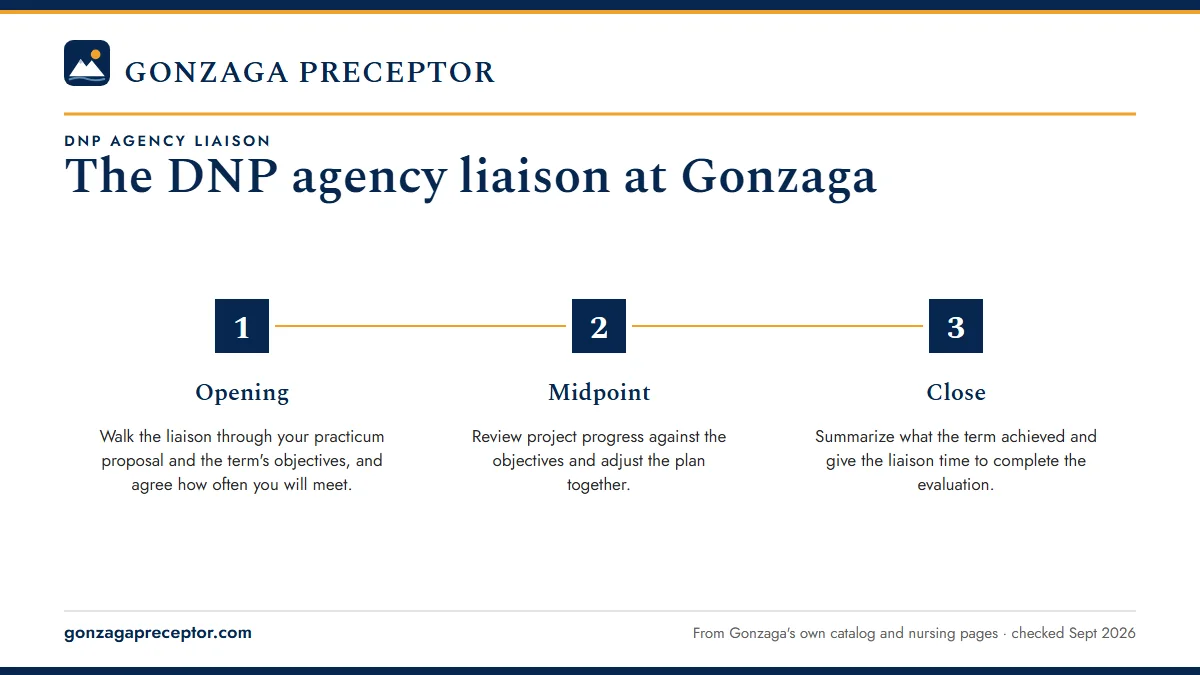
- OpeningWalk the liaison through your practicum proposal and the term's objectives, and agree how often you will meet.
- MidpointReview project progress against the objectives and adjust the plan together.
- CloseSummarize what the term achieved and give the liaison time to complete the evaluation.
The end-of-course evaluation
At the end of each course, the liaison evaluates your work. From Spring 2026, Gonzaga lists NURS 760, NURS 701 and NURS 702 among the courses whose evaluations run through its CORE platform, with the email arriving within two weeks after the practicum ends. Other DNP courses use the DNP Project Student Evaluation web form on the Preceptor Portal.
Tell your liaison which version to expect, and when, so the CORE email gets opened promptly. The evaluation closes each course, and a liaison who has followed the project closely through three real contacts can speak to your work in specific terms, which is one more reason to keep those meetings substantive. Questions about evaluations go to nursingpracticum@gonzaga.edu. The preceptor evaluations guide covers the process in more detail.
Finding and preparing a liaison
Most of the work of finding a liaison happens in NURS 700, when you establish your practicum site. A simple order keeps it moving.
- Name the gapSettle the practice problem your project will address; it points to the organization and the department where a liaison belongs.
- Map the organizationIdentify leaders whose work touches that problem and who sit outside your reporting line.
- Make the ask with the checklistExplain the project, share Gonzaga's checklist and be clear about three contacts and an end-of-course evaluation.
- Check the agreementAsk the Clinical Placement Team whether Gonzaga already has an affiliation agreement with the organization, since health systems expect one before a student starts.
- Draft the proposal togetherWrite your individualized practicum proposal and objectives with the liaison's input before the term begins.
Why DNP students choose us
The right liaison opens an organization to your project; the wrong one leaves a proposal waiting in a queue. We search for settings and leaders that fit your practice gap, sit outside your reporting line and have room for three contacts a semester, and we brief them on Gonzaga's checklist before they say yes.
Your placement advisor prepares the liaison's details, the organization's agreement contact and a proposed meeting schedule, so your practicum proposal starts on firm ground. DNP faculty hold the approval; we see to it that the package they review answers every checklist point. If a liaison changes roles mid-project, we start on a replacement right away. Tell us about your project with the form below.
Questions Gonzaga students ask
Can my manager be my Gonzaga DNP agency liaison?
No. The DNP Agency Liaison Checklist asks the liaison to confirm there is no direct reporting relationship with you, and Gonzaga's DNP FAQ says the liaison preceptor cannot be your direct supervisor. A leader in another department of the same organization can serve, provided the practicum stays outside your own area and your paid time.
How often will Gonzaga contact my DNP liaison?
At least three times each semester, according to the checklist the liaison completes. Before the term, Gonzaga also emails the liaison orientation information and the course objectives. At the end of the course, the liaison completes an evaluation, through CORE for the courses Gonzaga has moved there and by web form for the rest.
Is a DNP agency liaison the same as a preceptor?
The liaison fills the preceptor role for the Post-Master's DNP, but the work differs. NP preceptors supervise direct patient care, while DNP hours are indirect care hours built around your project, so the liaison guides your work inside the organization rather than supervising patient visits. Gonzaga's FAQ calls this person your liaison preceptor.
Where does the liaison complete Gonzaga's checklist?
Online, through the DNP Agency Liaison Checklist on Gonzaga's Preceptor Portal. Send the link once your prospective liaison has agreed in principle, and check with course faculty that the checklist is on file before your practicum term begins, so nothing holds up your first contact.
Can a friend who works at the organization be my liaison?
No. The checklist asks the liaison to confirm they are neither related to you nor your friend, and that they have no reporting relationship with you. A friend can still introduce you to the right leader in the organization, but the liaison role goes to someone without a personal tie to you.
Related pages
Last checked 2026-09-25
We check these pages against Gonzaga's catalog, FAQs, preceptor packets and Department of Nursing pages. Your course, the Graduate Nursing Student Handbook and Gonzaga's Clinical Placement Team have the final word.
Gonzaga asks you to find local preceptors first. Let us run that search.
Tell us your Gonzaga program, your practicum course and where you live and can travel. We find preceptors who fit the course and prepare the license, certification and site details your Practicum Site Placement Request needs, early in the semester before.
- Preceptors matched to the course: primary care across the lifespan for
NURS 661PtoNURS 664P, psychiatric care forNURS 661MtoNURS 663M, an agency liaison for the DNP - Credentials, license, board certification and site contact ready for your site request
- In Spokane, across Washington or wherever in the ten western states you are licensed
Start your placement plan
Your program, city and next practicum term is all we need to begin.