The Gonzaga clinical placement process, start to finish
Gonzaga builds each graduate practicum through a shared process, and the first move is yours: you approach local providers, then submit the preceptor and site for faculty approval. Before any hour counts, the affiliation agreement has to be active, your CPNW clearance current and the semester underway. Here is the full sequence in order, with a link to the guide that covers each step in depth.
Get your placement plan
Tell us your Gonzaga program and where you live. A placement advisor replies with the preceptor and site options that fit your Gonzaga course.
A shared process with a clear starting point
Gonzaga's graduate FAQ says clinical placements are "secured through a process shared by staff, program directors, students, faculty and clinical agencies." Each of those parties owns a different piece. You find and propose the preceptor. Faculty judge whether the preceptor and site fit the course. The Clinical Placement Team closes out the placement along with its contract paperwork, and the site's own education office decides whether it can host you.
The order matters because each step leans on the one before it. A preceptor who agrees informally still has to clear faculty review; an approved site still needs an active agreement; an agreement still needs your compliance record to be current. Both MSN nurse practitioner tracks follow this pattern, as does the Second MSN, while Post-Master's DNP students follow a project-based version with an agency liaison. The Clinical Placement Team guide explains which role handles what.
Before the semester: from first call to faculty approval
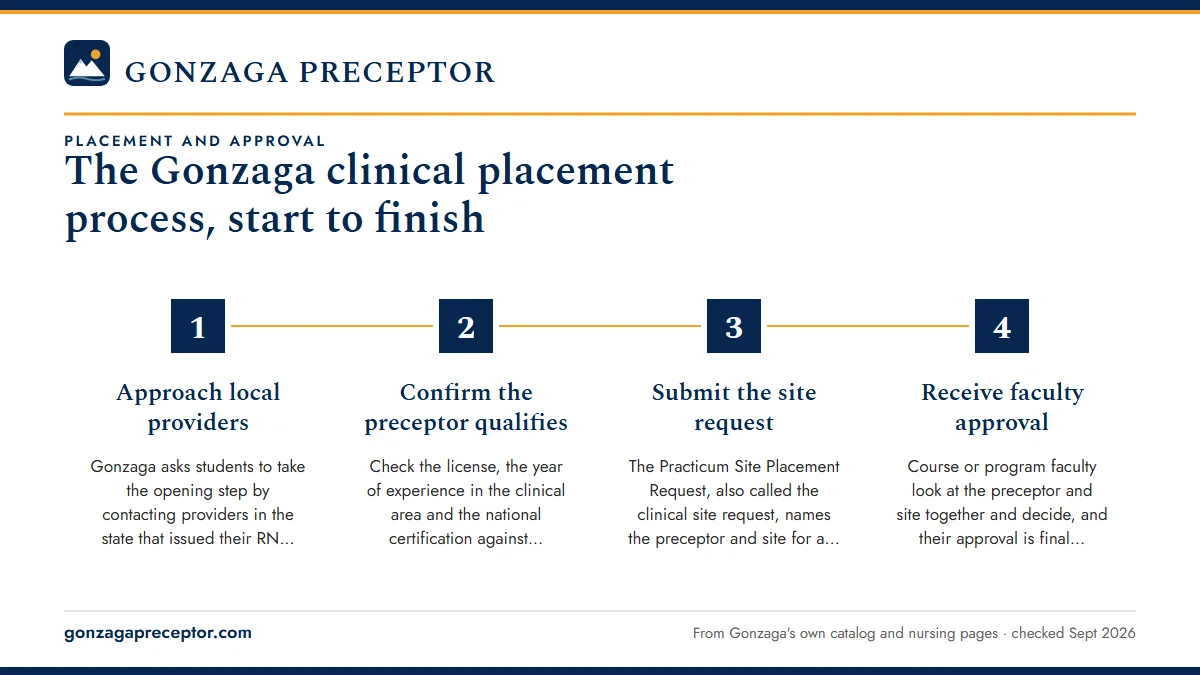
Most of the work happens months before a practicum course opens. These four steps get a preceptor and site approved.
- Approach local providersGonzaga asks students to take the opening step by contacting providers in the state that issued their RN license. Start with the setting the course needs, such as primary care for
NURS 601. See finding local preceptors. - Confirm the preceptor qualifiesCheck the license, the year of experience in the clinical area and the national certification against Gonzaga's published criteria. FNP students also map out how a nurse practitioner will cover half or more of the hours.
- Submit the site requestThe Practicum Site Placement Request, also called the clinical site request, names the preceptor and site for a specific practicum course.
- Receive faculty approvalCourse or program faculty look at the preceptor and site together and decide, and their approval is final. After that, the Clinical Placement Team carries the placement the rest of the way with you.
Clearing to start: agreement, compliance and the first contact
Approval gives you a yes on paper. Four more pieces turn that yes into a practicum where hours can be logged.
- An active affiliation agreementGonzaga and the site need a current agreement before any practicum experience begins. Plenty of sites in the West are already under contract with Gonzaga; one that has never hosted a Gonzaga student needs a contract processed first. The affiliation agreement guide covers existing versus new sites.
- CPNW and compliance clearanceGonzaga's FNP packet ties hour accrual to following CPNW and meeting its compliance items. BLS, immunizations, a 10-panel drug screen and a background check have been tracked in CastleBranch, with Gonzaga moving students into CORE by spring 2026.
- Schedule and first-day materialsAbout two weeks before the rotation, confirm the schedule with your preceptor, built around their availability. Hand over your CV or resume plus your written semester goals; the FNP guide also asks for week-by-week objectives.
- Point of contact oneEarly in the semester you arrange a short phone or video call with your preceptor and clinical faculty to review your goals. It is the first of three contacts that Washington's WAC 246-840-533 requires.
During and after the practicum
Once the semester has started and every gate is open, hours accrue only with your approved preceptor and only inside the term. University breaks and the gap between semesters do not count, and a course cannot run past its end date without an extension that course faculty approve. The hour accrual rules cover each limit.
Record your encounters in Typhon each week, or in CORE after your cohort's move, entering each day's patients on the day you see them. Around mid-semester comes the faculty site visit, the second point of contact. FNP students in Washington, Idaho, Oregon and Montana are visited at their site, while students in the other six states add a day in Spokane beside an immersion. At the end, your preceptor completes an evaluation with you, which closes the third contact and becomes part of your permanent record.
What has to be true before your first hour counts
Gonzaga's FNP clinical faculty packet lists the gates in one sentence. Run through them before you walk into clinic on day one.
- The semester's official start date has passed.
- You are following CPNW and current on every item it requires.
- Faculty have approved the site and the preceptor.
- Gonzaga has confirmed an active affiliation agreement with the practicum site.
- You are working with an approved preceptor, one of no more than two for the semester.
Hours logged outside these conditions may not count, and the packet warns that breaking the rules can lead to dismissal from the program. That risk is why the order above matters more than speed.
A preceptor's yes by email is not a placement. Until faculty approval, the agreement and your clearance are all in place, the time you spend in clinic is not practicum time.
Timing: no published deadline, so plan early
You will not find a request deadline anywhere on gonzaga.edu. Gonzaga keeps that date in its Graduate Nursing Student Handbook, handed to students once enrolled, and in course materials. Look it up as soon as your progression plan shows a practicum, and ask the Clinical Placement Team if the date is unclear.
Clinical sites run on calendars of their own, too. Providence sets a four-week minimum for its Inland Northwest onboarding packet, while Kootenai Health will take a school's request no earlier than 90 days before the start date and no later than two weeks before it. For most MSN students the first clinical course, NURS 601, falls in year two; the first clinical course guide shows when to start looking.
Why Gonzaga students choose us for this process
Our service is built around Gonzaga's own sequence. The placement desk searches your state in person for a preceptor and site that fit the specific practicum course, then confirms the details Gonzaga's faculty and Clinical Placement Team rely on: the preceptor's license, board certification and experience, who signs contracts at the site, the clinic schedule and how it maps to the course.
You submit a complete request early instead of chasing missing pieces the week before term. If a preceptor withdraws, we start a replacement search right away. Gonzaga's faculty give the final approval; our job is making sure everything that reaches them is complete and fits the rules on the first pass. Tell us your track, course and state with the form below, and the search starts from there.
Questions Gonzaga students ask
Does Gonzaga find preceptors for its NP students?
Gonzaga describes a shared process. Students take the initial step by identifying local providers willing to precept, and the Clinical Placement Team then helps them lock in the site and preceptor, contract paperwork included. Gonzaga's department also has contracts in place with facilities throughout the western U.S., so ask the team which sites near you are already covered.
How early should a Gonzaga student start the placement process?
No deadline is posted publicly, so start as soon as your progression plan shows a practicum course and check the Graduate Nursing Student Handbook for the internal date. A new site needs an affiliation agreement, and some health systems want paperwork a month or more before the start date, so several months of lead time is sensible.
Can I start clinical hours while the agreement is still being processed?
No. Gonzaga's FNP packet lets hours accrue only after the semester starts and once you are following CPNW, have site approval and have confirmation of an active agreement with the practicum site. Time in clinic before all of that is in place may not count toward your total.
What happens if my preceptor backs out after approval?
Gonzaga's public pages do not describe a re-placement procedure, so alert your course faculty and the placement team the same day. Any replacement needs approval, and the two-preceptor limit per semester still applies. Gonzaga's extension courses and flexible progression plans exist for hours that slip. The preceptor dropped out guide covers next steps.
Is the process the same for Gonzaga's Post-Master's DNP?
The shape differs. DNP practicum hours count as indirect hours built around your DNP project, so you propose a practice setting and an agency liaison rather than a direct-care preceptor. You submit an individualized practicum proposal and objectives for NURS 701, NURS 702 and NURS 703, and the liaison completes Gonzaga's online checklist.
Related pages
Last checked 2026-09-25
We check these pages against Gonzaga's catalog, FAQs, preceptor packets and Department of Nursing pages. Your course, the Graduate Nursing Student Handbook and Gonzaga's Clinical Placement Team have the final word.
Gonzaga asks you to find local preceptors first. Let us run that search.
Tell us your Gonzaga program, your practicum course and where you live and can travel. We find preceptors who fit the course and prepare the license, certification and site details your Practicum Site Placement Request needs, early in the semester before.
- Preceptors matched to the course: primary care across the lifespan for
NURS 661PtoNURS 664P, psychiatric care forNURS 661MtoNURS 663M, an agency liaison for the DNP - Credentials, license, board certification and site contact ready for your site request
- In Spokane, across Washington or wherever in the ten western states you are licensed
Start your placement plan
Your program, city and next practicum term is all we need to begin.