Finding psychiatric preceptors in the West for Gonzaga's PMHNP track
Mental health care is the thinnest part of the western clinical workforce, and PMHNP students feel it first. Gonzaga widens the pool by accepting a range of qualified mental health professionals as preceptors, but the search still needs a plan for three practicums with different populations. Here are the numbers, the rules and the settings that work.
Get your placement plan
Tell us your Gonzaga program and where you live. A placement advisor replies with the preceptor and site options that fit your Gonzaga course.
How short the western supply is
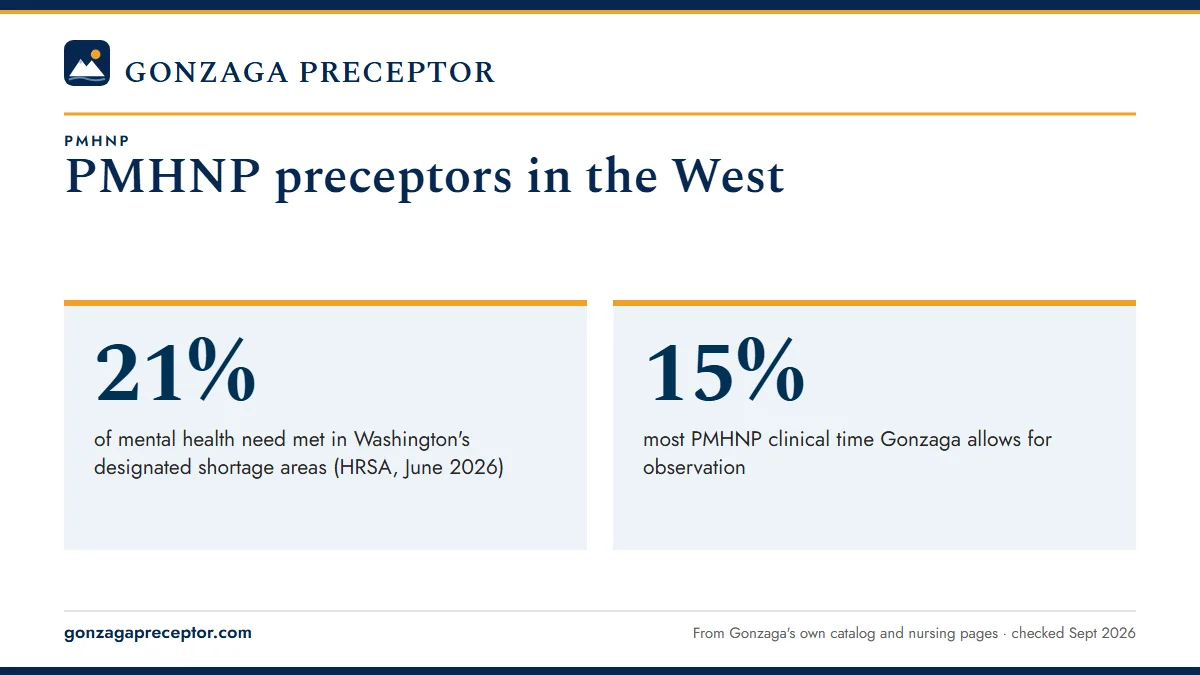
HRSA's shortage designations, with data as of June 30, 2026, show how little mental health need is met in the northern states where many Gonzaga students live. Washington meets about 21 percent of need in its designated areas, the lowest of these five, and needs more added mental health practitioners than the other four combined.
| State | Mental health HPSAs | Share of need met | Practitioners needed |
|---|---|---|---|
| Washington | 243 | 21.13% | 249 |
| Idaho | 65 | 30.37% | 48 |
| Oregon | 135 | 25.43% | 90 |
| Montana | 112 | 40.87% | 55 |
| Alaska | 347 | 28.89% | 32 |
Shortage cuts both ways. Psychiatric clinicians are stretched and careful about adding a student, yet these are the communities that most need new PMHNPs, and a clear, complete request makes it far easier for a busy clinician to say yes.
Who can precept Gonzaga PMHNP hours
Gonzaga opens PMHNP precepting to a broad group it calls qualified mental health professionals. Its examples run from advanced practice nurses and psychiatrists to psychologists, social workers and licensed therapists. The Preceptor Portal's baseline still holds for all of them: twelve months or more in the clinical area, a clear license in the practicum state, and paperwork showing licensure and national certification.
Gonzaga's sources word the narrower cases differently. For NURS 683M, the extension course, one source names a psychiatric nurse practitioner or psychiatrist, while another uses a broader nurse practitioner, physician or PA wording. Confirm with course faculty which professionals can supervise which hours in your course, especially before building a semester around a therapist or social worker. Course detail is on the PMHNP practicum courses page.
Matching settings to the psychiatric practicums
Each specialty practicum asks for a different caseload, so one preceptor rarely covers the whole track.
NURS 661M: the first psychiatric practicum, centered on assessment and diagnosis. Outpatient psychiatric clinics and community mental health centers with steady intake work well.NURS 662M: adults, where the work combines prescribing with individual and group therapy. Look for a preceptor who both prescribes and runs therapy, or pair a prescriber with a therapy setting.NURS 663M: child and adolescent clients along with older adults. It often takes two settings, one for young people and one for elders, so plan both early.NURS 683M: the repeatable extension course for remaining hours, which has no faculty site visit.
Settings that often fit include community mental health and behavioral health centers, state psychiatric hospitals, VA mental health services, psychiatric care integrated into primary care clinics, and private psychiatric practices.
Where psychiatric preceptors practice across the ten states
| State | Examples of where psychiatric clinicians practice | A state step to know |
|---|---|---|
| Washington | Eastern State and Western State hospitals, VA Spokane, CHAS Health behavioral health centers | Home-state rule, WAC 246-840-533 |
| Idaho | Kootenai Health, St. Luke's Health System | Kootenai asks for Idaho Health and Welfare fingerprinting for behavioral health units |
| Oregon | OHSU, Providence Oregon, Legacy Health | OSBN requires no notice or approval from out-of-state APRN programs |
| California | Kaiser Permanente, University of California Health | Gonzaga is on the BRN's out-of-state NP list for Psych/Mental Health; a California RN license is required |
| Alaska | Providence Alaska Medical Center, Alaska Native Medical Center | Each student files an APRN Preceptorship Registration; the preceptor is an APRN or physician in a comparable practice focus |
| Montana | Billings Clinic, Logan Health | No board approval for graduate programs, but a license valid in Montana |
| Arizona, Nevada, Utah, Wyoming | Banner Health, Renown Health, Intermountain Health, Cheyenne Regional Medical Center | Each has its own step for out-of-state programs |
Ask Gonzaga's Clinical Placement Team which of these systems already holds an active agreement. For California's list, see California BRN approval; for the other states, the state guides.
Gonzaga rules that shape a PMHNP semester
Three Gonzaga rules change how you build a psychiatric placement. Watching from the corner is capped: observation may fill 15 percent of clinical time at most, so a preceptor has to let you assess, diagnose, plan care and deliver treatment rather than only watch. Your own RN practice setting is off the table, although another part of the same organization can work with faculty approval. And only two preceptors can count in a semester, which matters when one course covers two populations.
Site visits run a little differently too. Gonzaga's PMHNP materials allow the clinical faculty visit in person or as a telehealth observation of you with patients. The workplace practicum rules page covers the employer conditions in full.
How we find psychiatric preceptors for Gonzaga students
We treat a PMHNP placement as a plan across three courses, not a single search. We map each course to the settings and populations it needs, look across psychiatric practices, community mental health centers, integrated clinics and hospital outpatient services in your licensed state, and screen every preceptor against Gonzaga's list of qualified professionals and the observation limit before you see a name.
You get preceptors lined up in course order, with the credentials and site details your request needs, and a replacement plan if one leaves. The first psychiatric practicum usually falls in year three, after NURS 601 in year two, so year two is the time to start. See your first clinical course for the timing.
Questions Gonzaga students ask
Can a psychologist or licensed clinical social worker precept my PMHNP hours?
Gonzaga's PMHNP materials name psychologists, social workers and licensed therapists among the qualified mental health professionals who can precept. Some course wording is narrower, so confirm with course faculty which hours such a preceptor can supervise. Many students pair a therapist with a prescribing preceptor to cover psychotherapy and medication management.
Is NURS 601 a psychiatric practicum?
No. NURS 601 is the 60-hour advanced health assessment practicum taken with NURS 600, and it runs in primary care for FNP and PMHNP students alike. Your psychiatric practicums begin with NURS 661M. Line up a primary care preceptor for NURS 601 and start the psychiatric search alongside it.
Can PMHNP students do clinicals in California?
Yes, if you live and are licensed there. Gonzaga appears, for both its Family and Psych/Mental Health tracks, on the California BRN's roster of nurse practitioner programs based outside California, and students need an active California RN license for California clinicals. Preceptors must also meet the BRN's own requirements.
How many PMHNP clinical hours does Gonzaga require?
Plan on 660 by the count on Gonzaga's 2026 PMHNP pages: the 60-hour NURS 601 plus 600 hours spread over the psychiatric practicums. The catalog states the 600 alone. Hour ranges for single courses shift between documents, so check each syllabus and confirm targets with the faculty teaching it. See the MSN PMHNP.
Do Idaho behavioral health units need anything extra?
Kootenai Health asks students on its behavioral health units for Idaho Health and Welfare fingerprinting, on top of immunizations, a background check, a flu shot and AHA BLS. Other Idaho systems set their own lists. Add those steps to your timeline next to CPNW and Gonzaga's own compliance items.
Related pages
Last checked 2026-09-25
We check these pages against Gonzaga's catalog, FAQs, preceptor packets and Department of Nursing pages. Your course, the Graduate Nursing Student Handbook and Gonzaga's Clinical Placement Team have the final word.
Gonzaga asks you to find local preceptors first. Let us run that search.
Tell us your Gonzaga program, your practicum course and where you live and can travel. We find preceptors who fit the course and prepare the license, certification and site details your Practicum Site Placement Request needs, early in the semester before.
- Preceptors matched to the course: primary care across the lifespan for
NURS 661PtoNURS 664P, psychiatric care forNURS 661MtoNURS 663M, an agency liaison for the DNP - Credentials, license, board certification and site contact ready for your site request
- In Spokane, across Washington or wherever in the ten western states you are licensed
Start your placement plan
Your program, city and next practicum term is all we need to begin.