The Practicum Site Placement Request, explained
The Practicum Site Placement Request, which Gonzaga's packets also call the clinical site request, is how you put a preceptor and site in front of faculty. Faculty review each one and give the final approval, and only then can the agreement, clearance and scheduling that lead to your first hour move forward. A complete request is the fastest way through.
Get your placement plan
Tell us your Gonzaga program and where you live. A placement advisor replies with the preceptor and site options that fit your Gonzaga course.
What the request does
Gonzaga's PMHNP preceptor packet sets out the sequence. "The student submits a Practicum Site Placement Request for approval," it says, and an affiliation agreement follows before any practicum experience begins. Then: "The PMHNP faculty reviews each preceptor/clinical site submitted in the student clinical site request and gives the final approval."
The FNP clinical faculty packet lists the same duty for course faculty: "Approve clinical site requests." On both NP tracks, then, the request is the formal point where a preceptor you found becomes a preceptor Gonzaga has accepted for a specific course.
One request covers the preceptor and the site together. Faculty are not only checking a person's license; they are judging whether that clinic can deliver the patients, setting and hours the course needs, and whether the arrangement fits the rest of your semester.
What to have ready before you submit
Gonzaga gives enrolled students the request itself, so its exact fields come from Gonzaga. Whatever the layout, faculty are weighing the facts below, and gathering them first avoids a returned request.
- The preceptor's name, credential and role: ARNP or NP, MD, DO or PA, or for PMHNP the mental health license they hold.
- License details for the state where you will precept, showing an active, unencumbered license.
- Documentation of national board certification.
- Years of experience in the clinical area you will train in, with one year as Gonzaga's floor.
- The site's name, address and type of practice, and the patient population it serves.
- The course you are requesting for, such as
NURS 662PorNURS 662M, and the hours you plan to complete there. - The person at the site who handles affiliation agreements, and whether Gonzaga already has one in place.
- Your relationship to the preceptor, confirming they are not your direct supervisor or a family member.
How faculty review a request
Faculty measure the request against Gonzaga's published preceptor criteria and the rules of your track. For FNP students they look for a nurse practitioner, physician or physician assistant, with enough NP time planned to reach at least half of your hours. For PMHNP students they look for a qualified mental health professional and a setting that keeps observation within the 15% cap.
They also test the setting against the course. Every FNP practicum sits in primary care, with NURS 664P adding other settings, and PMHNP practicums move from diagnosis to adult treatment to child, adolescent and older adult populations. They check the fit with your semester too, since an approved preceptor counts toward the two you may have in a term.
Final approval rests with course or program faculty. The preceptor requirements guide lists the criteria in Gonzaga's words.
Matching the request to the course
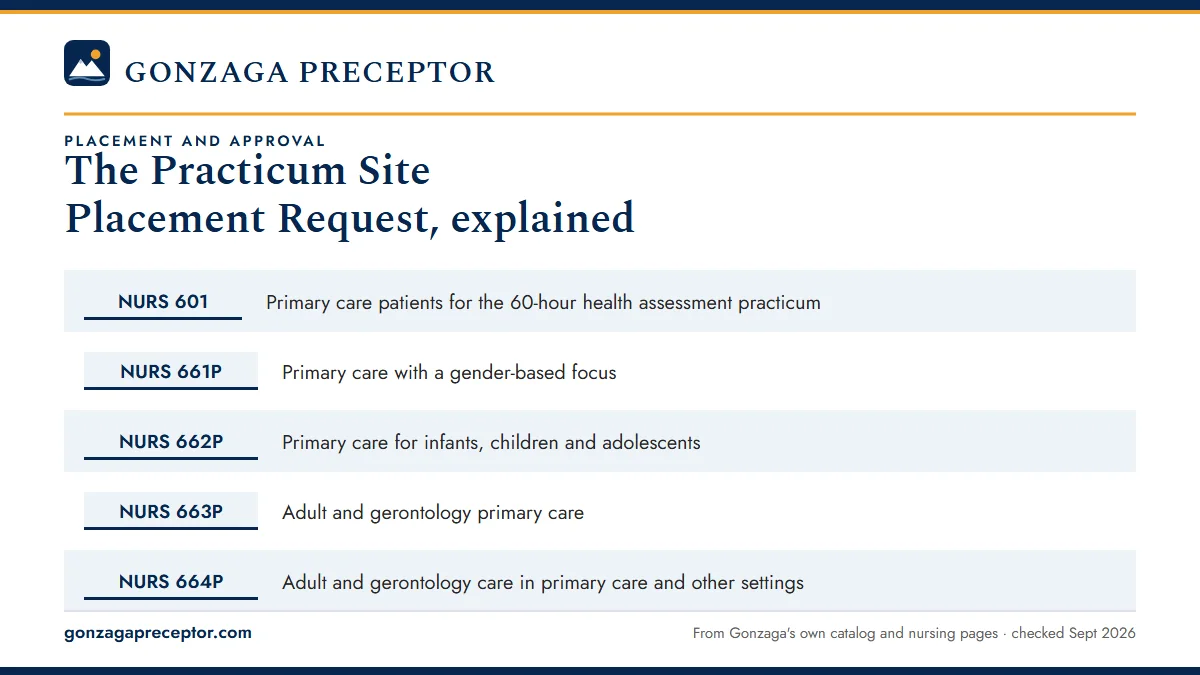
The course code on the request decides what the site must offer. Gonzaga's catalog and program pages describe each practicum this way; hour ranges by course are in the FNP practicum guide and the PMHNP practicum guide.
| Course | What the site needs to offer |
|---|---|
NURS 601 | Primary care patients for the 60-hour health assessment practicum |
NURS 661P | Primary care with a gender-based focus |
NURS 662P | Primary care for infants, children and adolescents |
NURS 663P | Adult and gerontology primary care |
NURS 664P | Adult and gerontology care in primary care and other settings |
NURS 661M | Psychiatric assessment and diagnosis |
NURS 662M | Adults: medication management with individual and group psychotherapy |
NURS 663M | Child, adolescent and older adult clients |
If one site cannot cover a course's whole population, such as a family practice with few young patients for NURS 662P, raise it with course faculty before you submit rather than after.
After approval: what still stands between you and hour one
Approval is a milestone, not a start signal. Three more things have to fall into place before Gonzaga counts an hour.
- A current contract between Gonzaga and the site; for a site new to Gonzaga, the Clinical Placement Team processes one. See affiliation agreements.
- Your compliance clearance: following CPNW, with records in CastleBranch or, after your cohort's switch, in CORE.
- The start of the semester, a schedule confirmed with your preceptor about two weeks out, and the first point of contact with your preceptor and clinical faculty.
The hour accrual rules explain what counts once you begin.
An approved request does not clear you to start. Hours before the agreement is active and the semester has begun may not count.
Timing your request
Gonzaga posts no request deadline publicly. The internal date is in the Graduate Nursing Student Handbook and your course materials, and the Clinical Placement Team can confirm it for your term.
Work backward from the site as well as from Gonzaga. Any site without a Gonzaga contract must sign one before you begin, and large systems keep their own calendars. Kaiser Permanente Washington takes school placement requests on an annual cycle, Providence Oregon notes that a new agreement can take several weeks, and Providence's Inland Northwest facilities want onboarding forms at least four weeks before a rotation. Submitting a complete request a full term ahead keeps those clocks from colliding with your start date. If your state adds its own paperwork, such as Alaska's per-student APRN preceptorship registration, build that time in as well.
Why students let us prepare the request
A returned request can cost weeks. Our placement desk builds each match around the request itself: a preceptor in your state who meets Gonzaga's criteria for your track, a site that fits the course code, and the documents faculty look for, including license verification, board certification, experience in the clinical area, the site's agreement contact and a schedule that fits the semester. Every document is checked against the course before it reaches you, so the request reads as one consistent package.
You submit once, early and complete. Faculty make the final decision; we make sure what reaches them answers their questions before they ask. If anything changes after approval, such as a preceptor leaving, we start the replacement search immediately. Start with the form below.
Questions Gonzaga students ask
Is the clinical site request the same as the Practicum Site Placement Request?
Yes. Gonzaga's PMHNP packet uses both names for one submission: the Practicum Site Placement Request that the student submits, and the clinical site request that PMHNP faculty review. The FNP clinical faculty packet refers to clinical site requests among course faculty duties. Use whichever name your course materials use.
Who gives final approval of my preceptor and site?
Faculty do. The PMHNP packet says the PMHNP faculty review each preceptor and site and give the final approval, and the FNP packet lists approving clinical site requests among course faculty duties. The Clinical Placement Team then finalizes the placement and handles the agreement with the site.
Can I list two preceptors for one practicum?
Gonzaga allows up to two approved preceptors in a semester, and each needs approval before you log hours with them. A planned pair can help FNP students reach the nurse practitioner share or cover a preceptor's time away. The two-preceptor rule covers the details.
What if faculty send my request back?
Gonzaga does not publish an appeal step, so ask course faculty what fell short: the preceptor's credential, the setting, the hours or the agreement. Many returned requests can be fixed with missing documents or a better-matched site. Starting early leaves room for a second submission before the semester opens.
Does a returning preceptor need a new request each semester?
Gonzaga's public documents describe faculty reviewing each preceptor and site you submit, and each practicum course has its own setting and objectives. Whether a preceptor you have already worked with needs a fresh request for a new course depends on rules in the Graduate Nursing Student Handbook, which course faculty can confirm for you.
Related pages
Last checked 2026-09-25
We check these pages against Gonzaga's catalog, FAQs, preceptor packets and Department of Nursing pages. Your course, the Graduate Nursing Student Handbook and Gonzaga's Clinical Placement Team have the final word.
Gonzaga asks you to find local preceptors first. Let us run that search.
Tell us your Gonzaga program, your practicum course and where you live and can travel. We find preceptors who fit the course and prepare the license, certification and site details your Practicum Site Placement Request needs, early in the semester before.
- Preceptors matched to the course: primary care across the lifespan for
NURS 661PtoNURS 664P, psychiatric care forNURS 661MtoNURS 663M, an agency liaison for the DNP - Credentials, license, board certification and site contact ready for your site request
- In Spokane, across Washington or wherever in the ten western states you are licensed
Start your placement plan
Your program, city and next practicum term is all we need to begin.