Gonzaga's MSN Family Nurse Practitioner track, from the core to the last practicum
Gonzaga's online Family Nurse Practitioner track runs 47 credits over nine semesters, with 660 precepted hours in primary care and six trips to Spokane for immersions. Admission is limited to residents of ten western states, and each practicum takes place where your RN license is held. This guide sets out the plan, the hours and the preceptors each stage calls for.
Find your FNP preceptor
Tell us your state and your next practicum course.
The FNP track in numbers
Two details in that table deserve a second look. Gonzaga's live FNP page teaches a 15-credit core of NURS 561 through NURS 565, yet the 2026-27 catalog shows a redesigned 12-credit core numbered NURS 501 to NURS 504, and both versions still total 47 credits. Your progression plan settles which core you take, and neither one carries clinical hours.
A bachelor's degree outside nursing can still work if you hold an RN license, but up to five foundational courses come first, among them statistics, research, community health and a community health practicum. Up to 9 graduate credits may transfer in.
| Item | What Gonzaga publishes |
|---|---|
| Credits | 47, MSN core included |
| Length | 9 semesters, about 3 years across fall, spring and summer |
| Delivery | Online and asynchronous; core courses run 8 weeks, track courses 16 weeks in fall and spring and 12 in summer |
| Clinical hours | 660 on the program pages; the catalog lists 600 practicum hours (10 credits) plus the 1-credit NURS 601 |
| Immersions | 6 in Spokane, built around OSCEs |
| Pace | No cohort model; you may slow your plan but must finish within five years |
| Admission | Active, unrestricted RN license; a bachelor's degree, BSN preferred; residence in one of ten western states |
| Next posted start | Summer 2027, application deadline Feb 1, 2027 |
Where the 660 clinical hours come from
Every one of the 660 hours is precepted, and all of it sits in primary care. Sixty come from NURS 601, the practicum you take alongside NURS 600 Advanced Health Assessment. The remaining 600 are spread over four specialty practicums, each paired with a didactic course, plus an extension course if you need more time.
| Practicum | Paired course | Hours |
|---|---|---|
| NURS 601 | NURS 600 Advanced Health Assessment | 60 |
| NURS 662P | NURS 652P Infant, Child, Adolescence | 120 (web: 120-180) |
| NURS 661P | NURS 651P Gender Based | 60-180 |
| NURS 663P | NURS 653P Adult/Gerontology I | At least 180 (web: 180-240) |
| NURS 664P | NURS 654P Adult/Gerontology II | At least 120 (web: 120-240) |
| NURS 683P | Taken after NURS 654P and 664P | Variable, repeatable |
At about 60 clock hours per practicum credit, the catalog's 600 and the program page's 660 describe one plan counted two ways. How many hours you place in a given course depends on the credits you register for and that course's syllabus. The FNP practicum courses guide takes each one in turn.
The ten-state rule and your faculty site visits
Gonzaga admits FNP students only if they live in Washington, Idaho, Oregon, Montana, California, Nevada, Utah, Alaska, Wyoming or Arizona, the order its eligibility page uses. Practicums run where you are licensed, so your preceptors will practice in one of those ten states, usually within driving distance of home. The ten-state admission rule page covers what a mid-program move can mean for licensure.
Your state also decides how the faculty site visit happens. If you live in Washington, Idaho, Oregon or Montana, clinical faculty travel to your own site at least once in each practicum course. From the other six states, you add a day on campus next to one of the immersions in every practicum course, and the visit takes place in Spokane. The faculty site visits guide explains how that day is graded.
A few of the ten states add a step of their own for out-of-state NP programs. California's Board of Registered Nursing names Gonzaga's Family track on its list of out-of-state NP programs, and Alaska asks each APRN student to register a preceptorship before starting.
When clinical work begins, year by year
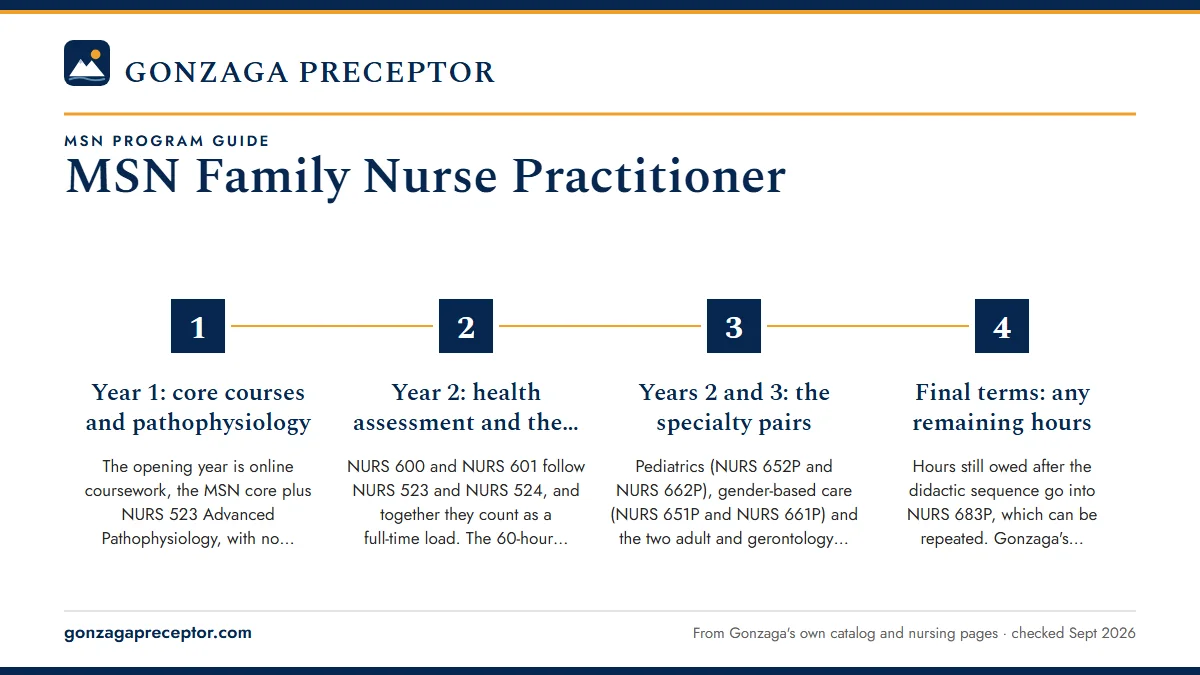
- Year 1: core courses and pathophysiologyThe opening year is online coursework, the MSN core plus
NURS 523Advanced Pathophysiology, with no clinical hours. It is the best window to line up a primary care preceptor for health assessment. - Year 2: health assessment and the first practicum
NURS 600andNURS 601followNURS 523andNURS 524, and together they count as a full-time load. The 60-hour practicum and the first two Spokane immersions land here, and the first specialty practicum,NURS 662Pin pediatrics, falls in the same year. The NURS 600 and 601 guide covers that semester. - Years 2 and 3: the specialty pairsPediatrics (
NURS 652PandNURS 662P), gender-based care (NURS 651PandNURS 661P) and the two adult and gerontology blocks (NURS 653PandNURS 663P, thenNURS 654PandNURS 664P) each run as a didactic course and practicum in one term. Each pair needs the earlier courses at C or better and brings a 3-day immersion. - Final terms: any remaining hoursHours still owed after the didactic sequence go into
NURS 683P, which can be repeated. Gonzaga's progression plans let you slow down within the five-year limit if a term's hours slip.
Faculty advise capping paid work at 20 hours weekly after clinicals begin, since practicum days follow the preceptor's calendar rather than your employer's.
The preceptors an FNP student needs
FNP practicums are primary care placements, and the pediatric course expects you to see patients in every age group. Nurse practitioners, physicians and physician assistants all qualify, except in states that reserve precepting for an MD or NP. At least half of your total hours belong with nurse practitioners, so leaning mostly on physicians leaves a gap.
Gonzaga also looks for at least a year of practice in the specialty, board certification on file and a license in good standing in your state. Two approved preceptors per semester is the ceiling, and your direct supervisor cannot fill the role. The preceptor requirements page and the NP hours rule guide show how to plan the mix across all four practicums.
Time spent with an unapproved preceptor, or at a site still awaiting clearance, may not count toward the 660.
Six immersions in Spokane
You travel to campus six times. Two 2-day immersions come with NURS 600, and each of the four specialty courses, NURS 651P through NURS 654P, brings a 3-day immersion. The centerpiece is the OSCE: you take a history and perform a targeted exam with a scripted model patient, then give a differential, a most-likely diagnosis and a plan of care in front of practicing faculty.
The first immersion typically arrives near the program's midpoint, with one or two each semester after that, and travel is at your own expense, as is transportation to clinical sites. If you live outside Washington, Idaho, Oregon or Montana, one immersion in each practicum course also carries your site-visit day, so that trip runs a day longer. Block practicum days around those trips early so a preceptor's schedule and a Spokane visit never collide. The Spokane immersions guide lists what each visit covers.
Why Gonzaga FNP students choose us
Gonzaga's process starts with you reaching out to local providers; the Clinical Placement Team and faculty then carry the site request through approval and the affiliation agreement. Our service is built for that opening step. Your placement advisor searches your own state for primary care preceptors who fit the course ahead, confirms each one meets Gonzaga's criteria and plans the nurse practitioner share across the whole sequence, not one term at a time.
What an FNP student gets
- A preceptor matched to the practicum in front of you, from the 60-hour
NURS 601to pediatrics and the adult and gerontology blocks - Everything the Practicum Site Placement Request asks about, gathered early: license, board certification, site and agreement contact, schedule and course fit
- A preceptor mix that keeps at least half of your hours with nurse practitioners
- A fresh search, fast, if a preceptor steps away mid-term
Faculty still approve every site and preceptor, and the Clinical Placement Team finalizes each placement. What we hand you is a request that is complete and on target when it reaches them. Share your state and next course through the form below.
Questions Gonzaga students ask
Is Gonzaga's FNP program 600 or 660 clinical hours?
Both numbers describe the same plan. The catalog counts the 600 hours in the four specialty practicums and the extension course, worth 10 credits. The program pages also count the 60-hour health assessment practicum, NURS 601, which brings the total to 660. Your syllabus and course faculty confirm the target for each course, and your logs need to reach the full program total before you graduate.
Can I join Gonzaga's FNP track if I live outside the ten western states?
Not while you live there. Gonzaga's NP tracks admit only residents of the ten western states listed above, and its licensure disclosures name other states it cannot accept MSN students from at all. If you plan to move during the program, contact the program before you do, since relocating can affect licensure eligibility.
How long does the Gonzaga FNP take if I keep working?
The published plan is nine semesters, about three years with summers included. There is no cohort, so you can slow your progression plan, but the degree must be finished within five years. Faculty suggest keeping paid work to 20 hours a week or less once clinicals begin, because practicum days follow the preceptor's schedule.
Does Gonzaga assign FNP preceptors to students?
Gonzaga describes placement as shared work. You begin by approaching local providers who might precept. From there, Gonzaga's Clinical Placement Team steps in to help lock down the site, process the contract paperwork and finalize the placement with you, drawing on affiliation agreements across the western U.S. Faculty approve each preceptor and site before any hour counts.
Can I complete FNP practicum hours at the clinic where I work?
With faculty approval, yes, under three conditions. Someone other than your direct supervisor must precept you, practicum time stays apart from paid time, and the practicum runs on a unit other than the one you staff. Gonzaga nudges students toward sites outside their own facility too, which widens the range of patients you see.
Related pages
Last checked 2026-09-25
We check these pages against Gonzaga's catalog, FAQs, preceptor packets and Department of Nursing pages. Your course, the Graduate Nursing Student Handbook and Gonzaga's Clinical Placement Team have the final word.
Gonzaga asks you to find local preceptors first. Let us run that search.
Tell us your Gonzaga program, your practicum course and where you live and can travel. We find preceptors who fit the course and prepare the license, certification and site details your Practicum Site Placement Request needs, early in the semester before.
- Preceptors matched to the course: primary care across the lifespan for
NURS 661PtoNURS 664P, psychiatric care forNURS 661MtoNURS 663M, an agency liaison for the DNP - Credentials, license, board certification and site contact ready for your site request
- In Spokane, across Washington or wherever in the ten western states you are licensed
Start your placement plan
Your program, city and next practicum term is all we need to begin.