Typhon clinical logs at Gonzaga
Gonzaga's NP students have kept their clinical hours and patient encounters in Typhon, entered on the day they see patients and brought up to date every week. Course faculty audit those logs against registered credits and against the ages and populations each course has to cover. Gonzaga set spring 2026 as the point by which all students would be on CORE, so confirm which system your cohort now uses.
Get your placement plan
Tell us your Gonzaga program and where you live. A placement advisor replies with the preceptor and site options that fit your Gonzaga course.
What Gonzaga asks of your log
The FNP Clinical Faculty Packet lists the requirement among student responsibilities: "Maintain an accurate and timely electronic clinical log of patient encounters in Typhon on a weekly basis." Accurate means the entries match what happened in clinic. Timely means the log is current every week, not rebuilt from memory in the last days of the semester.
The PMHNP packet also wants a completed Typhon log, turned in with your self-evaluation through the course's Canvas drop box at term's end. On both tracks, the log is the record faculty use to judge whether your hours and your patient mix satisfy the course. It sits next to your preceptor's evaluation as proof of the semester you had.
A current log also makes every conversation easier. At each of the three points of contact, the natural question is how the hours and the patient mix are going, and a log that is up to date lets you answer with numbers rather than estimates. It is also the fastest way to notice that a course is running behind while there are still weeks left to fix it.
Enter each day on the day you see patients
Gonzaga compares clinical logging to charting: data goes in on the date the patients are seen. The habit protects you. Details recorded that evening are precise, while a week later they blur, and a log pieced together at term's end is exactly what an audit tends to question. HIPAA is among the conduct rules in the same packet, so follow your course template for what patient detail belongs in an entry.
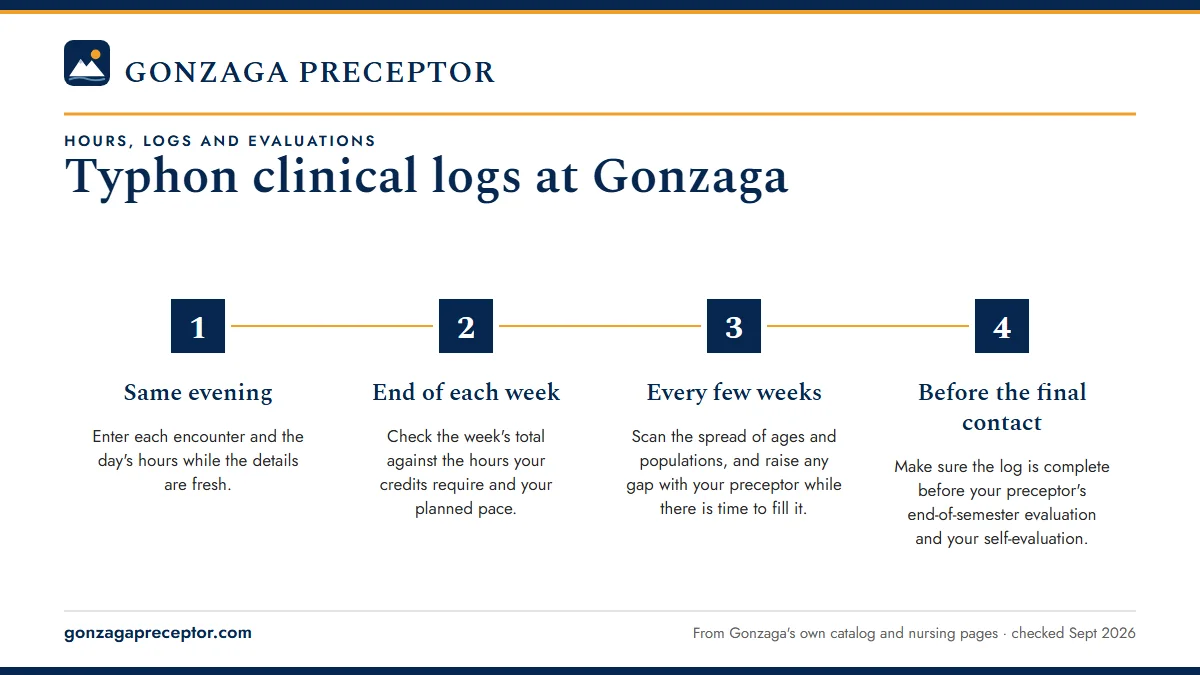
- Same eveningEnter each encounter and the day's hours while the details are fresh.
- End of each weekCheck the week's total against the hours your credits require and your planned pace.
- Every few weeksScan the spread of ages and populations, and raise any gap with your preceptor while there is time to fill it.
- Before the final contactMake sure the log is complete before your preceptor's end-of-semester evaluation and your self-evaluation.
What course faculty check in an audit
Course faculty review the log for two things. First, that logged hours "align with credit hours registered": a three-credit practicum needs the hours three credits carry, which Gonzaga's own figures put at roughly 60 clock hours a credit. Second, that your encounters cover all ages and the population foci the course is built around.
Where coverage matters most
NURS 662P, the infant, child and adolescent practicum: Gonzaga's packet says the student must see patients in every age groupNURS 663PandNURS 664P, the adult and gerontology practicums: the log should reflect both adult and older-adult patientsNURS 661P, the gender-based primary care practicum- PMHNP practicums
NURS 661MtoNURS 663M: diagnosis, then adult treatment, then child, adolescent and older-adult clients
A gap spotted in week four is a scheduling conversation with your preceptor. A gap spotted in week fifteen can mean a short course and an extension. Your hour targets per course are on the clinical hours guide.
How the log ties into the rest of the semester
The log does not stand alone. Course faculty spot check your three points of contact and read the log next to the preceptor's evaluation, your own self-evaluation and your evaluation of the clinical site. SOAP notes, which clinical faculty grade, are a separate submission, turned in as an original and a revised version.
A log also records only what the rules allow. Time with a preceptor still awaiting approval, before CPNW clearance or during a break may not count however neatly it is entered, and the accrual rules page covers those gates. When the term ends, the log and your preceptor's evaluation should tell the same story.
Typhon, or CORE if your cohort has moved
Typhon belongs to Gonzaga's older setup. In November 2024 Gonzaga announced it was moving clinical tracking into CORE, a platform that takes over student case logs and time logs as well as compliance documents, onboarding and site management. The stated plan was to have all students in CORE by spring 2026, leaving CORE and CPNW as the department's two platforms.
The discipline carries over whatever the software: same-day entries, weekly completeness, and coverage that matches the course. If you began in Typhon and your course now points to CORE, ask course faculty whether earlier entries transfer or need a summary. The CORE ELMS guide covers the change in detail.
Placements built for a clean log
A strong log starts with the right placement. We look for preceptors whose patient panels fit the course in front of you: families with children for NURS 662P, adult and older-adult panels for the adult-gerontology courses, and psychiatric settings suited to each PMHNP population. Coverage then builds naturally over the term instead of turning into a chase in the final weeks.
We also match the preceptor's clinic days to the hours your credits require, and we prepare the preceptor's license, board certification and site details for the Practicum Site Placement Request, so approval and the affiliation agreement are settled before your first entry. Send your course and state through the form below.
Questions Gonzaga students ask
How often do Gonzaga NP students update Typhon?
At least weekly, according to the FNP Clinical Faculty Packet, with each day's encounters entered on the date you see the patients. Short same-evening entries keep the record accurate and ready for course faculty to review at any point in the semester, not only at the end.
What if my logged hours fall short of my credits?
Faculty compare the hours in your log with the credits on your registration. A shortfall usually means more clinic time before the course ends, a faculty-approved extension, or an extension course such as NURS 683P or NURS 683M. Raise it with course faculty as soon as you notice it.
Does Gonzaga still use Typhon?
Typhon reflects the older setup. Gonzaga announced in 2024 that CORE would replace it, along with CastleBranch and other tools, with every student meant to be on CORE by spring 2026. Your syllabus or Canvas course names the system your cohort logs in now.
Where does the Typhon log go at the end of a PMHNP course?
The PMHNP packet asks students to upload the completed log together with their self-evaluation into the course's Canvas drop box. If your cohort now logs in CORE, follow the submission steps in your syllabus, since the location may be different.
Why does Gonzaga check age groups in my clinical log?
Nurse practitioner courses are built around populations, and the log is how faculty confirm you met them. Gonzaga's packet says students in the pediatric FNP practicum must see every age group, and the PMHNP sequence moves from adults to child, adolescent and older-adult clients.
Related pages
Last checked 2026-09-25
We check these pages against Gonzaga's catalog, FAQs, preceptor packets and Department of Nursing pages. Your course, the Graduate Nursing Student Handbook and Gonzaga's Clinical Placement Team have the final word.
Gonzaga asks you to find local preceptors first. Let us run that search.
Tell us your Gonzaga program, your practicum course and where you live and can travel. We find preceptors who fit the course and prepare the license, certification and site details your Practicum Site Placement Request needs, early in the semester before.
- Preceptors matched to the course: primary care across the lifespan for
NURS 661PtoNURS 664P, psychiatric care forNURS 661MtoNURS 663M, an agency liaison for the DNP - Credentials, license, board certification and site contact ready for your site request
- In Spokane, across Washington or wherever in the ten western states you are licensed
Start your placement plan
Your program, city and next practicum term is all we need to begin.