Gonzaga's PMHNP practicum courses and who can precept them
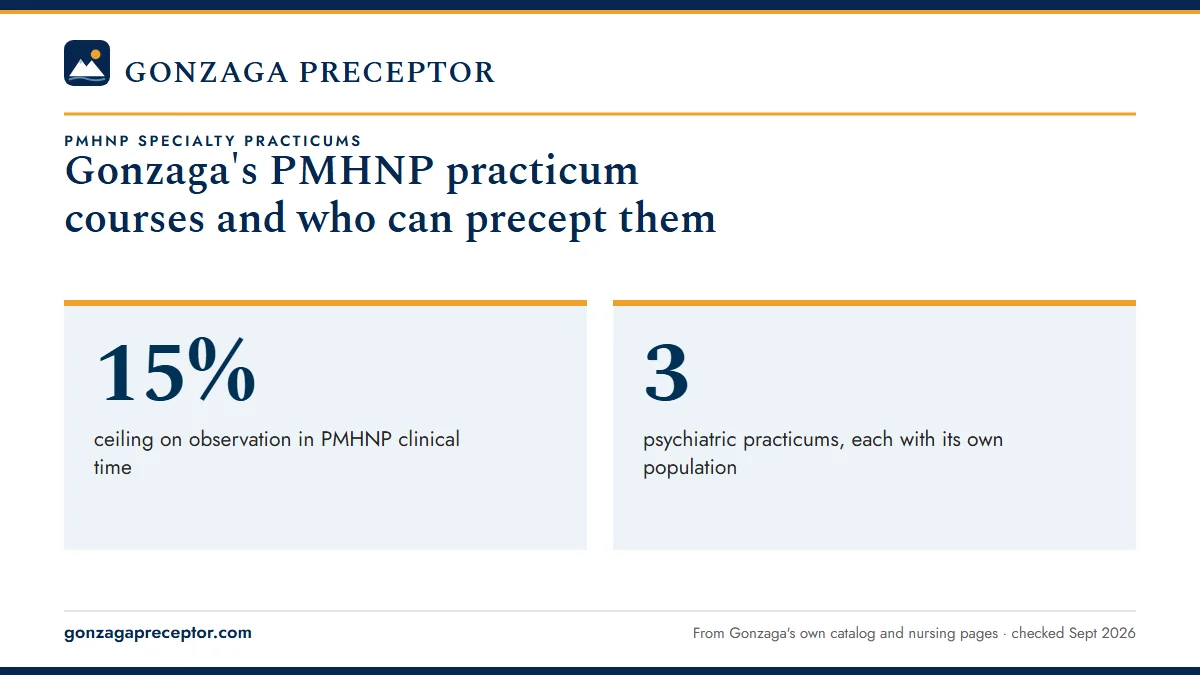
After health assessment, Gonzaga's PMHNP students move through three psychiatric practicums, NURS 661M, NURS 662M and NURS 663M, each paired with a concepts course, with NURS 683M available for extra hours. The population shifts each term, the preceptor pool is broader than in the FNP track, and observation is capped at 15% of your clinical time.
Get your placement plan
Tell us your Gonzaga program and where you live. A placement advisor replies with the preceptor and site options that fit your Gonzaga course.
Three practicums, three populations
Each PMHNP practicum runs beside a Psych-Mental Health Nurse Concepts course: NURS 652M with NURS 661M, NURS 653M with NURS 662M, and NURS 654M with NURS 663M. The first practicum usually opens year three, once NURS 600, NURS 601 and NURS 670 Psychopharmacology are complete at C or better.
| Practicum | Paired course | Credits | Focus | Hours |
|---|---|---|---|---|
NURS 661M Practicum I | NURS 652M | 1-3 | Diagnosis | 60-180 |
NURS 662M Practicum II | NURS 653M | 1-4 | Adults: medication management, individual and group psychotherapy | 60-240 (packet); 120-240 (2026 web) |
NURS 663M Practicum III | NURS 654M | 1-4 | Children, adolescents and older adults | 60-240 |
NURS 683M Extension | None | 1-3, repeatable | Extra hours when needed | 60-180 |
The sequence means one preceptor rarely covers everything. An adult outpatient psychiatric practice lines up with NURS 662M, while NURS 663M asks for young people and older adults, which may call for a second setting or a practice that sees a wide age range.
600 hours, 660 hours and the ranges between
Gonzaga states the PMHNP clinical total two ways. The catalog and the PMHNP course objectives page describe 600 practicum hours (10 credits) spread over at least three semesters; the 2026 PMHNP page and the preceptor packet give 660 by adding the 60 primary care hours of NURS 601. Each figure is right about its own scope, and the clinical hours hub lines them up.
Per-course ranges move with the credits you register for, at roughly 60 hours per credit. The NURS 662M floor is the one to watch: the 2023-24 packet says 60 hours, the 2026 web page says 120. Confirm the number in your syllabus before asking a preceptor to commit, because the preceptor's clinic days set the pace of your term, not the other way around.
Who can precept PMHNP hours
Gonzaga's PMHNP materials describe preceptors as qualified mental health professionals and name psychiatrists, psychologists, licensed therapists, social workers and advanced practice nurses as examples. That pool is wider than the FNP track's. The course focus still matters, though: NURS 662M centers on medication management, so plan which member of your preceptor mix actually prescribes.
The catalog is narrower for the extension course. For NURS 683M it asks for a psychiatrist or a psychiatric NP, whereas the program web page borrows the FNP formula: an NP, physician or PA, except where a state insists on a physician or NP. PMHNP faculty and your syllabus settle which applies.
Every preceptor also meets Gonzaga's baseline: twelve months or more in the specialty, a current license without restrictions in your practicum state, certification on file, and no role as your boss. See preceptor requirements for the full list.
The 15% observation cap
Under Gonzaga's PMHNP preceptor guide, observing of any type is capped at 15% of your clinical time. In a 180-hour practicum, that leaves room for no more than 27 hours of watching; everything else has to be your own work with patients under supervision.
Gonzaga describes creditable PMHNP work as assessment, differential diagnosis, building a plan of care, and carrying out psychopharmacology and psychotherapy treatment, along with presenting patients and documenting. In settings built around group or individual therapy, agree with the preceptor at the outset how you will move from sitting in to leading parts of sessions. The what counts as clinical hours guide covers how to log each kind of time.
A term spent mostly shadowing a therapist will not meet Gonzaga's PMHNP standard: observation tops out at 15% of your clinical time.
Settings, site visits and your own workplace
Gonzaga asks PMHNP students to put forward preceptors, and either the student or clinical placement staff arrange each placement at an approved site in your state of licensure. Your own RN unit is off the table for PMHNP hours; a different department in the same organization may qualify with faculty approval. See the workplace practicum rules for the conditions.
Each specialty practicum includes a clinical faculty site visit. The PMHNP packet allows it in person or virtually, with faculty observing you with patients through a telehealth system, and NURS 683M has no site visit at all. Each of the three concepts courses also brings a 2-day Spokane immersion.
Some sites add clearance of their own. Kootenai Health in Coeur d'Alene, for example, requires Idaho Health and Welfare fingerprints before students join its behavioral health units; see immunizations and health records for other site extras.
Pacing with NURS 683M
The Psych-Mental Health Practicum Extension (NURS 683M) carries 1 to 3 credits and 60 to 180 hours, and it can be repeated. Students take it in terms without a PMHNP specialty didactic course, so it is the route to finish hours after the three-course sequence or after a term that came up short. The practicum extension courses page covers registration and progression plans.
Evaluations follow each course. From Spring 2026, Gonzaga lists NURS 661M, NURS 662M and NURS 663M among the courses evaluated through its CORE platform, while a PMHNP Student Evaluation web form remains on the Preceptor Portal for others. Your preceptor completes one at the end of every practicum term, so make sure they know which to expect.
Why PMHNP students choose us
Washington meets only about a fifth of mental health need in its designated shortage areas, and Gonzaga's PMHNP rules add layers on top: three populations, a prescriber for medication management, a 15% ceiling on observation and a bar on your own RN unit. Our searches are built around exactly those rules.
We match each course to the right setting in your state: a diagnostic practice for NURS 661M, adult medication management and therapy for NURS 662M, and young people and older adults for NURS 663M. Your placement advisor pulls together the site request file: licensure and certification proof, the agreement contact at the practice, clinic dates, and a note on how the setting matches the course, so PMHNP faculty open a finished request. If a preceptor steps away mid-term, the replacement search starts at once. Start with the form below.
Questions Gonzaga students ask
Can a psychologist or social worker precept Gonzaga PMHNP hours?
Gonzaga's PMHNP materials list psychologists, social workers and licensed therapists alongside advanced practice nurses and psychiatrists as qualified mental health professionals. Faculty still approve each preceptor, and the catalog wording for NURS 683M names only a psychiatric NP or psychiatrist, so confirm your course's rule before relying on a non-prescriber.
How much observation counts in Gonzaga's PMHNP practicums?
At most 15% of your clinical time can be observation of any kind, according to Gonzaga's PMHNP preceptor guide. The rest should be hands-on work under supervision: assessing patients, forming differential diagnoses, building care plans, delivering psychopharmacology or psychotherapy, and presenting and documenting cases.
Can I complete PMHNP hours at the hospital where I work?
Possibly, with faculty approval, but not in your own RN practice setting. Gonzaga allows PMHNP hours elsewhere in the same organization, on a different unit, with a preceptor who is not your direct supervisor and with practicum hours kept separate from the hours you are paid for.
Is there a site visit in NURS 683M?
No. The PMHNP course objectives page leaves NURS 683M without a site visit. The three specialty practicums each include one, in person or through telehealth observation as the PMHNP packet allows. The extension still needs an approved preceptor, site and agreement, and the preceptor still completes an evaluation.
When does the first PMHNP practicum start?
NURS 661M usually falls at the start of year three of the nine-semester MSN, after NURS 600, NURS 601 and NURS 670 Psychopharmacology are complete with at least a C. Second MSN students reach it on an individualized plan. The first clinical course guide maps the timing for each program.
Related pages
Last checked 2026-09-25
We check these pages against Gonzaga's catalog, FAQs, preceptor packets and Department of Nursing pages. Your course, the Graduate Nursing Student Handbook and Gonzaga's Clinical Placement Team have the final word.
Gonzaga asks you to find local preceptors first. Let us run that search.
Tell us your Gonzaga program, your practicum course and where you live and can travel. We find preceptors who fit the course and prepare the license, certification and site details your Practicum Site Placement Request needs, early in the semester before.
- Preceptors matched to the course: primary care across the lifespan for
NURS 661PtoNURS 664P, psychiatric care forNURS 661MtoNURS 663M, an agency liaison for the DNP - Credentials, license, board certification and site contact ready for your site request
- In Spokane, across Washington or wherever in the ten western states you are licensed
Start your placement plan
Your program, city and next practicum term is all we need to begin.