When your Gonzaga clinical hours count, and when they do not
A Gonzaga practicum hour counts only when four things are already true: the semester has started, you are in compliance with CPNW, your site is approved, and an active affiliation agreement covers it. From there, hours must fall inside the term, outside university breaks, with your approved preceptor, and before the course end date. Hours logged outside those limits may not count, and Gonzaga's packet names dismissal as a possible result.
Get your placement plan
Tell us your Gonzaga program and where you live. A placement advisor replies with the preceptor and site options that fit your Gonzaga course.
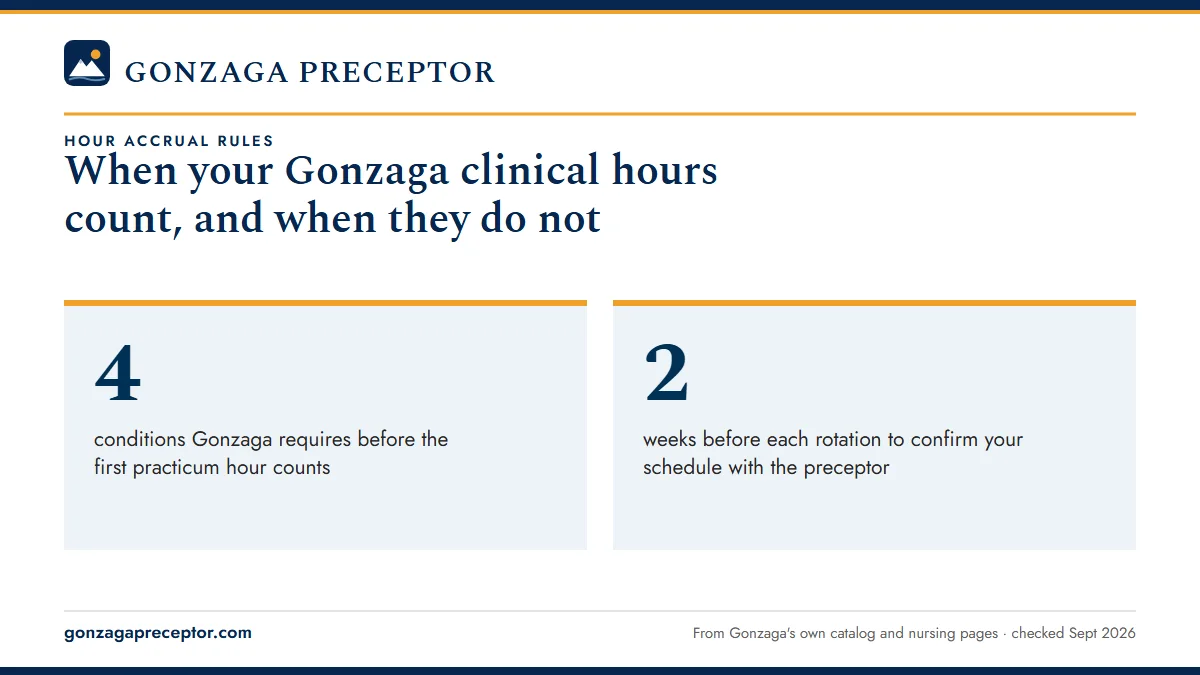
The four gates before hour one
Gonzaga's FNP Clinical Faculty Packet opens its "Accrual of Clinical Hours" section with this sentence: "Students may not begin to accrue clinical hours for a clinical rotation prior to the start date of the semester, are following CPNW, have site approval, and confirmation of an active affiliation agreement between Gonzaga University and the practicum site." Read plainly, it lists four gates, and all four must be open.
- The semester has started. A preceptor who is ready in August still waits for the fall start date.
- You are following CPNW, meaning your CPNW clearance is complete in every area CPNW requires.
- Your site is approved, through a site request that faculty have reviewed and signed off.
- An active affiliation agreement between Gonzaga and that site is confirmed, not merely requested.
Each gate belongs to a different part of the process, which is why the last one to open decides your real start date. An agreement still in legal review, or one missing immunization record, holds back the first hour even when the preceptor is eager to begin.
Hours happen inside the term, never between terms
The second rule is short: "Students may not accrue clinical hours during any University break or in between semesters." Practicum courses run the full semester on Gonzaga's online graduate calendar, so the countable windows for 2026-27 look like this.
| Term | Practicum window (full term) | Not countable |
|---|---|---|
| Fall 2026 | September 1 to December 18, 2026 | December 19 until spring opens on January 12 |
| Spring 2027 | January 12 to May 7, 2027 | May 8 until summer opens on May 17 |
| Summer 2027 | May 17 to August 6, 2027 (12-week term) | From August 7 until the fall 2027 term opens |
The calendar also shows gaps inside terms, such as the space between the spring A and B sessions. It does not say which of those pause practicum hours, so ask course faculty before you plan clinic days in them. The guide to the online graduate calendar lists the sessions in full.
Only with your approved preceptor, on their schedule
Hours count only when the provider supervising them is the preceptor faculty approved for that course, and Gonzaga allows no more than two approved preceptors in a semester; see two preceptors per semester. A covering colleague on a day your preceptor is out is not an approved preceptor, however qualified, unless faculty have approved them as well.
The packet adds that "The student must accomplish clinical hours at the availability of the preceptor." It also tells students not to ask preceptors to bend their schedules around personal or employment needs. Plan your job and family time around the clinic calendar rather than the reverse, and confirm the schedule with your preceptor about two weeks before each rotation, as the FNP and PMHNP guides ask.
What counts inside an hour, such as documentation and consult time for FNP students or the observation cap for PMHNP students, is covered in what counts as clinical hours.
The course end date, and what happens if you run short
Hours for a course cannot run past that course's end date. Gonzaga's packet leaves one door open: "an extension may be granted with course faculty approval." That is a request, not a right, and it goes best when you raise it early with a realistic plan for the hours left and a preceptor who has agreed to the extra dates.
When the gap is larger, Gonzaga's structure offers two more routes. The extension courses NURS 683P and NURS 683M can be repeated in semesters without a specialty didactic course, and the MSN lets you slow your progression plan as long as you finish within five years. The guide to practicum extension courses explains when each fits.
Course faculty also check that your logged hours align with the credits you registered for. Gonzaga's own figures work out to about 60 clock hours per practicum credit, so compare your plan with your registration before the term starts.
What is at stake when hours fall outside the rules
Gonzaga's packet is direct about the consequence. Hours done outside these rules, whether with an unapproved preceptor, without CPNW compliance or without an active agreement, "may result in dismissal from the program or the completed hours not counting," which can mean taking the course again. The packet adds that this "may create a delay in the progression plan."
Lost hours hurt twice. The time is gone, and a repeated course pushes every later practicum back a term. In a nine-semester program where the practicums fill the second half, one repeated course can move your finish date; our page on delayed graduation covers that situation.
The easiest hours to lose are the early ones: a clinic day before the semester opens, or before the agreement is confirmed, does not count however good the learning was.
Keeping every hour provable
An hour that counts still has to be documented. Under the older setup, Gonzaga students logged encounters in Typhon every week and entered each day's data on the day they saw patients. Gonzaga planned to move all students into CORE by spring 2026, so log in Typhon, or CORE if your cohort has moved. The guide to Typhon clinical logs covers the mechanics.
Faculty review those logs against your registered credits and for age and population coverage, and the preceptor's end-of-semester evaluation confirms you were there. Keep your own short record as well: date, start and end time, preceptor and site for every clinic day, matched to the approved schedule. If a question comes up about a date months later, that record answers it in minutes.
How we protect your first hour
The accrual rules reward a placement that is fully in place before the term begins. We start your search early enough that the preceptor is confirmed, the site request is complete, and the agreement question is with the Clinical Placement Team well ahead of the start date. We gather the preceptor's license, board certification, years in the clinical area and the site contact up front, so the request that reaches faculty is whole the first time.
We also build the schedule with your preceptor against the course's hour range and the term dates, so the hours fit inside the semester with room to spare for a missed day. The approval itself is Gonzaga's; our aim is that every gate is ready to swing open on the first day of the term. Send your course and start term through the form below.
Questions Gonzaga students ask
Can I do clinical hours over winter break at Gonzaga?
No. Gonzaga's rule bars accruing clinical hours during any university break or between semesters. On the 2026-27 online graduate calendar the fall term ends December 18 and spring begins January 12, so days in between count toward neither course. If your preceptor offers days in that gap, thank them and book the same number of days early in the new term.
Do extra hours from one course carry over to the next?
Gonzaga's published rules tie hours to a clinical rotation within a semester, bar hours between semesters, and have faculty check each course's log against its registered credits. Nothing public describes carrying surplus hours into the following course. Ask course faculty before you plan on it, and aim to finish each course's required hours inside its own term.
What if my affiliation agreement is still pending when the semester starts?
Then the hours wait. Gonzaga requires confirmation of an active affiliation agreement between the university and the practicum site before any hours accrue, so a pending agreement means a later start inside the term. Tell course faculty how many weeks remain and whether your preceptor can add clinic days later in the semester to reach the course's hours.
Do hours with a covering provider count if my preceptor is out sick?
Only if that provider is also an approved preceptor for your course. Gonzaga allows hours only with an approved preceptor and caps you at two per semester. If your preceptor is out for a day, reschedule the day rather than working with a stand-in. If the absence will be long, ask faculty about approving a second preceptor.
Does Gonzaga really dismiss students for breaking hour rules?
The FNP Clinical Faculty Packet says non-compliance may result in dismissal or in the hours not counting, which can mean retaking the course. How faculty apply that in any single case is not public; the Graduate Nursing Student Handbook and course faculty are the deciding sources. The sensible reading is to treat every rule as binding and log nothing until all four conditions are met.
Related pages
Last checked 2026-09-25
We check these pages against Gonzaga's catalog, FAQs, preceptor packets and Department of Nursing pages. Your course, the Graduate Nursing Student Handbook and Gonzaga's Clinical Placement Team have the final word.
Gonzaga asks you to find local preceptors first. Let us run that search.
Tell us your Gonzaga program, your practicum course and where you live and can travel. We find preceptors who fit the course and prepare the license, certification and site details your Practicum Site Placement Request needs, early in the semester before.
- Preceptors matched to the course: primary care across the lifespan for
NURS 661PtoNURS 664P, psychiatric care forNURS 661MtoNURS 663M, an agency liaison for the DNP - Credentials, license, board certification and site contact ready for your site request
- In Spokane, across Washington or wherever in the ten western states you are licensed
Start your placement plan
Your program, city and next practicum term is all we need to begin.