The three points of contact: your job in each Gonzaga practicum
Every Gonzaga NP practicum includes three conferences between you, your preceptor and your clinical faculty member: a short call at the start, the faculty site visit in the middle, and the preceptor evaluation at the end. Washington's nursing education rule requires them, and Gonzaga expects you, rather than faculty, to set each one up.
Get your placement plan
Tell us your Gonzaga program and where you live. A placement advisor replies with the preceptor and site options that fit your Gonzaga course.
The rule behind the three contacts
Gonzaga's FNP Clinical Faculty Packet ties the model to state law: "The Washington Administration Code (WAC) #246-840-533 states that nursing faculty, responsible for the overall supervision and evaluation of the student, must confer simultaneously with each primary preceptor, and student three times during the student learning experience: Beginning of semester. Mid semester. End of semester."
Gonzaga is a Washington program, and its packets apply the model to NP practicums in whichever of the ten western states you precept. The same Washington rule expects preceptors to be oriented in advance to the course objectives and to written role expectations, so the first contact is a natural moment to confirm your preceptor has the right course's objectives. For how the rule shapes precepting more broadly, see Washington's rules for NP preceptors.
WABON opened rulemaking on these education rules in December 2025, so the wording may change. Until it does, plan on all three contacts in each practicum course unless your syllabus says otherwise. Gonzaga's PMHNP pages, for instance, list no site visit in the extension course NURS 683M.
The three contacts at a glance
| Contact | When | Format | What happens |
|---|---|---|---|
| First (POC 1) | Start of the semester | A 5 to 10 minute phone or video call | You, your preceptor and clinical faculty review the goals you set for the semester |
| Second (POC 2) | Mid semester | The clinical faculty site visit, in person for FNP | You see at least 3 to 4 patients and are graded on the OSCE rubric |
| Third (POC 3) | End of the semester | A conference around the preceptor evaluation | Your preceptor completes the evaluation with you, and the feedback becomes next term's goals |
Course faculty spot check that all three took place, alongside the preceptor evaluations, your self-evaluation and the clinical site evaluation. A missing contact shows up in that review, so treat each one as a course requirement with a date, not a courtesy to fit in when convenient.
Point of contact one: your goals on the table
The first contact is short, but it sets the direction of the semester. Gonzaga's packet describes a call of five to ten minutes to "review student-set goals for the semester." Those goals are yours to write, and the preceptor guides ask you to bring them in writing, along with a CV or resume, before your first clinic day.
Good goals name the course, the populations you still need to see and the skills you are building. FNP students add the week-by-week objectives the FNP guide asks for. From your second practicum onward, last semester's end-of-term feedback belongs in the list, because Gonzaga's model feeds POC 3 comments into the next set of goals.
Aim to hold the call in the first week or two of the semester, once you know your clinical faculty assignment. Offer your preceptor two or three times that sit around their patient schedule, then send one calendar invitation to all three people with your goals attached.
Point of contact two: the site visit
The middle contact is the clinical faculty site visit. For FNP students, Gonzaga's packet grades it on the OSCE rubric, has you see three or four patients, and requires it in person. Students in Washington, Idaho, Oregon and Montana host the visit at their clinical site; students in the other six admission states complete it in Spokane on an added day beside an immersion.
PMHNP students coordinate an in-person or virtual visit, and the PMHNP packet lets faculty observe patient care through a telehealth system. Everything about preparing the site, the patients and the preceptor for that day is in the guide to faculty site visits.
Your coordinating load is heaviest here. The date has to suit the faculty member's travel, the preceptor's clinic and a patient schedule with enough visits for grading, so start proposing dates early in the term and hold a backup day.
Point of contact three: the evaluation conference
At the end of the semester, the packet says "the preceptor will complete the preceptor evaluation with the student," with faculty part of the conversation. The feedback becomes the starting point for your goals in the next practicum, which is why the three contacts work as a loop across your program rather than three unrelated meetings. Use the time well: ask which skills grew most and which need work in the next course, and write the answers down while they are fresh.
The evaluation form reaches the preceptor by email. Gonzaga moved evaluations for many practicum courses into CORE from Spring 2026, while other courses still use web forms; the guide to preceptor evaluations lists which courses use which. Let your preceptor know the email is coming so it does not sit unread in a busy inbox.
Coordinating all three: a working checklist
Gonzaga's packet is plain about who drives this: "Students are expected to take the leadership role in coordination of these visits." The PMHNP packet lists the same duty for psychiatric students. A student who proposes times, confirms them and follows up makes all three contacts easy for everyone to keep.
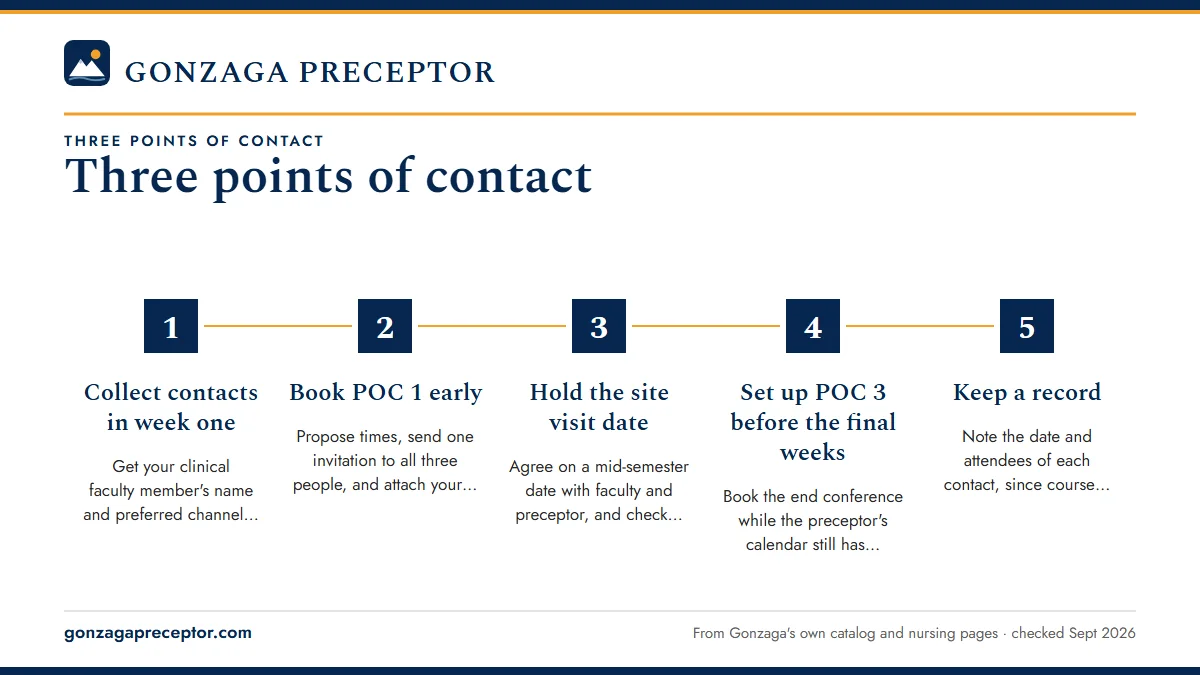
- Collect contacts in week oneGet your clinical faculty member's name and preferred channel from the course, and ask your preceptor for their best time for a short call.
- Book POC 1 earlyPropose times, send one invitation to all three people, and attach your written goals.
- Hold the site visit dateAgree on a mid-semester date with faculty and preceptor, and check the clinic can schedule suitable patients that day.
- Set up POC 3 before the final weeksBook the end conference while the preceptor's calendar still has room, and remind them the evaluation email will follow.
- Keep a recordNote the date and attendees of each contact, since course faculty spot check them.
Why students choose us: preceptors ready for all three
A provider who has never worked with Gonzaga may not expect a faculty call in week one, a graded visit mid-term and a conference at the end. When we match you, we explain the three points of contact to the preceptor before they agree, so the time involved is clear and the visit day holds no surprises.
We place Gonzaga students with preceptors in their own state who meet Gonzaga's rules, and we prepare the details faculty need for the site placement request: credentials, license, board certification, site contact, schedule and course fit. Gonzaga's faculty approve the placement and lead the contacts; our part is a preceptor who is ready for all three from the first conversation. Use the form below to start.
Questions Gonzaga students ask
What happens if a Gonzaga point of contact is missed?
Gonzaga's public documents do not set out a penalty for a missed contact, but course faculty spot check all three, and the contacts are how Gonzaga meets a Washington rule. If one slips, tell your clinical faculty member at once and reschedule inside the semester. Your syllabus and the Graduate Nursing Student Handbook set the consequences for your cohort.
Does my preceptor need to prepare anything for the first call?
Very little. The first call reviews the goals you set, so send your written goals and CV beforehand and ask your preceptor to skim them. It also helps if they have seen the course objectives on Gonzaga's Preceptor Portal, since Washington's rule expects preceptors to be oriented to the objectives before the experience begins.
Do I have three contacts with each preceptor if I have two?
The rule Gonzaga cites has faculty confer with each primary preceptor and the student three times. If both of your preceptors are primary, expect contacts with each; if one plays a smaller role, ask your clinical faculty member how they will handle it. Settle this at the start of the term so the site visit and end conference include the right people.
Do Gonzaga DNP students have three points of contact?
The Post-Master's DNP uses an agency liaison instead of a clinical preceptor, and Gonzaga's liaison checklist has the liaison accept being contacted at least three times over the semester and completing an end-of-course evaluation. The pattern suits indirect project hours. The agency liaison guide covers what the liaison agrees to.
Can the first point of contact happen by email?
Gonzaga's packet describes it as a phone or video call, and the Washington rule calls for faculty to confer with the preceptor and the student at the same time. An email thread does not fit that description. Five to ten minutes on a call with all three of you is enough, so look for a slot before clinic opens or between patients.
Related pages
Last checked 2026-09-25
We check these pages against Gonzaga's catalog, FAQs, preceptor packets and Department of Nursing pages. Your course, the Graduate Nursing Student Handbook and Gonzaga's Clinical Placement Team have the final word.
- Gonzaga University FNP Clinical Faculty Packet 2023-2024
- Gonzaga University PMHNP Preceptor Packet 2023-2024
- Washington State Board of Nursing: Nursing Education Rules (WAC 246-840-533)
- Gonzaga University Department of Nursing: Student Evaluations
- Gonzaga University Department of Nursing: FNP Preceptor Guide
Gonzaga asks you to find local preceptors first. Let us run that search.
Tell us your Gonzaga program, your practicum course and where you live and can travel. We find preceptors who fit the course and prepare the license, certification and site details your Practicum Site Placement Request needs, early in the semester before.
- Preceptors matched to the course: primary care across the lifespan for
NURS 661PtoNURS 664P, psychiatric care forNURS 661MtoNURS 663M, an agency liaison for the DNP - Credentials, license, board certification and site contact ready for your site request
- In Spokane, across Washington or wherever in the ten western states you are licensed
Start your placement plan
Your program, city and next practicum term is all we need to begin.