Preceptor evaluations at Gonzaga
At the end of every Gonzaga practicum, your preceptor completes an evaluation of you, and that form documents your presence in the clinical setting and joins your permanent record. From Spring 2026, most NP and DNP practicum evaluations arrive by email from CORE, while a few still run on Gonzaga's web forms. You owe a self-evaluation of your own as well.
Get your placement plan
Tell us your Gonzaga program and where you live. A placement advisor replies with the preceptor and site options that fit your Gonzaga course.
Why this one form matters
The FNP Preceptor Guide describes the evaluation in plain terms: "This form serves as documentation of the student's presence in the clinical setting and will be part of the student's permanent record." It is more than an input to a grade. It is Gonzaga's confirmation, from the person who supervised you, that the time in your log actually happened.
Course faculty review every preceptor evaluation together with student self-evaluations and clinical site evaluations, and they spot check the three points of contact. A missing evaluation leaves a hole in all of that, which is why the close of a semester deserves as much planning as the opening week.
The semester counts for your preceptor too. Gonzaga's Preceptor Portal lists a signed verification of precepting hours certificate, which preceptors can apply toward board or licensure recertification, along with adjunct faculty opportunities, DynaMed Plus access and recognition awards. Mentioning those when you ask for the evaluation is a courteous reminder of what the preceptor gains from the time they gave you.
How the request reaches your preceptor
Gonzaga's Student Evaluations page sets the current route: "Effective Spring 2026, all NURS 601, 661M, 662M, 663M, 661P, 662P, 663P, 760, 701, and 702 student evaluations will be completed through our new CORE eLMS platform." The request comes to the preceptor from CORE within two weeks of the practicum's completion.
Preceptors who have hosted Gonzaga students before may remember an older process, so tell yours at the first point of contact that the request will come from CORE, and ask them to watch filtered mail for it. If the email never arrives or a link fails, Gonzaga lists nursingpracticum@gonzaga.edu for evaluation questions. The CORE ELMS guide explains the platform itself.
Courses that still use web forms
Gonzaga's Preceptor Portal still posts web evaluation forms for courses and situations outside the CORE list. The forms named on the Student Evaluations page are:
- FNP Evaluation
- PMHNP Student Evaluation
- FNP Student Evaluation (under 20 hours)
- NURS 601 Evaluation
- DNP Project Student Evaluation
NURS 601 shows up both on the CORE list and as a web form, which reflects a platform in transition rather than two separate requirements. Your syllabus names the route for your course. If it is unclear, ask course faculty which one your preceptor should complete well before the final week, and share the answer with your preceptor. The Preceptor Portal page describes the rest of what Gonzaga publishes for preceptors.
The end-of-semester point of contact
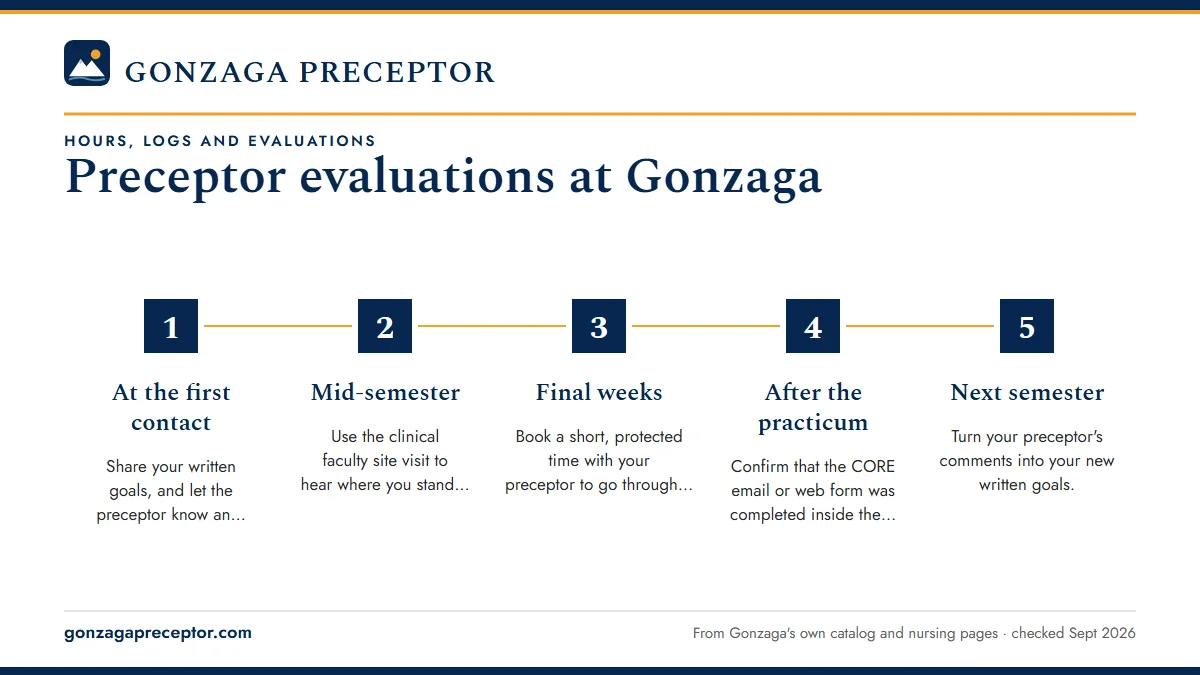
The evaluation is the third of Gonzaga's three points of contact. At the end of the term your preceptor completes it with you, and the feedback becomes the starting goals for your next semester. Gonzaga expects students to take the lead in coordinating all three contacts, so arranging this conversation falls to you.
- At the first contactShare your written goals, and let the preceptor know an evaluation will follow at term's end.
- Mid-semesterUse the clinical faculty site visit to hear where you stand before the final evaluation.
- Final weeksBook a short, protected time with your preceptor to go through the evaluation together.
- After the practicumConfirm that the CORE email or web form was completed inside the two-week window.
- Next semesterTurn your preceptor's comments into your new written goals.
Your side: self-evaluations and site evaluations
Evaluation at Gonzaga runs in both directions. Students complete self-evaluations, and course faculty also review clinical site evaluations. The PMHNP packet asks students to upload the self-evaluation with the completed clinical log into the course's Canvas drop box.
Write the self-evaluation against the goals you set at the first contact. Be specific about patient types, skills gained and gaps that remain, since next semester's goals grow from the same material. A self-evaluation that lines up with your preceptor's view reads as insight; one that contradicts it invites questions. For the log that travels with it, see the clinical logs page.
DNP agency liaisons evaluate too
In the Post-Master's DNP, the agency liaison fills the preceptor's role. On the DNP Agency Liaison Checklist, the liaison agrees to complete an end-of-course evaluation and acknowledges being contacted at least three times during the semester. Evaluations for NURS 760, NURS 701 and NURS 702 are on the CORE list, and the DNP Project Student Evaluation form remains on the web. The agency liaison guide covers the checklist.
Preceptors who are ready for the evaluation
An evaluation goes smoothly when the preceptor knew from day one what Gonzaga would ask. When we match you, we brief the preceptor on Gonzaga's expectations up front, including the three points of contact and the end-of-term evaluation, so the close of the semester holds no surprises.
We also prepare the preceptor's credentials, license and board certification for the Practicum Site Placement Request and keep the preceptor's contact details current, so faculty can reach them at every point of contact. If a preceptor leaves before the evaluation, your placement advisor starts on a replacement straight away, and the dropped preceptor guide explains the steps. Use the form below to begin.
Questions Gonzaga students ask
When does my Gonzaga preceptor get the evaluation email?
For courses on Gonzaga's CORE list, the request comes from CORE within two weeks after your practicum ends. Tell your preceptor to expect it and to check filtered folders. Courses outside the list may use Gonzaga's web evaluation forms instead, and your syllabus names the right one.
What if my preceptor never completes the evaluation?
The evaluation documents that you were in the clinical setting, and course faculty review every one, so a missing form is a real gap. Follow up with your preceptor promptly and politely, then contact course faculty or the evaluation inbox on Gonzaga's Student Evaluations page for help.
Who reviews Gonzaga preceptor evaluations?
Course faculty. Gonzaga's FNP faculty packet lists reviewing all preceptor evaluations, student self-evaluations and clinical site evaluations among course faculty duties, along with spot checks of the three points of contact. The preceptor's form also becomes part of your permanent record.
Do Gonzaga NP students complete a self-evaluation?
Yes. Course faculty review student self-evaluations alongside the preceptor's form. PMHNP students upload theirs with the completed clinical log to the course's Canvas drop box. Write it against the goals set at your first point of contact, since the feedback shapes next semester's goals.
Does a DNP agency liaison fill out an evaluation?
Yes. On Gonzaga's DNP Agency Liaison Checklist, the liaison agrees to complete an end-of-course evaluation and to be contacted at least three times in the semester. Evaluations for NURS 760, NURS 701 and NURS 702 run through CORE from Spring 2026.
Related pages
Last checked 2026-09-25
We check these pages against Gonzaga's catalog, FAQs, preceptor packets and Department of Nursing pages. Your course, the Graduate Nursing Student Handbook and Gonzaga's Clinical Placement Team have the final word.
Gonzaga asks you to find local preceptors first. Let us run that search.
Tell us your Gonzaga program, your practicum course and where you live and can travel. We find preceptors who fit the course and prepare the license, certification and site details your Practicum Site Placement Request needs, early in the semester before.
- Preceptors matched to the course: primary care across the lifespan for
NURS 661PtoNURS 664P, psychiatric care forNURS 661MtoNURS 663M, an agency liaison for the DNP - Credentials, license, board certification and site contact ready for your site request
- In Spokane, across Washington or wherever in the ten western states you are licensed
Start your placement plan
Your program, city and next practicum term is all we need to begin.