CORE ELMS at Gonzaga nursing
CORE ELMS is the clinical platform Gonzaga's Department of Nursing chose to replace several older tools, Typhon and CastleBranch among them. Gonzaga planned to have every student in CORE by spring 2026, with CPNW kept alongside it, and moved preceptor evaluations for most NP and DNP practicums into CORE that same spring.
Get your placement plan
Tell us your Gonzaga program and where you live. A placement advisor replies with the preceptor and site options that fit your Gonzaga course.
What CORE is and why Gonzaga adopted it
CORE is made by CORE Higher Education Group, and Gonzaga's pages call it CORE eLMS or CORE ELMS. Gonzaga's IT story of November 15, 2024 presents it as the replacement for multiple tools used "for compliance documents, onboarding, student case logs, time logs, and clinical site management."
The aim was consolidation. By Gonzaga's account, the department had been working across five or six platforms and would come down to two, CORE and CPNW. For students, that means one home for most clinical paperwork in place of separate systems for compliance, logging and site details, and one place to look when a site asks what you have on file.
What moves into CORE
| What it covers | Where it lived before | Status in CORE |
|---|---|---|
| Compliance documents: immunizations, background check, drug screen, BLS | CastleBranch | Moving to CORE under the 2024 plan |
| Clinical case logs and time logs | Typhon | Moving to CORE |
| Onboarding and clinical site management | Several separate tools | Moving to CORE |
| Affiliation agreement details | SharePoint, used internally | Planned, so students can see placement requirements |
| Preceptor evaluations for listed courses | Web forms | In CORE from Spring 2026 |
| Regional clinical clearance | CPNW | Stays in CPNW |
The agreement piece may help students most. Gonzaga said bringing agreement records into CORE would let students see key details about their placements, such as required vaccinations and certifications, instead of learning them from the site late in onboarding.
The transition timeline
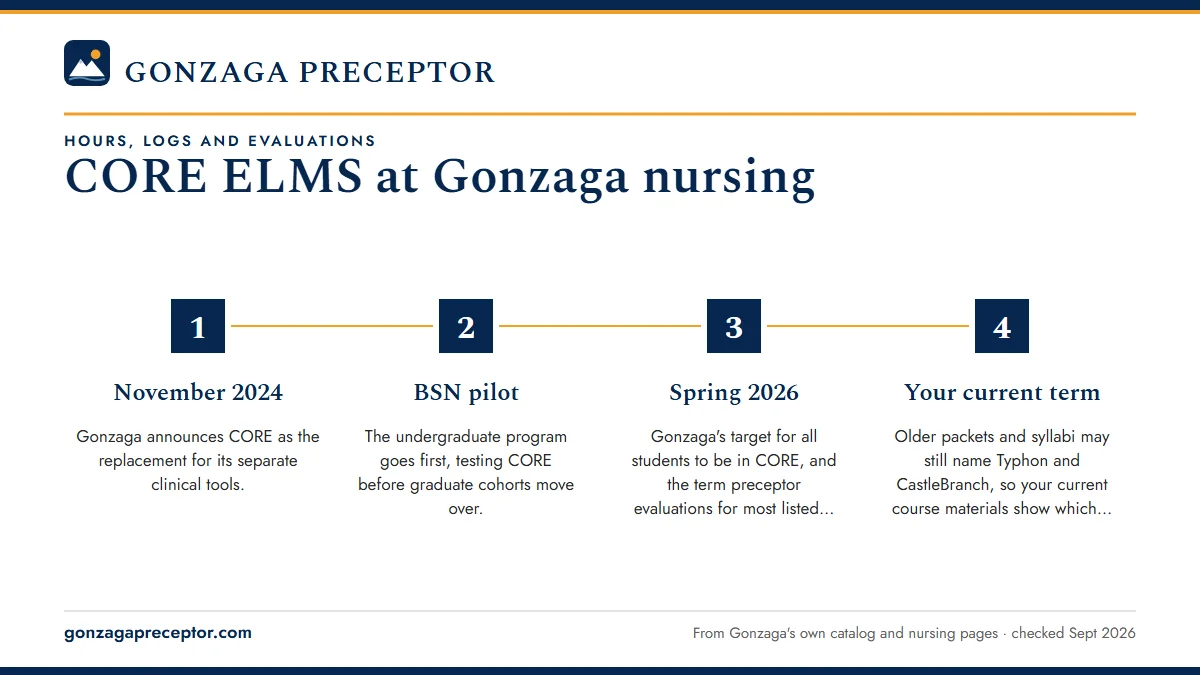
- November 2024Gonzaga announces CORE as the replacement for its separate clinical tools.
- BSN pilotThe undergraduate program goes first, testing CORE before graduate cohorts move over.
- Spring 2026Gonzaga's target for all students to be in CORE, and the term preceptor evaluations for most listed practicums shift to CORE.
- Your current termOlder packets and syllabi may still name Typhon and CastleBranch, so your current course materials show which system your cohort uses.
Gonzaga's public pages describe a plan and a target date, not a confirmed cutover for every cohort. Until your course says otherwise, the working rule is Typhon, or CORE if your cohort has moved. The Typhon logging guide covers the older system for students still on it.
If you are mid-program, watch for a course that straddles the change: a log begun in one system and finished in another, or a compliance item uploaded to CastleBranch and requested again in CORE. Raise either with course faculty or the Clinical Placement Team early, while there is time to sort it out before hours are due.
CORE plus CPNW
CORE sits beside CPNW rather than replacing it. Clinical Placements Northwest is the regional clearance used by health systems across Washington and northern Idaho, and Gonzaga's faculty packet makes CPNW compliance a condition before any clinical hour counts. CPNW's own list of participating programs includes Gonzaga's BSN and MSN.
In practice you keep two sets of records current: your Gonzaga-side documents and logs in CORE, and your CPNW clearance for the sites that rely on it. Some health systems also run onboarding of their own on top of both. The CPNW guide and the CastleBranch page cover the compliance side in detail.
Evaluations through CORE
Gonzaga's Student Evaluations page moves preceptor evaluations into CORE from Spring 2026 for NURS 601, the three PMHNP practicums, NURS 661P through NURS 663P, and the DNP courses NURS 760, NURS 701 and NURS 702. Preceptors receive the request by email from CORE within two weeks after the practicum ends.
Some practicums, NURS 664P among them, are not named on that list, and Gonzaga still posts web evaluation forms for FNP, PMHNP, NURS 601 and DNP project evaluations. Your syllabus says which route your course uses, and the preceptor evaluations page explains both.
Getting ready for a CORE semester
- Check your syllabus and Canvas course for the platform your cohort uses before the term begins
- Keep your own copies of immunization records, your BLS card, and background check and drug screen results, since records move between systems
- Let your preceptor know early, ideally in your first week, that CORE will email the end-of-term evaluation
- Log encounters on the day you see patients, whichever system holds the log
- Send evaluation questions to nursingpracticum@gonzaga.edu, the inbox Gonzaga lists for them
None of this changes who approves what. Course faculty still review and approve your site request, the Clinical Placement Team still handles the agreement and legal paperwork, and your preceptor still has to meet Gonzaga's requirements. CORE changes where the records live, which is why a complete, accurate request at the start saves time at every later step. The placement process page walks through the whole path.
Why students choose us alongside CORE
CORE organizes Gonzaga's records once a placement exists. The step before that, finding local providers willing to precept, is where Gonzaga asks students to start, and it is where we do our best work. We search for a preceptor and site in your licensed state that fit your Gonzaga course, and we put together the full file for your Practicum Site Placement Request: the preceptor's CV, license and certification, the name of the site's agreement contact, and a schedule sized to your hours.
With all of it ready early, faculty can review and approve your site while there is still time to complete the agreement, CPNW clearance and CORE onboarding before the semester opens. Share your program and state with the form below.
Questions Gonzaga students ask
What is CORE ELMS at Gonzaga?
It is the clinical education platform, from CORE Higher Education Group, that Gonzaga's Department of Nursing adopted to replace several older tools. It holds compliance documents, onboarding, case and time logs and clinical site details, and from Spring 2026 it carries preceptor evaluations for most listed NP and DNP practicum courses.
Does CORE replace CastleBranch for Gonzaga nursing students?
That is Gonzaga's stated plan. The 2024 announcement named CastleBranch among the tools CORE replaces for compliance documents. Students who started earlier may still see CastleBranch in packets or syllabi, so check your current course materials, and keep your CPNW clearance current either way.
Do I still need CPNW if Gonzaga uses CORE?
Yes. Gonzaga's plan keeps two platforms, CORE and CPNW. CPNW is the regional clearance many Washington and northern Idaho health systems use, and Gonzaga's faculty packet requires CPNW compliance before any clinical hour counts toward your total.
When did Gonzaga switch to CORE?
Gonzaga announced the move in November 2024, piloted CORE with BSN students first, and set spring 2026 as the target for all students. Preceptor evaluations for most listed practicums moved to CORE in Spring 2026. Your syllabus confirms whether your cohort logs in CORE or in Typhon.
How does my preceptor use CORE?
Gonzaga's Student Evaluations page says the evaluation request reaches preceptors by email from CORE within two weeks after the practicum ends. A quick heads-up from you means the message is watched for, and the evaluation that documents your hours gets completed on time.
Related pages
Last checked 2026-09-25
We check these pages against Gonzaga's catalog, FAQs, preceptor packets and Department of Nursing pages. Your course, the Graduate Nursing Student Handbook and Gonzaga's Clinical Placement Team have the final word.
Gonzaga asks you to find local preceptors first. Let us run that search.
Tell us your Gonzaga program, your practicum course and where you live and can travel. We find preceptors who fit the course and prepare the license, certification and site details your Practicum Site Placement Request needs, early in the semester before.
- Preceptors matched to the course: primary care across the lifespan for
NURS 661PtoNURS 664P, psychiatric care forNURS 661MtoNURS 663M, an agency liaison for the DNP - Credentials, license, board certification and site contact ready for your site request
- In Spokane, across Washington or wherever in the ten western states you are licensed
Start your placement plan
Your program, city and next practicum term is all we need to begin.