Gonzaga's FNP practicum courses, course by course
Gonzaga's FNP specialty sequence pairs four didactic courses with four practicums (NURS 661P to NURS 664P), with NURS 683P held in reserve if you need more time. Together the practicums carry 10 credits and 600 hours in primary care with patients across the lifespan, and Gonzaga's own documents give slightly different hour ranges for each course.
Get your placement plan
Tell us your Gonzaga program and where you live. A placement advisor replies with the preceptor and site options that fit your Gonzaga course.
Four pairs and an extension
Each FNP practicum is a corequisite of a 3-credit didactic course, so the classroom and clinical halves of a topic share a term. The pairs are Gender-Based primary care (NURS 651P with NURS 661P), infant, child and adolescent care (NURS 652P with NURS 662P), and two adult and gerontology courses (NURS 653P with NURS 663P, then NURS 654P with NURS 664P).
Gonzaga's course list puts the pediatric pair first, and NURS 662P is the first specialty practicum in the FNP plan, landing in the same year as health assessment. Prerequisites stack at a minimum grade of C: NURS 663P, for example, needs NURS 600, NURS 601, NURS 651P and NURS 661P first. Your progression plan fixes the actual terms, and NURS 683P follows the last adult pair for anyone still short of hours.
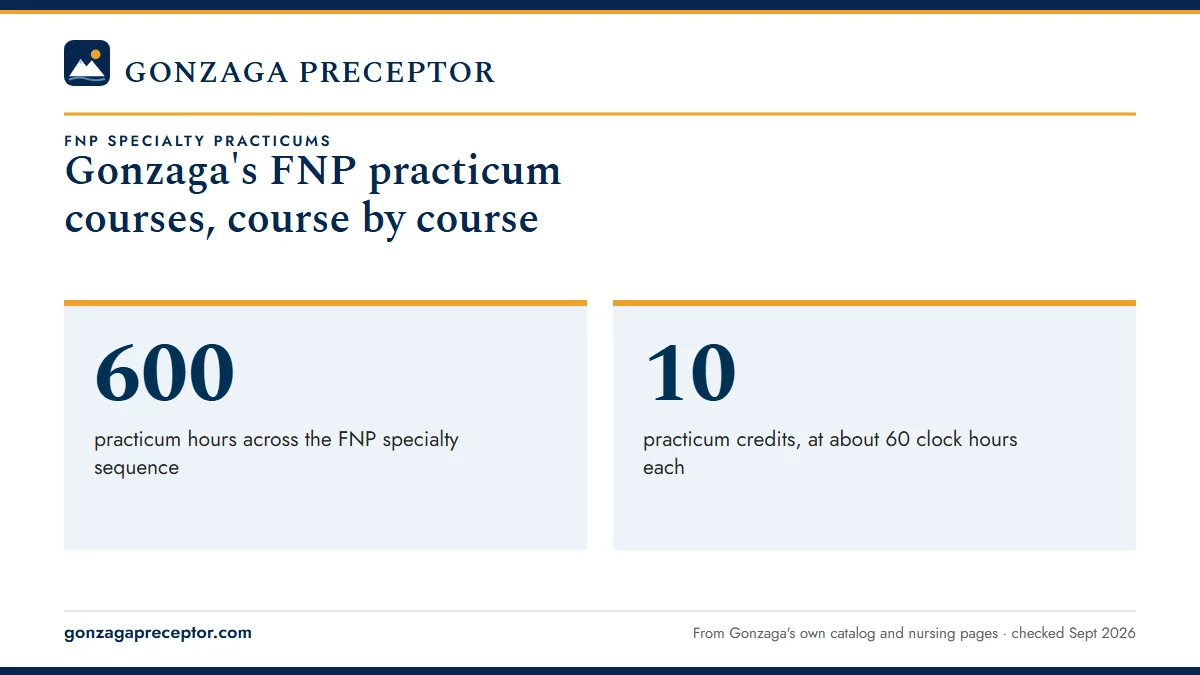
The practicum credits across the sequence total 10, which Gonzaga converts at 60 clock hours per credit into 600 hours. Add the 60 hours of NURS 601 and you reach the 660 on Gonzaga's 2026 FNP page.
Hours by course, and where the sources differ
Gonzaga publishes FNP practicum hours in three places that do not always agree: the 2025-26 catalog sets floors, the 2026 program page gives ranges, and the 2023-24 FNP clinical faculty packet carries its own summary grid.
| Course | Credits | Catalog | 2026 FNP page | Notes |
|---|---|---|---|---|
NURS 662P Infant, Child, Adolescence | 2-3 | 120 | 120-180 | Packet course list 120-180; packet grid 60-180 |
NURS 661P Gender-Based | 1-3 | 60-180 | 60-180 | Packet grid 120-180 |
NURS 663P Adult/Gerontology I | 3-4 | At least 180 | 180-240 | Highest floor in the sequence |
NURS 664P Adult/Gerontology II | 2-4 | At least 120 | 120-240 | Primary care and other settings |
NURS 683P Extension | 1, repeatable | Variable | Variable | After NURS 654P and NURS 664P |
The web ranges track the credit ranges at 60 hours per credit, and course faculty compare your logged total with your registered credits, so registration effectively sets your target. When sources conflict, your syllabus and course faculty decide.
Gonzaga's FNP preceptor guide frames rotations as 60 to 240 hours a semester, scheduled by preceptor and student before the term begins, and the faculty packet says students negotiate the number with preceptors based on course requirements and availability. What earns credit as an hour is covered in what counts as clinical hours.
Primary care, and every age group
Primary care is the setting for every FNP practicum. The last adult course and the extension, NURS 664P and NURS 683P, widen that to primary care and other settings, which helps when a final block needs somewhere a little different. Each practicum still has to be an approved clinical setting.
Lifespan coverage is the rule that shapes preceptor choice most. For the pediatric practicum the packet is blunt: the student must see patients in every age group, from infants to adolescents. Course faculty also audit logs for hours against registered credits and for coverage across ages and population foci, so a panel that leans heavily toward one age band can leave a gap to fill in a later term. Logs go in Typhon, or CORE if your cohort has moved; see Typhon clinical logs.
One more course appears only in the catalog: NURS 671 Care of Frail Elder, taken with NURS 683P, whose clinical work happens in internal medicine or long-term care. It sits outside the required FNP list, so check with your faculty advisor before planning around it.
Preceptors across the sequence
Gonzaga's catalog accepts an NP, a physician or a PA for each FNP practicum, except in states that insist on an MD or NP preceptor. A second rule sits on top: nurse practitioners must supervise 50% or more of your FNP hours, so a term spent mostly with a physician needs balancing elsewhere. The NP hours rule page shows how to plan that mix.
Each semester also allows at most two approved preceptors, and hours with anyone outside that approved list do not count; the two-preceptor limit page covers what to do when one leaves. A family practice preceptor who sees children, women and older adults may suit more than one course, while a pediatric office may fit NURS 662P alone. Faculty look over every site request and make the final call.
Immersions and site visits in each term
Each FNP didactic course brings one 3-day immersion in Spokane, so the four specialty terms add four campus trips to the two from NURS 600. Check immersion dates before you commit a preceptor schedule; the Spokane immersions page covers timing and travel.
Every practicum course also includes a clinical faculty site visit. Students living in Washington, Idaho, Oregon or Montana have at least one at their own clinical site, graded on an OSCE rubric while they see several patients. Students in the other six western states travel to Spokane for an extra campus day attached to an immersion instead. For the in-region version, tell your preceptor early that a faculty member will join a clinic day, since you coordinate the visit and need several patients booked for it. The faculty site visits guide explains how each version runs.
When hours run short: NURS 683P
NURS 683P, the Primary Care Practicum Extension, is a 1-credit course with variable hours that can be repeated. It is meant for terms when you are not in an FNP specialty didactic course, which makes it the standard route to finish hours after NURS 654P and NURS 664P when a preceptor fell through or a term came up short.
Hours stop at the course end date unless course faculty grant an extension, and an extension term needs the same approvals as any other: an approved preceptor and site, an active affiliation agreement and CPNW clearance. Because the MSN has no cohort model, a term in NURS 683P simply extends your progression plan; the program still has to be finished inside Gonzaga's five-year limit.
Why FNP students choose us
Four practicums in four terms means four chances for a search to stall. We plan the whole FNP sequence with you rather than one course at a time: a preceptor mix that keeps nurse practitioner hours above half, a site with a real pediatric panel for NURS 662P, and adult and older-adult caseloads for NURS 663P and NURS 664P, all in your own state.
Each course gets its own request package: the preceptor's license and certification records, the person at the site who handles agreements, clinic dates sized to that course's hour range, and a short explanation of fit. If a preceptor leaves mid-sequence, your placement advisor starts on the replacement right away. The approval decision is Gonzaga's; the package we hand you leaves faculty nothing to chase.
Questions Gonzaga students ask
How many hours is NURS 663P at Gonzaga?
The catalog sets a floor of 180 hours for Adult/Gerontology Practicum I, and the 2026 FNP page gives 180 to 240. The course carries 3 to 4 credits, and at Gonzaga's 60 hours per credit the two ranges match. Your syllabus and registered credits settle the exact number for your term.
Do I need a pediatric office for NURS 662P?
Not necessarily. The course needs primary care patients in every age group from infancy through adolescence, which a family practice with a strong pediatric panel may cover as well as a pediatric clinic. What matters is that your logs show each age group and that faculty approve the site and preceptor through your placement request.
Can a physician assistant precept Gonzaga FNP practicums?
Yes, except where state rules demand an MD or NP. The catalog names NPs, physicians and PAs as eligible for every FNP practicum. Keep Gonzaga's other rule in view: NPs have to supervise no less than half of all FNP hours, so time with a PA needs balancing across the sequence.
What is NURS 683P?
It is Gonzaga's Primary Care Practicum Extension: one credit, variable hours, repeatable, taken in terms without an FNP specialty didactic course. Students use it to finish practicum hours after the adult and gerontology pair. It needs the same approved preceptor, site, affiliation agreement and CPNW clearance as any other practicum.
Can I use two preceptors in one FNP practicum?
Yes, as long as the total stays at two approved preceptors for the term. Gonzaga caps it there, and hours with anyone outside your approved list do not count. A second preceptor can help with age coverage or the nurse practitioner share, but each one needs faculty approval before you start logging hours.
Related pages
Last checked 2026-09-25
We check these pages against Gonzaga's catalog, FAQs, preceptor packets and Department of Nursing pages. Your course, the Graduate Nursing Student Handbook and Gonzaga's Clinical Placement Team have the final word.
Gonzaga asks you to find local preceptors first. Let us run that search.
Tell us your Gonzaga program, your practicum course and where you live and can travel. We find preceptors who fit the course and prepare the license, certification and site details your Practicum Site Placement Request needs, early in the semester before.
- Preceptors matched to the course: primary care across the lifespan for
NURS 661PtoNURS 664P, psychiatric care forNURS 661MtoNURS 663M, an agency liaison for the DNP - Credentials, license, board certification and site contact ready for your site request
- In Spokane, across Washington or wherever in the ten western states you are licensed
Start your placement plan
Your program, city and next practicum term is all we need to begin.