Affiliation agreements: the contract behind every Gonzaga practicum
An affiliation agreement is the contract between Gonzaga and a clinical site that lets a student train there. Gonzaga holds agreements with many facilities and providers across the western U.S., and no practicum hour counts until one is active for your site. If your preceptor works somewhere new to Gonzaga, the agreement is often the longest step in the whole placement.
Get your placement plan
Tell us your Gonzaga program and where you live. A placement advisor replies with the preceptor and site options that fit your Gonzaga course.
What the agreement is, and who handles it
Gonzaga's graduate FAQ states the scale directly: "The Department of Nursing maintains affiliation agreements with many facilities and providers across the western U.S. to support practicum learning experiences." Each one is an institution-to-institution contract. It is separate from your preceptor's personal willingness to teach you, and separate from faculty approval of the site.
The Clinical Placement Team processes the contract and legal paperwork that clears students for placement, so you are not the one negotiating terms. Your part is giving the team the right contact at the site and flagging early that a new agreement may be needed. Gonzaga's 2024 news story on its move to CORE noted that agreements were stored on SharePoint and that bringing them into CORE would let students see key placement details, such as required vaccinations and certifications.
No active agreement, no hours
Gonzaga's rule leaves no gap. The PMHNP packet has the agreement completed before any practicum experience begins, and the FNP clinical faculty packet makes confirmation of an active agreement between Gonzaga and the practicum site one of the conditions for accruing hours, alongside the semester start, CPNW and site approval.
The word active carries weight. A contract signed years ago may have lapsed or be waiting on renewal, and hours logged in that window face the same risk as hours at an unapproved site: they may not count, and Gonzaga's packet warns that breaking the accrual rules can lead to dismissal. The hour accrual rules cover the other conditions.
Ask for confirmation that the agreement is active for your practicum dates, not just that one was signed at some point.
Existing sites versus new sites
If Gonzaga already has an active agreement with your site, the contract step may amount to a confirmation, and the placement moves on to compliance and scheduling. Ask the Clinical Placement Team early whether your site is covered before assuming either way.
A site new to Gonzaga needs an agreement drafted, reviewed by both sides and signed. Gonzaga does not publish how long that takes, and the answer depends on the site's legal review and how quickly each side responds. Providence Oregon, for example, tells schools that a new affiliation agreement "can take several weeks."
Your workplace counts as a site too. Precepting where you are employed still needs an active agreement, along with faculty approval and the conditions in the workplace practicum rules.
How to help a new agreement move faster
You cannot sign the contract, but you control most of the information it waits on. When your preceptor's site is new to Gonzaga, do these as soon as the preceptor agrees.
- Get the name and email of the person who handles student or education contracts at the site, not only your preceptor's details.
- Ask whether the site works from its own agreement template or reviews the school's, and pass that answer to the Clinical Placement Team.
- Give the team your practicum course and dates, so the agreement is in force for the whole semester.
- Ask what the site requires after the contract: CPNW clearance, a system portal, or a background check to a state standard, as OHSU requires for Oregon.
- Keep your preceptor updated while the contract is in progress, so they hold your spot for the term.
Why health systems require the agreement first
Health systems across the Northwest put the school contract ahead of any rotation, and their own student pages say so.
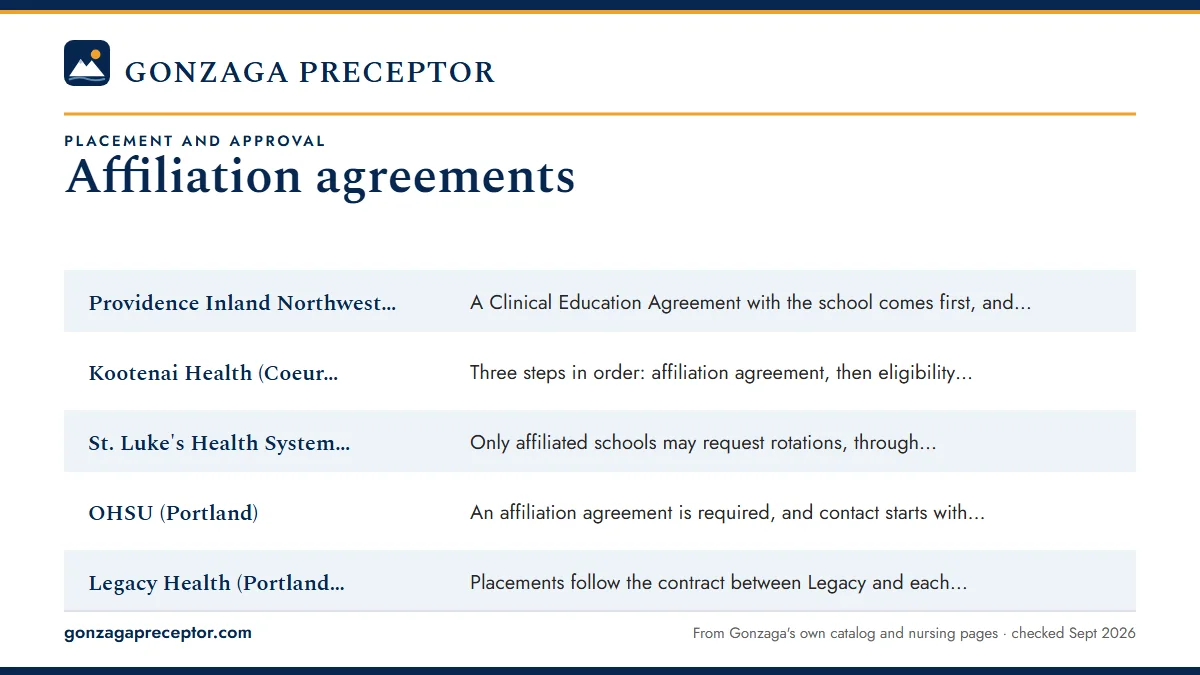
| System | What its student page says |
|---|---|
| Providence Inland Northwest (Spokane) | A Clinical Education Agreement with the school comes first, and all rotations are arranged through the Professional Development Coordinator |
| Kootenai Health (Coeur d'Alene) | Three steps in order: affiliation agreement, then eligibility, then placement |
| St. Luke's Health System (Boise) | Only affiliated schools may request rotations, through myClinicalExchange; NP students apply first |
| OHSU (Portland) | An affiliation agreement is required, and contact starts with its Clinical Placement Coordinator |
| Legacy Health (Portland, Vancouver) | Placements follow the contract between Legacy and each educational program |
| Kaiser Permanente Washington | Schools with an active agreement submit placement requests on an annual cycle |
| VA Spokane | Training requires an academic affiliation with the VA |
The pattern holds across the region: a clinician's willingness to precept is half the answer, and the contract between Gonzaga and the system is the other half. Many systems then add onboarding of their own, often through CPNW in Washington and northern Idaho.
State rules that ask for the contract too
Some of the ten western states write the school-site contract into their rules for visiting students. Wyoming asks post-licensure programs to sign a written contract with the clinical facility before clinicals start and to notify the Board in writing for each student. Alaska's APRN preceptorship registration, which each student precepting there files individually, asks for a copy of the agreement among the school, facility, student and preceptor.
California's rule for out-of-state NP programs requires a written agreement among the agency, preceptor and program that spells out the preceptor's role. Gonzaga appears on the California Board of Registered Nursing's list of out-of-state NP programs for its family and psychiatric-mental health tracks; see California BRN approval. Your state guide links each board's own rules.
Why Gonzaga students choose us for this step
Agreements move at the speed of the information behind them. When our placement desk secures a preceptor, we also find out who handles student contracts at that site, whether Gonzaga already has an active agreement there, and what the site's own onboarding requires, then hand you those details ready for the Clinical Placement Team.
Wherever possible we steer toward sites where the path is already clear, and when a new site is the right fit, we surface it early enough for the contract work to finish before your semester. Gonzaga's team handles the agreement itself; we make sure it starts on time with the right people at the table. Tell us your course, dates and state through the form below to get started.
Questions Gonzaga students ask
How do I find out whether my site has an agreement with Gonzaga?
Ask the Clinical Placement Team, which processes Gonzaga's contracts, and ask the site's education or student placement office. Gonzaga planned to bring agreement details into CORE so students could see placement requirements there, so check CORE too if your cohort has moved. Either way, confirm the agreement is active for your practicum dates.
How long does a new affiliation agreement take?
Gonzaga does not publish a timeline. The length depends on the site's legal review and how fast both sides trade drafts, and a large system usually runs a formal contract process of its own. Flag a new site to the Clinical Placement Team as soon as your preceptor agrees, well before the semester starts.
Does a small private practice need an agreement too?
Yes. Gonzaga's accrual rule calls for an active agreement between Gonzaga and the practicum site, with no exception for size. A solo practitioner's office needs one just as a hospital system does, which is why naming the practice's decision-maker early speeds things along.
Who signs the affiliation agreement?
The contract is between Gonzaga University and the clinical site, and Gonzaga's Clinical Placement Team handles the contract and legal documentation on the university's side. At the site, the signer is often an administrator or education office rather than your preceptor, so ask your preceptor who manages student contracts there.
If I change sites mid-program, does my old agreement carry over?
No. Agreements run site by site, so a practicum at a different site needs its own active agreement, faculty approval of the new preceptor and any onboarding that site requires, even if your previous site was fully cleared. Start the new site's paperwork as soon as you know you are moving.
Related pages
Last checked 2026-09-25
We check these pages against Gonzaga's catalog, FAQs, preceptor packets and Department of Nursing pages. Your course, the Graduate Nursing Student Handbook and Gonzaga's Clinical Placement Team have the final word.
- Gonzaga University, Online MSN FAQs
- Gonzaga University Department of Nursing, FNP Clinical Faculty Packet 2023-2024
- Gonzaga University Department of Nursing, PMHNP Preceptor Packet 2023-2024
- Gonzaga University, Gonzaga Nursing Streamlines Clinical Placement with CORE
- Kootenai Health, Health Care Student Placement
Gonzaga asks you to find local preceptors first. Let us run that search.
Tell us your Gonzaga program, your practicum course and where you live and can travel. We find preceptors who fit the course and prepare the license, certification and site details your Practicum Site Placement Request needs, early in the semester before.
- Preceptors matched to the course: primary care across the lifespan for
NURS 661PtoNURS 664P, psychiatric care forNURS 661MtoNURS 663M, an agency liaison for the DNP - Credentials, license, board certification and site contact ready for your site request
- In Spokane, across Washington or wherever in the ten western states you are licensed
Start your placement plan
Your program, city and next practicum term is all we need to begin.