Immunizations, TB, BLS and health records for Gonzaga practicums
Before a Gonzaga practicum starts, your health file has two readers: Gonzaga's compliance review and the clinical site. Gonzaga's published list covers hepatitis B, TB screening, MMR, varicella, Tdap, the yearly flu vaccine and a BLS card. Individual sites can add more, such as Idaho fingerprinting before work on a behavioral health unit.
Get your placement plan
Tell us your Gonzaga program and where you live. A placement advisor replies with the preceptor and site options that fit your Gonzaga course.
Gonzaga's published immunization list
Gonzaga posts one immunization checklist publicly, on the CastleBranch Compliance page of its NP Clinical Faculty Portal. It was written for clinical faculty, but it is the clearest public picture of what Gonzaga expects a clinical health file to hold. Students receive their own binding list in the Graduate Nursing Student Handbook.
| Item | What the checklist accepts | How often |
|---|---|---|
| Hepatitis B | The series or a titer, with at least 2 doses before practicum; a declination waiver is allowed | Until the series is complete |
| Tuberculosis | A two-step skin test or a QuantiFERON within 12 months; a chest x-ray if the result is positive | Every 12 months |
| MMR | Two doses | Once |
| Varicella | Two doses or a titer | Once |
| Tdap | A Tdap dose, then a Td booster every 10 years | Every 10 years |
| Influenza | The seasonal flu vaccine | Every year |
| BLS | An AHA BLS provider card or a Military Training Network card | Before the card expires |
The same page covers the background check, the 10-panel drug screen and the consent form, which the CastleBranch guide explains.
Reading the list as a student
A few lines on the checklist are more flexible than they first look. The hepatitis B line needs only two doses in place before practicum, so you can start clinicals partway through the series. The TB line accepts either a two-step skin test or a QuantiFERON, and a positive result leads to a chest x-ray rather than ending the conversation. The varicella line accepts a titer, which helps anyone without a vaccine record.
Other lines are strict. The BLS card has to come from the American Heart Association provider course or the Military Training Network equivalent, and the TB result has a fixed window. Because the page was written for faculty and dates from the CastleBranch setup, confirm each item against the handbook and your syllabus. Where the handbook differs, the handbook wins.
The TB result has a 12-month window. Test too early and it can expire in the middle of a rotation, so time it against the semester you are entering.
Extras individual sites add
Gonzaga's list is the baseline. Health systems add their own items, and a few of them change your timeline more than any vaccine does.
- Kootenai Health, Coeur d'Alene: immunizations, a background check, a flu shot, an AHA BLS card, Idaho licensure if your program requires it, and Idaho Health and Welfare fingerprinting for its behavioral health units.
- Providence Inland Northwest: an onboarding packet at least four weeks before the start date, and the Providence Clinical Passport forms at least two weeks before.
- Kaiser Permanente Washington: confidentiality agreements signed by students and faculty at least one week before starting.
- CPNW member sites: compliance in every area CPNW requires, which Gonzaga's packet makes a condition for counting hours. The CPNW guide explains it.
Gonzaga's IT story on CORE says that moving affiliation agreements into CORE would let students see key placement details, including required vaccinations and certifications. Until that view shows for your site, ask the site contact or the Clinical Placement Team what the site adds.
PMHNP students and behavioral health units
Idaho's fingerprinting step matters most to psychiatric students. Kootenai Health requires Idaho Health and Welfare fingerprinting before a student works on its behavioral health units, which is where a NURS 662M or NURS 663M rotation might sit for a PMHNP student in North Idaho. Fingerprinting is a separate appointment with its own processing, so book it when the site is first named rather than after approval. If you already work on a behavioral health unit, note that Gonzaga's PMHNP packet keeps practicum hours out of your own RN practice setting, although another part of the organization can qualify.
Across the border, Washington's two state psychiatric hospitals, Eastern State in Medical Lake and Western State, are CPNW partners, so CPNW requirements apply there as well. The PMHNP practicum courses guide covers which populations each course expects, and the Idaho guide covers practice in that state.
Other health records Gonzaga asks about
Beyond vaccines, the published checklist includes a signed Consent to Release Information form. Gonzaga's BSN program page, citing the Washington State Board of Nursing, adds that a student who has been injured or ill may need a medical release before returning to clinical work, and that no student may attend clinical while impaired. BSN students also meet the department's Essential Functional Abilities.
The graduate handbook is not public, but the same logic is worth applying to your own file: your clinical record shows you are fit to see patients now. If an injury, illness or leave falls between rotations, raise it with course faculty before your next practicum starts rather than on the first day back. Keep a copy of any release letter with the rest of your file, so the next site sees a complete record.
A records timeline that fits the semester
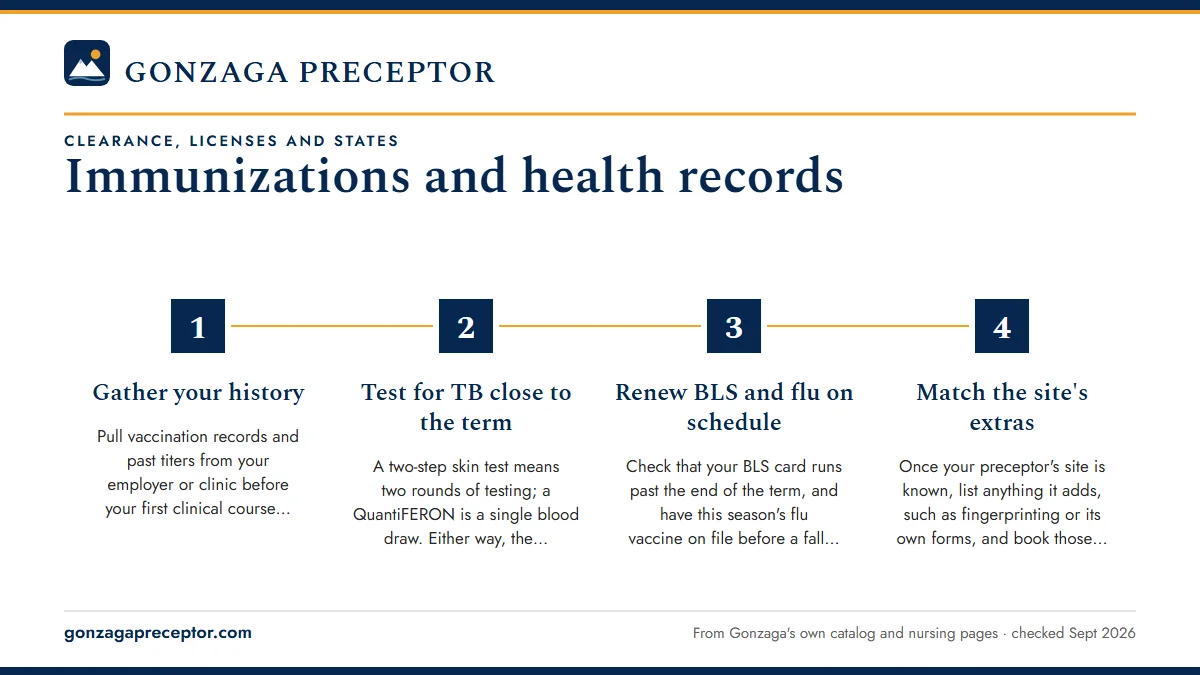
Health items fail on timing more often than on substance. Working backward from the start date keeps each one valid for the full term.
- Gather your historyPull vaccination records and past titers from your employer or clinic before your first clinical course. Gaps mean new titers or doses, which add time.
- Test for TB close to the termA two-step skin test means two rounds of testing; a QuantiFERON is a single blood draw. Either way, the 12-month window should cover the full semester.
- Renew BLS and flu on scheduleCheck that your BLS card runs past the end of the term, and have this season's flu vaccine on file before a fall practicum.
- Match the site's extrasOnce your preceptor's site is known, list anything it adds, such as fingerprinting or its own forms, and book those appointments first.
Where our placement desk helps
Health-record surprises are among the easiest practicum delays to avoid, provided you know the site early. When we match you with a preceptor, we check the site's own requirements against Gonzaga's list and tell you what to book and by when, including extras like Idaho fingerprinting or a Providence onboarding packet. If a preceptor steps away mid-term, we find a replacement and flag the new site's extras straight away.
Your site request then goes to Gonzaga with the preceptor's credentials, site contacts, dates and course match already settled, and your health file is ready the day the site asks for it. Faculty at Gonzaga sign off on each site, and our aim is a file they never need to send back. See how it works.
Questions Gonzaga students ask
Can I decline the hepatitis B vaccine for Gonzaga clinicals?
Gonzaga's published checklist allows a declination waiver for hepatitis B, alongside the series or a titer. That checklist was written for clinical faculty, and clinical sites set their own rules, so confirm with the student handbook and your site before relying on a waiver for a practicum.
Is a QuantiFERON accepted instead of a TB skin test?
Yes, on Gonzaga's published checklist: either a two-step skin test or a QuantiFERON within 12 months meets the TB line, with a chest x-ray if the result is positive. Whichever you choose, keep the result inside its 12-month window for the whole rotation.
Which BLS cards does Gonzaga accept?
The checklist names an American Heart Association BLS provider card, or a card from the Military Training Network. Kootenai Health also asks for AHA BLS. If your current card comes from another organization, ask the Clinical Placement Team whether it will be accepted before your first practicum rather than after.
Do I need fingerprinting for a Kootenai Health placement?
For behavioral health units, yes: Kootenai's student placement page lists Idaho Health and Welfare fingerprinting for those units. Kootenai takes placement requests between 90 days and two weeks before the start date, so a PMHNP student headed there should book fingerprinting as soon as the site is confirmed.
Where will my health records live after the move to CORE?
Gonzaga planned to move compliance documents into CORE for all students by spring 2026, keeping CPNW alongside it. Older packets still say CastleBranch. Your syllabus or the Clinical Placement Team will say where to upload, and the CORE ELMS guide covers the system itself.
Related pages
Last checked 2026-09-25
We check these pages against Gonzaga's catalog, FAQs, preceptor packets and Department of Nursing pages. Your course, the Graduate Nursing Student Handbook and Gonzaga's Clinical Placement Team have the final word.
- Gonzaga University Department of Nursing, CastleBranch Compliance (NP Clinical Faculty Portal)
- Gonzaga University Department of Nursing, BSN About the Program
- Gonzaga University, Gonzaga Nursing Streamlines Clinical Placement with CORE (2024)
- Kootenai Health, Health Care Student Placement
- Providence Sacred Heart Medical Center, Student and Instructor Portal
Gonzaga asks you to find local preceptors first. Let us run that search.
Tell us your Gonzaga program, your practicum course and where you live and can travel. We find preceptors who fit the course and prepare the license, certification and site details your Practicum Site Placement Request needs, early in the semester before.
- Preceptors matched to the course: primary care across the lifespan for
NURS 661PtoNURS 664P, psychiatric care forNURS 661MtoNURS 663M, an agency liaison for the DNP - Credentials, license, board certification and site contact ready for your site request
- In Spokane, across Washington or wherever in the ten western states you are licensed
Start your placement plan
Your program, city and next practicum term is all we need to begin.