NURS 600 and 601: Gonzaga's health assessment pair
NURS 600 Advanced Health Assessment and its 1-credit practicum, NURS 601, are where every Gonzaga FNP and PMHNP student first works beside a preceptor: 60 hours in a primary care setting, plus two 2-day immersions in Spokane. Gonzaga treats the pair as a full-time load, and the clinical half has to go well for the course to pass.
Get your placement plan
Tell us your Gonzaga program and where you live. A placement advisor replies with the preceptor and site options that fit your Gonzaga course.
How the two courses fit together
NURS 600 is the 3-credit Advanced Health Assessment course, and NURS 601, Advanced Health Assessment Practicum I, is its 1-credit clinical companion. You register for both in the same term. Gonzaga's program materials describe roughly 13 hours of supervised lab inside NURS 600, with the 60-hour precepted clinical carried by NURS 601.
Both MSN nurse practitioner tracks share the pair, as do Second MSN students in either specialty and current Post-Baccalaureate DNP students. Gonzaga's FNP program page adds a rule worth reading twice: NURS 600 cannot be passed without satisfactory clinical performance. Lab skills and exams alone will not carry the course; the clinical hours are part of passing it.
| Course | Title | Credits | Clinical piece |
|---|---|---|---|
NURS 600 | Advanced Health Assessment | 3 | Two 2-day immersions in Spokane; about 13 hours of supervised lab |
NURS 601 | Advanced Health Assessment Practicum I | 1 | 60 precepted hours in a primary care setting |
Sixty hours in primary care
The catalog places the NURS 601 hours within a primary care setting, and Gonzaga's credit math makes the size easy to remember: one practicum credit, 60 clock hours. Those 60 hours are the gap between the 600 practicum hours the catalog lists for the specialty courses and the 660 total on Gonzaga's 2026 program pages. The clinical hours guide sets both figures side by side.
For FNP students, primary care is home ground, and NURS 601 previews the settings the specialty practicums will use. In the PMHNP track, the point that follows is easy to overlook: health assessment is still a primary care practicum, so the first preceptor a PMHNP student needs is a primary care clinician. The psychiatric settings come later, starting with NURS 661M.
None of the 60 hours count until the usual gates are open: the term has begun, your preceptor and site are approved, an affiliation agreement is active and you are current with CPNW. The hour accrual rules explain what happens to hours logged outside them.
PMHNP students: NURS 601 is a primary care practicum, so line up a primary care preceptor for it even though the rest of your clinical sequence is psychiatric.
Who can supervise NURS 601
Gonzaga's sources differ slightly on this course. The catalog entry for NURS 601 names a nurse practitioner or physician, while the program web pages add physician assistants. Treat the course syllabus and your course faculty as the deciding word before you approach a PA, and keep an NP or physician option in reserve.
Gonzaga's general preceptor standard applies on top: someone in active practice, with a year or more in the specialty they will teach, a clean and current license in your practicum state, and proof of licensure plus national board certification. The preceptor requirements guide sets these out track by track.
Two limits narrow the field further. Your preceptor may not be your direct supervisor, and a practicum inside your own employer needs faculty approval under Gonzaga's workplace practicum rules. Faculty sign off on each site request before a single hour begins.
The two immersions that come with NURS 600
NURS 600 carries two 2-day immersions on the Spokane campus. For most students they are the first campus trips of the program, the opening two of six in the FNP track and five in the PMHNP track. Campus trips tend to start once you are about halfway through the MSN, with one or two in a term, and that is the stage at which health assessment usually arrives.
Expect focused, hands-on assessment work with faculty and OSCEs, the observed patient encounters Gonzaga's FAQ singles out as key to student success. Getting to Spokane is the student's to arrange and budget, so put the dates beside your clinic schedule as soon as they are posted. OSCE format, travel and the extra site-visit day for some states are on the Spokane immersions page.
When the pair lands in your plan
NURS 600 and NURS 601 open only after Advanced Pathophysiology (NURS 523) and Advanced Pharmacology (NURS 524). In the nine-semester MSN that places them in year two, somewhere in semesters four to six. Second MSN plans are individualized, so the pair is likely to come in the second or third term. The first clinical course guide maps timing for every program.
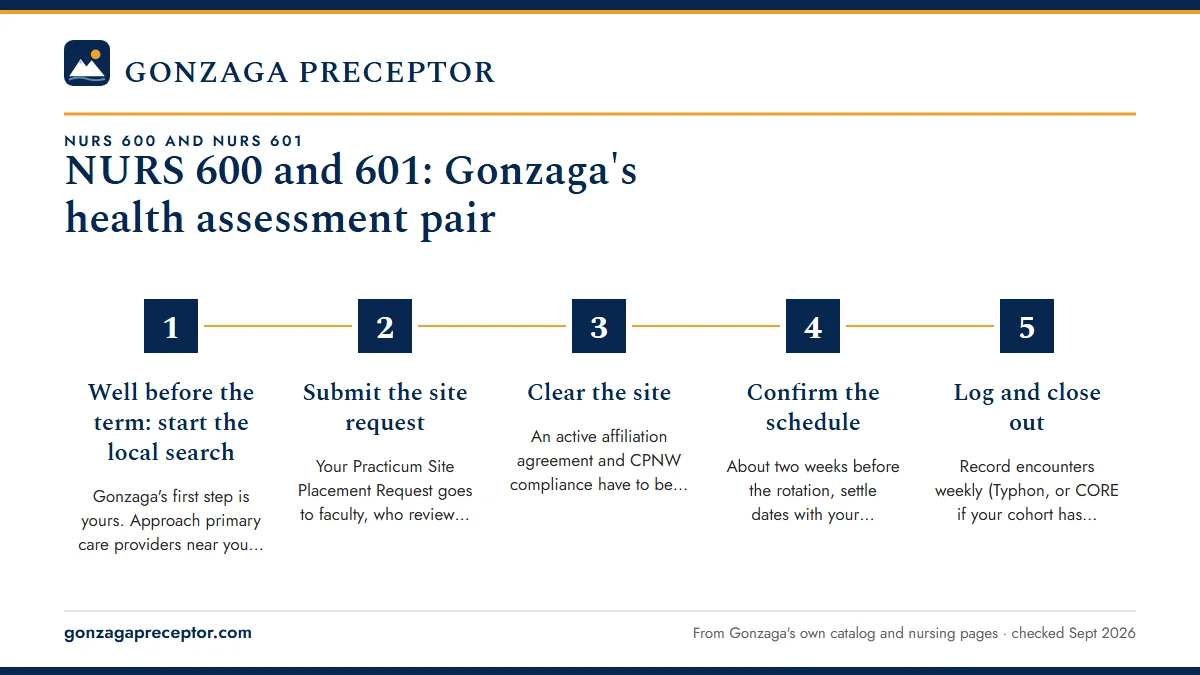
- Well before the term: start the local searchGonzaga's first step is yours. Approach primary care providers near you who might precept, as soon as your progression plan shows the health assessment term.
- Submit the site requestYour Practicum Site Placement Request goes to faculty, who review the preceptor and site and give final approval.
- Clear the siteAn active affiliation agreement and CPNW compliance have to be in place before any hour counts.
- Confirm the scheduleAbout two weeks before the rotation, settle dates with your preceptor and hand over a CV or resume with written learning goals.
- Log and close outRecord encounters weekly (Typhon, or CORE if your cohort has moved), then your preceptor completes the end-of-term evaluation.
Planning for a full-time load
Gonzaga counts NURS 600 with NURS 601 as a full-time load, even though the pair carries four credits. The week explains why: lab work, two immersion trips and 60 hours with a preceptor whose clinic hours set your schedule, because your clinic days follow the preceptor's calendar, not your own.
Faculty also advise keeping paid work to about 20 hours a week or less from the first clinical term, and health assessment is where that advice first bites. If the term looks unworkable, remember that the MSN does not move students in cohorts: your plan can stretch out, provided the degree is done within five years. The grades and progression page covers the rules behind that choice.
At the end of the term your preceptor evaluates you. Gonzaga lists NURS 601 among the courses whose evaluations moved to CORE from Spring 2026, yet the Preceptor Portal still shows a NURS 601 web form, so check with course faculty which route applies to your term.
Why Gonzaga students choose us for NURS 601
A first practicum is where a slow search costs the most, because the whole progression plan rests on it. We are specialists in Gonzaga's clinical process, and we build the NURS 601 search around it: a primary care preceptor in your own state whose credentials match what the syllabus names, at a site that can host a student for 60 hours in your term.
Your file for the Practicum Site Placement Request and the Clinical Placement Team comes together in one pass: proof of the preceptor's license and certification, who signs agreements at the site, proposed clinic dates inside the term, and a short case for why the setting suits NURS 601. Approval stays with Gonzaga's faculty, and the file they open is whole from the start. PMHNP students get the same care, with a primary care match for this one course before the psychiatric sequence begins. Tell us your term and state with the form below.
Questions Gonzaga students ask
Do PMHNP students take NURS 601 at Gonzaga?
Yes. Both MSN nurse practitioner tracks include NURS 600 and NURS 601, and so does the Second MSN in either specialty. For PMHNP students the 60 practicum hours still sit in a primary care setting, so the preceptor is a primary care clinician. The psychiatric practicums follow afterward, beginning with NURS 661M.
Can a physician assistant precept NURS 601?
Possibly. Gonzaga's program web pages list a nurse practitioner, physician or physician assistant, but the catalog entry for NURS 601 names only a nurse practitioner or physician. Because the two disagree, confirm with course faculty and the syllabus before you ask a PA, and have an NP or physician option ready in case your course follows the catalog.
How many hours is Gonzaga's health assessment practicum?
Sixty. NURS 601 is one credit, and Gonzaga's practicum math works out to 60 clock hours per credit. Those 60 hours plus the 600 in the specialty practicums make up the 660-hour total on Gonzaga's 2026 MSN pages, while the catalog counts only the 600 specialty hours.
What if I struggle in the clinical part of NURS 600?
Gonzaga's FNP page ties a passing grade in NURS 600 to satisfactory progress at your clinical site. Graduate students are expected to earn a B or better, and the specialty practicums list the course as a prerequisite. If your preceptor raises concerns, talk with course faculty early; a slower progression plan is an option within the five-year limit.
Can I start NURS 601 hours before the semester begins?
No. Gonzaga counts practicum hours only after the semester starts, with an approved preceptor at an approved site, an active affiliation agreement and CPNW compliance in place. Hours during university breaks or between semesters do not count either. Use the weeks before the term to finish the paperwork and confirm your schedule instead.
Related pages
Last checked 2026-09-25
We check these pages against Gonzaga's catalog, FAQs, preceptor packets and Department of Nursing pages. Your course, the Graduate Nursing Student Handbook and Gonzaga's Clinical Placement Team have the final word.
Gonzaga asks you to find local preceptors first. Let us run that search.
Tell us your Gonzaga program, your practicum course and where you live and can travel. We find preceptors who fit the course and prepare the license, certification and site details your Practicum Site Placement Request needs, early in the semester before.
- Preceptors matched to the course: primary care across the lifespan for
NURS 661PtoNURS 664P, psychiatric care forNURS 661MtoNURS 663M, an agency liaison for the DNP - Credentials, license, board certification and site contact ready for your site request
- In Spokane, across Washington or wherever in the ten western states you are licensed
Start your placement plan
Your program, city and next practicum term is all we need to begin.