When a missing preceptor pushes back your Gonzaga graduation
At Gonzaga a missing preceptor rarely ends a program, but it can move the finish line. Practicums are paired with didactic courses, each pair builds on the one before, and every student works inside a five-year limit. Here is how a delay spreads through the plan, and how to keep it as short as possible.
Get your placement plan
Tell us your Gonzaga program and where you live. A placement advisor replies with the preceptor and site options that fit your Gonzaga course.
Why one missing practicum moves the rest
Gonzaga pairs each NP practicum with a didactic course taken alongside it: NURS 651P with NURS 661P, NURS 652P with NURS 662P, and on through the FNP and PMHNP sequences. Later courses list earlier pairs as prerequisites at a C or better, so a practicum that cannot start can hold up its partner course and everything scheduled after it.
The immersions travel with the didactic courses too. FNP students attend a three-day immersion in Spokane with each specialty course, so a shifted course usually means a shifted trip, and PMHNP students attend a two-day immersion with each of their three psychiatric concepts courses. The FNP practicum courses and PMHNP practicum courses pages lay out each sequence.
The room Gonzaga builds in
Gonzaga's online MSN has no cohort model. Its FAQ lets students slow a progression plan as long as they finish within five years, so a term without a practicum does not mean falling out of a class.
The plan still matters. Each student's progression plan reserves a seat in the courses on it, and any change off the plan has to be cleared with Gonzaga staff and your faculty advisor first. Dropping a practicum on your own can cost you the seat you need next term.
Post-Master's DNP students run on a similar clock of five years from acceptance. Grades and progression covers probation, Incompletes and the rest of the rules.
Clear any off-plan change with Gonzaga staff and your faculty advisor before you drop or add a course: your progression plan is what holds your seat.
Finishing hours in a later term
Gonzaga has a formal route for hours that spill past the didactic sequence. NURS 683P, the Primary Care Practicum Extension, and NURS 683M, the Psych-Mental Health Practicum Extension, are taken in semesters without a specialty didactic course and may be repeated for credit. The DNP has NURS 704 for extra practicum time toward its 1,000 hours.
Inside a term, course faculty can approve an extension past the course end date, and an Incomplete can stand for up to a year before it turns into an F. These tools buy time, but each one still needs an approved preceptor to finish the hours. See practicum extension courses for how they fit a plan, and ask course faculty which option they prefer well before the last weeks of the term.
What a later finish affects
A delay is measured in more than semesters. Weigh these before you settle on a revised plan.
- Fees: Gonzaga lists a per-semester program fee for the NP tracks and a course fee on each practicum course, so an added term adds cost. ZagWeb and Gonzaga's tuition page carry the current figures.
- Licensure: in Washington, an ARNP application needs an official transcript sent after your degree posts, plus national certification sent by the certifying body, so a later posting means a later license.
- The title itself: Washington's ARNP title changes to APRN on June 30, 2027, which matters for anyone licensing around that date.
- Work: Gonzaga recommends working no more than 20 hours a week once clinicals start, and a longer clinical stretch extends that limit.
- The clock: every added term uses part of the five-year window.
None of this is a reason to panic. It is a reason to plan the remaining practicums now, while you still have choices.
Keeping the slip short
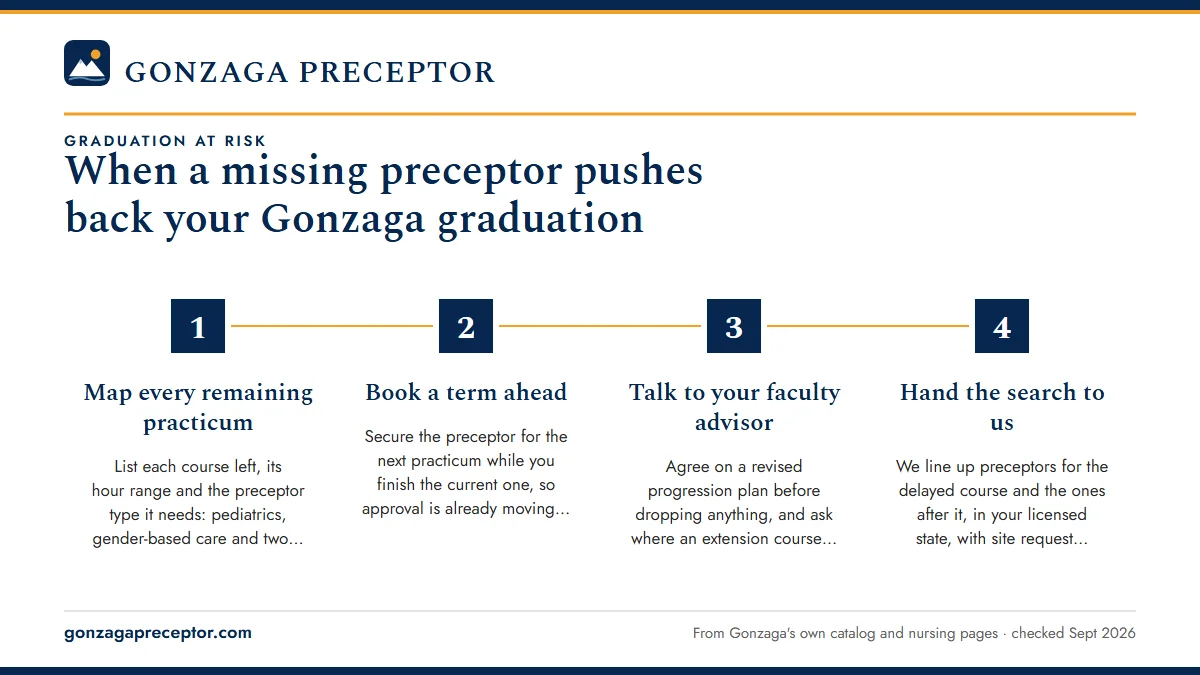
One late term is manageable. A delay that repeats is what pushes a plan toward the edge of the five-year window, and these four moves keep it from repeating.
- Map every remaining practicumList each course left, its hour range and the preceptor type it needs: pediatrics, gender-based care and two adult-gerontology courses for FNP, or the three psychiatric populations for PMHNP.
- Book a term aheadSecure the preceptor for the next practicum while you finish the current one, so approval is already moving when the term opens.
- Talk to your faculty advisorAgree on a revised progression plan before dropping anything, and ask where an extension course fits.
- Hand the search to usWe line up preceptors for the delayed course and the ones after it, in your licensed state, with site request details ready each time.
How we help students already off plan
Students who come to us after a delay usually need two things at once: a preceptor for the course that slipped, and a plan so the next course holds. Your placement advisor works on both. We find a preceptor who fits the extension or delayed practicum, then look ahead to the next course in your sequence and start that search early. For heavy courses such as NURS 663P, with its 180-hour minimum, we can also line up a second approved preceptor in reserve, within Gonzaga's two-per-semester limit.
You keep one contact for the rest of the program, and Gonzaga's faculty keep the final say on every site. Tell us your program and remaining courses through the contact form, or read how it works first.
Questions Gonzaga students ask
Will I lose my seat if I sit out a practicum term?
Your progression plan reserves a seat in the courses on it, and Gonzaga asks that any change off the plan be cleared with staff and your faculty advisor first. Talk to them before you drop a course, so the revised plan holds a seat in the term you return to.
How long can a Gonzaga MSN take?
Gonzaga sets a five-year limit from acceptance or first graduate enrollment. The standard FNP and PMHNP plan runs nine semesters, about three years across fall, spring and summer, so a delay of a term or two can fit inside the limit when the remaining practicums are planned.
Can I take a practicum extension course more than once?
Yes. Gonzaga's catalog says both NURS 683P and NURS 683M may be repeated for credit. They are meant for semesters when you are not enrolled in NP specialty didactic courses, so they fit after the sequence or in a term you have paused. Each run still needs an approved preceptor.
Is a delay a warning sign for dismissal?
Slowing down is not. Gonzaga's FAQ presents a slower progression plan as an option within the five-year limit. Dismissal risk comes from other things: a program GPA below 3.00, which starts a probation semester, or hours logged outside Gonzaga's rules. Keep your hours clean and your advisor informed.
When should I start looking for my next preceptor?
At least a term ahead. Gonzaga publishes no public request deadline, but approval, the affiliation agreement and clearance all take time, and large health systems add lead times of their own. If your next term is close, see need a preceptor fast.
Related pages
Last checked 2026-09-25
We check these pages against Gonzaga's catalog, FAQs, preceptor packets and Department of Nursing pages. Your course, the Graduate Nursing Student Handbook and Gonzaga's Clinical Placement Team have the final word.
Gonzaga asks you to find local preceptors first. Let us run that search.
Tell us your Gonzaga program, your practicum course and where you live and can travel. We find preceptors who fit the course and prepare the license, certification and site details your Practicum Site Placement Request needs, early in the semester before.
- Preceptors matched to the course: primary care across the lifespan for
NURS 661PtoNURS 664P, psychiatric care forNURS 661MtoNURS 663M, an agency liaison for the DNP - Credentials, license, board certification and site contact ready for your site request
- In Spokane, across Washington or wherever in the ten western states you are licensed
Start your placement plan
Your program, city and next practicum term is all we need to begin.