Gonzaga's traditional Bachelor of Science in Nursing
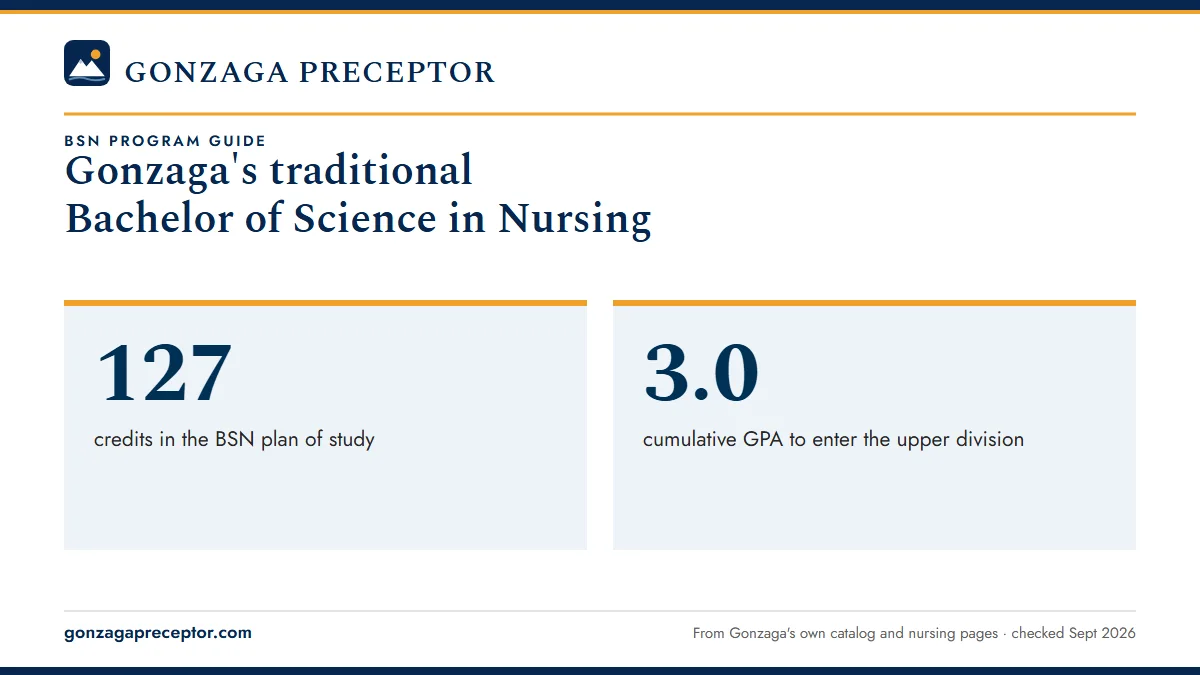
Gonzaga admits nursing students as freshmen only, and its 127-credit BSN takes eight semesters for some students and nine for others because clinical placements in Spokane are limited. Clinical courses start in the junior year, the Department of Nursing arranges them, and the program ends with a final practicum under a registered nurse. This guide explains how those clinical years are built.
Plan your BSN final practicum
Tell us your term and the setting you want.
Freshman entry and the first two years
Gonzaga admits nursing students only as freshmen. Its BSN admission page rules out applications to the nursing major from current Gonzaga students and from transfer students, so a later switch into the major is off the table. The first two years mix university core and science prerequisites with nursing courses that have no clinical component, such as NURS 110 Caring Matters, NURS 230 Medical Terminology, NURS 210 Growth and Development and NURS 220 Social Determinants of Health.
Moving into the upper division takes a cumulative GPA of 3.0 or higher and at least a C in every nursing prerequisite. Gonzaga allows a single retake in two of those courses. Students must also meet the department's Essential Functional Abilities, which carry through the clinical years.
Why the BSN can take nine semesters
Clinical capacity sets the calendar. The undergraduate catalog warns that limits on clinical placements may stretch the BSN to nine semesters, and the program page explains the mechanics: half of each class starts clinical experiences in the fall of junior year, and the other half waits until spring.
You state a preference for a fall or spring start of the upper-division courses during the second semester of freshman year. When fall fills, seats go by prerequisite GPA ranking, which makes your early science grades count twice. A July 2026 Gonzaga story about its endorsed simulation program points to "the limited clinical rotation capacity available in our local hospital settings," and simulation now works alongside hospital clinicals.
Local hospitals also train students from more than one Gonzaga program. The new Accelerated BSN, launching in Summer 2027, runs its own clinical rotations across Spokane's regional health systems.
The upper-division clinical sequence
| Term | Clinical course | Focus | Paired theory or lab |
|---|---|---|---|
| Junior fall | NURS 331 | Foundations of Practice 1, the first clinical, in community settings | NURS 330 theory, NURS 331L lab |
| Junior spring | NURS 341 | Foundations of Practice 2, acute and chronic care | NURS 340, NURS 341L |
| Junior spring | NURS 361 | Psychiatric and mental health | NURS 360 |
| Senior fall | NURS 431 | Foundations of Practice 3 | NURS 430, NURS 431L |
| Senior fall | NURS 441 and NURS 451 | Obstetric and pediatric clinicals | NURS 440, NURS 450 |
| Senior spring | NURS 481 | Population health, in community settings | NURS 480 |
| Senior spring | NURS 495 | Final Practicum under a registered nurse | NURS 490, NURS 494, NURS 498 |
The table follows the catalog's fall-start plan; if your upper division begins in spring, your first clinical, NURS 331, comes in junior spring instead. The catalog lists no clinical hours for any BSN course, so your syllabi are where those numbers live. The last course on the list is the one where your own planning counts most, and the BSN final practicum guide covers it.
Students on the legacy curriculum
Some current students entered under the older plan, which Gonzaga's Upper Division Curriculum web page still shows. Its practicums carry heavier credit loads and were graded satisfactory or unsatisfactory, with a minimum grade of S listed as the prerequisite for the next course.
| Course | Credits | When | Notes |
|---|---|---|---|
| NURS 315 Practicum I | 5 | Junior semester 1 | First clinical |
| NURS 352 Practicum II | 5 | Junior semester 2 | Second clinical |
| NURS 403 Practicum III | 6 | Senior semester 1 | Third clinical, the largest by credits |
| NURS 467 Practicum IV: Population Health | 2 | Senior semester 2 | In an assigned community agency |
| NURS 468 Practicum V: Member of Nursing Profession | 3 | Senior semester 2 | Capstone with an RN preceptor in a setting you request |
If you are unsure which plan applies to you, the BSN Academic Advisor can confirm it before you register for senior-year courses.
Clinical rules, clearance and records
Clinicals take place in "a variety of healthcare settings," and the department holds students to professional standards that the Washington State Board of Nursing requires it to enforce. You cannot attend clinical while impaired, and after an injury or illness you may need a medical release before returning. The BSN has its own student handbook, separate from the graduate one, and it holds the detailed clinical policies.
Clearance runs through regional systems. Clinical Placements Northwest lists Gonzaga's BSN among its participating programs, and its partner hospitals in the Spokane area include Providence Sacred Heart, Holy Family, VA Spokane and Eastern State Hospital. Gonzaga also piloted CORE, its new platform for compliance documents, case logs and time logs, with BSN students first. The CPNW clearance and immunizations and health records guides list what to have ready.
Accreditation and simulation on campus
CCNE accredits Gonzaga's baccalaureate program through June 30, 2030, and the BSN appears on WABON's approved in-state program list dated August 24, 2026. Gonzaga's licensure disclosures mark the BSN as meeting requirements in every state they list, which helps if you plan to take the NCLEX and work outside Washington. The accreditation guide explains what clinical sites ask about.
On campus, the 2019 Tilford building expansion added a simulation center with two suites and control rooms, a medication room, a debriefing room and a high-fidelity patient simulator. Labs such as NURS 331L, NURS 341L and NURS 431L run beside the clinical courses in the plan.
Where we help Gonzaga BSN students
Gonzaga arranges your rotations, so our work for BSN students centers on the place where you have a say: the final practicum. We help you pick a setting that fits the nurse you want to become, identify units and experienced RNs who can guide you there, and assemble the details faculty need to review the request, early enough that clearance and onboarding keep pace.
If you later return to Gonzaga for an online nurse practitioner degree, the first step toward each preceptor will be yours, and our search is built for exactly that. The MSN FNP guide shows what the path involves. Tell us where you are in the program through the form below.
Questions Gonzaga students ask
Can I transfer into Gonzaga's nursing program?
Not into the BSN. Gonzaga admits nursing students as freshmen only, and its admission page rules out applications to the major from current Gonzaga students and from transfer students. If you already hold a bachelor's degree in another field, the Accelerated BSN starting in Summer 2027 is Gonzaga's route into nursing instead.
Why do some Gonzaga BSN students take nine semesters?
Spokane clinical placements are limited. Half of each class begins clinicals in junior fall and half in junior spring, and the catalog says that constraint can extend the program to nine semesters. You request a start term in the second semester of freshman year, and if fall is oversubscribed, prerequisite GPA ranking decides who starts first.
Do Gonzaga BSN students find their own clinical placements?
For almost every course, no. The Department of Nursing arranges BSN rotations, and its staff includes a BSN Clinical Placement Manager. The exception is the final practicum: the legacy NURS 468 description lets you request a setting of your choice with an RN preceptor, and faculty review decides the final placement.
How many clinical hours are in Gonzaga's BSN?
Gonzaga's catalog lists no clinical hours for the traditional BSN courses, so check each course syllabus for its expectation. The newer Accelerated BSN describes over 800 clinical and simulation practice hours across its 15 months, which gives a sense of scale, but the two programs are built differently and that figure belongs to the ABSN.
What GPA do I need to start Gonzaga's upper-division nursing courses?
A cumulative GPA of 3.0 or higher, plus at least a C in every nursing prerequisite, with a single retake allowed in two of those courses. GPA also shapes timing: when more students want a fall start than there are seats, prerequisite GPA ranking decides who begins clinicals in the fall.
Related pages
Last checked 2026-09-25
We check these pages against Gonzaga's catalog, FAQs, preceptor packets and Department of Nursing pages. Your course, the Graduate Nursing Student Handbook and Gonzaga's Clinical Placement Team have the final word.
- Gonzaga University Bachelor of Science in Nursing, About the Program
- Gonzaga University Undergraduate Catalog 2026-27, Nursing
- Gonzaga University Catalog, Nursing (BSN) program
- Washington State Board of Nursing, Approved In-State Nursing Programs (Aug. 24, 2026)
- Clinical Placements Northwest, Participating Programs
Gonzaga asks you to find local preceptors first. Let us run that search.
Tell us your Gonzaga program, your practicum course and where you live and can travel. We find preceptors who fit the course and prepare the license, certification and site details your Practicum Site Placement Request needs, early in the semester before.
- Preceptors matched to the course: primary care across the lifespan for
NURS 661PtoNURS 664P, psychiatric care forNURS 661MtoNURS 663M, an agency liaison for the DNP - Credentials, license, board certification and site contact ready for your site request
- In Spokane, across Washington or wherever in the ten western states you are licensed
Start your placement plan
Your program, city and next practicum term is all we need to begin.