Gonzaga's Accelerated Bachelor of Science in Nursing
Gonzaga's Accelerated BSN is a new 15-month path into nursing for people who already hold a bachelor's degree in another field. The first cohort begins in Summer 2027. Theory courses run online, while labs and clinical rotations take place in person in Spokane, adding up to more than 800 clinical and simulation practice hours.
Plan your ABSN final practicum
Tell us your cohort and the setting you want.
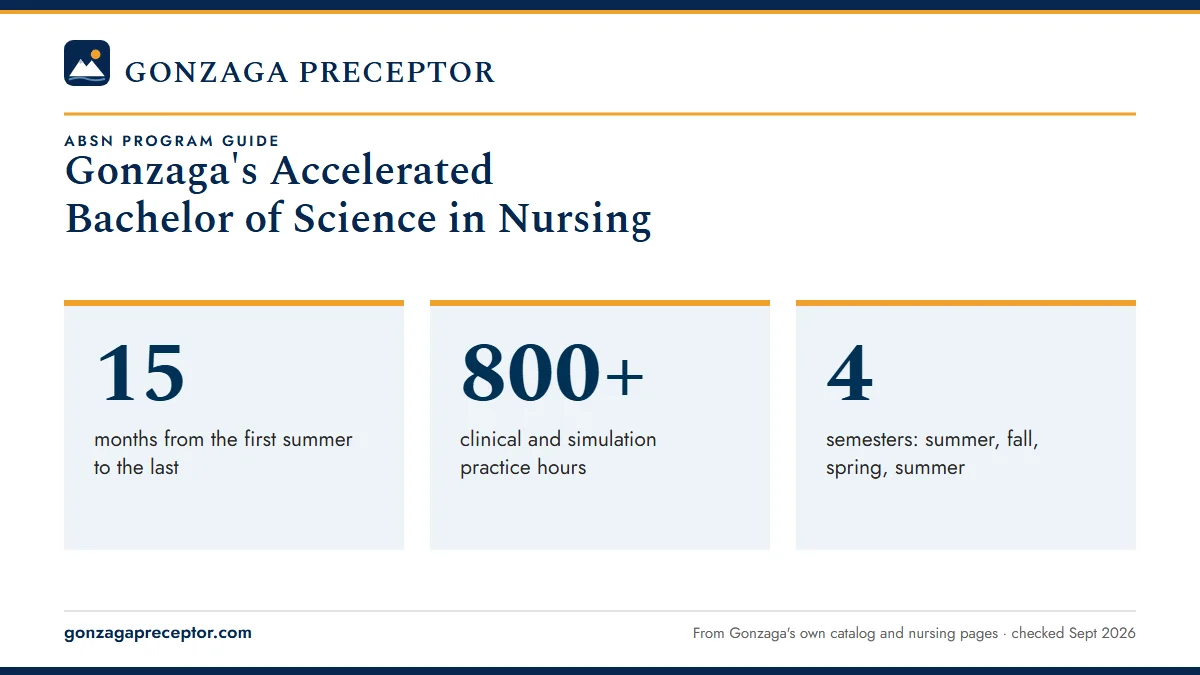
The ABSN in brief
The one-credit mismatch between the overview and curriculum pages is minor, but it matters when you plan a budget or a course load. Go by the curriculum page, whose listed courses add up to 65, and confirm the figure with admissions.
| Item | What Gonzaga publishes |
|---|---|
| Catalog name | Post Baccalaureate BSN (ABSN) |
| Length | 15 months over four semesters: Summer, Fall, Spring, Summer |
| Credits | 64 on the overview page; 65 on the curriculum page, where the listed courses total 65 |
| Format | Hybrid: asynchronous online theory; labs and clinicals in person in Spokane |
| Clinical and simulation hours | Over 800 |
| Clinical areas | Medical-surgical, mental health, pediatrics, obstetrics and population health |
| First start | Summer 2027, a small cohort (a Gonzaga story says June 2027) |
| Application deadline | Feb 1, 2027 |
Who the ABSN is built for
The ABSN is designed for career changers. Applicants need a bachelor's degree in a field other than nursing, a cumulative GPA of 2.5, and a 3.0 across the science and statistics prerequisites the catalog lists.
Prerequisites in the catalog
- General Chemistry with lab
- Anatomy and Physiology I and II, with labs
- Microbiology with lab
- Introductory Statistics
- Lifespan Growth and Development
- Nutrition
Finishing prerequisites well before the February deadline helps twice: once for admission, and again because the program moves quickly from its first week. Gonzaga's traditional BSN takes freshmen only, so for anyone who already holds a degree, the ABSN is the Gonzaga route into nursing.
Semester by semester
Clinical work begins in your very first semester with NURS 331A, whereas the traditional BSN holds NURS 331 until junior year. The fall term carries three clinicals at once: adult foundations, mental health and population health. The final summer is the densest, with obstetric and pediatric clinicals, the NURS 495A Final Practicum and NURS 498A NCLEX preparation all in one term.
Two online university core courses, one in Christian or Catholic traditions and an ethics course, PHIL 301, complete the plan. Gonzaga publishes the 800-hour figure for the program as a whole rather than hours for each course, so each syllabus tells you what that course expects.
| Semester | In person in Spokane | Online theory and practice courses |
|---|---|---|
| 1, Summer | NURS 331A clinical, NURS 331AL lab | NURS 110A, 220A, 230A, 310A, 330A |
| 2, Fall | NURS 341A, 361A and 481A clinicals; NURS 341AL lab | NURS 340A, 360A, 480A |
| 3, Spring | NURS 431A clinical, NURS 431AL lab | NURS 342A, 430A, 440A, 450A, 490A |
| 4, Summer | NURS 441A, 451A and 495A clinicals | NURS 494A, 498A |
Clinical rotations across Spokane
Gonzaga describes ABSN rotations as running "across Spokane's top regional health systems" in medical-surgical, mental health, pediatric, obstetric and population health care. The program arranges them, as the department does for the traditional BSN.
Spokane's hospitals are in heavy demand as training sites. A July 2026 Gonzaga story on its simulation endorsement notes limited rotation capacity in local hospitals, and the ABSN's 800-hour total counts clinical and simulation practice together. Area hospitals that belong to Clinical Placements Northwest, including Providence Sacred Heart and Holy Family, clear students through CPNW's shared standards. The CPNW clearance and immunizations and health records guides list what to prepare before your first rotation.
How the ABSN compares with the traditional BSN
The two programs share a course architecture: the same Foundations of Practice clinicals, the same specialty populations and the same final practicum under an RN, with an A added to each ABSN course number. What differs is the pace. The ABSN compresses the upper-division sequence into four back-to-back terms with no summer break, so a missed prerequisite or a late clearance document has less room to be absorbed.
| Item | Traditional BSN | Accelerated BSN |
|---|---|---|
| Who enters | Freshmen only | Holders of a non-nursing bachelor's degree |
| Length | 8 semesters, or 9 when clinical seats are short | 15 months, four semesters |
| Credits | 127 | 64 or 65, depending on the page |
| Format | On campus in Spokane | Online theory; labs and clinicals in Spokane |
| First clinical | NURS 331, junior fall or spring | NURS 331A, first semester |
| Published clinical hours | None listed in the catalog | Over 800, clinical and simulation combined |
| Final practicum | NURS 495 (legacy NURS 468) | NURS 495A |
Planning your 15 months
The hybrid format lets you read and complete theory on your own schedule, but labs and clinicals need you in Spokane in every semester, and rotation times follow the hospital's calendar rather than yours. Expect to treat the ABSN as a full-time commitment from the first summer to the last.
Plan the final summer early. NURS 495A places you under a registered nurse, and the traditional BSN's legacy capstone description lets students request a setting, with faculty review deciding the final placement. Ask early whether the ABSN follows the same request process; the final practicum guide explains how the BSN version works.
The final summer stacks obstetrics, pediatrics, the final practicum and NCLEX preparation, so settle the practicum setting you want to request during spring.
Approval and the NCLEX
Washington's nursing board names both Gonzaga's BSN and ABSN options on its approved in-state program list dated August 24, 2026, and CCNE accredits Gonzaga's baccalaureate nursing program through June 30, 2030. NURS 498A in the final term is built around NCLEX-RN preparation. The accreditation guide explains what those approvals mean to clinical sites.
Once you are licensed, Gonzaga's online MSN nurse practitioner tracks are open to RNs who live in one of the ten western states the program admits from, which gives ABSN graduates a clear next step inside the same department.
Where we help ABSN students
Gonzaga arranges your core rotations. Where our placement advisors add the most is the final practicum and the paperwork around it: we help you decide which setting to request, find experienced RNs and units that fit, check each preceptor against Washington's rules and assemble the details faculty review, so your request is ready well before the final summer.
Faculty decide the final placement; we make sure what reaches them is complete and well matched. Tell us your cohort and the setting you have in mind in the form below.
Questions Gonzaga students ask
When does Gonzaga's Accelerated BSN start?
The first cohort starts in Summer 2027, with applications due by Feb 1, 2027. A Gonzaga news story from July 2026 describes the program as set to begin in June 2027. The cohort is small, and the program runs four semesters over 15 months, finishing in the summer of 2028 for that first group.
Is Gonzaga's ABSN online?
Partly. Theory courses are online and asynchronous, but labs and clinical rotations take place in person in Spokane, so plan to be there throughout the program. The hybrid design suits people who want flexibility for reading and coursework while still getting hands-on training in Spokane's regional health systems.
How many credits is the Gonzaga ABSN?
Gonzaga's pages disagree slightly. The ABSN overview says 64 credits, while the curriculum page says 65 and its listed courses add up to 65. The difference does not change the clinical plan, but confirm the figure with admissions before you budget tuition or plan financial aid.
Who arranges ABSN clinical placements?
Gonzaga does. The program organizes ABSN clinical rotations across Spokane's regional health systems, as it does for the traditional BSN. Your own planning matters most at the end, in NURS 495A Final Practicum, where you work under a registered nurse, so ask early how the ABSN handles setting requests for that course.
How many clinical hours are in the Gonzaga ABSN?
More than 800 clinical and simulation practice hours in total, as Gonzaga describes it. The program does not break that figure down by course, and simulation counts inside it alongside time on hospital units and in community settings. Each course syllabus sets out what that course expects from you.
Related pages
Last checked 2026-09-25
We check these pages against Gonzaga's catalog, FAQs, preceptor packets and Department of Nursing pages. Your course, the Graduate Nursing Student Handbook and Gonzaga's Clinical Placement Team have the final word.
- Gonzaga University School of Health Sciences, Accelerated BSN
- Gonzaga University Accelerated BSN curriculum
- Gonzaga University news: Nursing Simulation Earns Endorsement
- Gonzaga University Undergraduate Catalog 2026-27, Nursing
- Washington State Board of Nursing, Approved In-State Nursing Programs (Aug. 24, 2026)
Gonzaga asks you to find local preceptors first. Let us run that search.
Tell us your Gonzaga program, your practicum course and where you live and can travel. We find preceptors who fit the course and prepare the license, certification and site details your Practicum Site Placement Request needs, early in the semester before.
- Preceptors matched to the course: primary care across the lifespan for
NURS 661PtoNURS 664P, psychiatric care forNURS 661MtoNURS 663M, an agency liaison for the DNP - Credentials, license, board certification and site contact ready for your site request
- In Spokane, across Washington or wherever in the ten western states you are licensed
Start your placement plan
Your program, city and next practicum term is all we need to begin.