The Gonzaga BSN final practicum and your RN preceptor
Your last clinical course in Gonzaga's BSN, NURS 495 Final Practicum (NURS 468 for students on the legacy curriculum), pairs you with an experienced registered nurse preceptor. The legacy course description calls it a practicum in a clinical setting of the student's choice, with faculty reviewing every request before the placement is final. That makes it the one BSN clinical where your own planning shapes the outcome.
Plan your final practicum
Tell us your final term and the setting you want.
Which course is your capstone
One course title causes confusion. NURS 490, Prof Practice 3: Leadership, has a catalog description that still mentions a preceptorship, but that text is out of date: the course is not clinical, and the ABSN teaches its version online. Your precepted capstone is NURS 495, or NURS 468 on the legacy plan. The BSN guide shows where the capstone sits in the full clinical sequence, and in the Accelerated BSN, NURS 495A shares the final summer with the obstetric and pediatric clinicals.
| Plan | Course | Credits | When |
|---|---|---|---|
| BSN, 2026-27 catalog | NURS 495 Prof Practice 5: Final Practicum | 3 | Senior spring |
| BSN, legacy curriculum | NURS 468 Practicum V: Member of Nursing Profession | 3 | Senior semester 2 |
| Accelerated BSN | NURS 495A Prof Practice 5: Final Practicum | 3 | Fourth semester, the final summer |
The setting you request and the review that follows
The legacy catalog entry is the most detailed description Gonzaga has published. It calls NURS 468 an intensive practicum in a clinical setting the student chooses, guided and supervised by an experienced registered nurse preceptor, and adds, in capital letters, that faculty review each student's practicum request to determine the final clinical placement.
The current NURS 495 entry describes the capstone as practice under a registered nurse's guidance and says less about how settings are chosen. If you are on the new plan, ask course faculty or the BSN Clinical Placement Manager whether the request process matches the legacy one, when the request window opens, and how far from Spokane a requested site may be.
A strong request ties the setting to a goal faculty can see. If you plan to start your career on a medical-surgical floor, in a critical care unit or in a clinic, say so and show how the capstone builds toward it; a request that reads as a considered next step gives faculty a clear reason to approve it.
Choice here means a request, not a booking. Faculty review decides the final placement, so bring a first choice with a clear reason behind it and a realistic alternative in case the first cannot be arranged.
What your RN preceptor needs
Gonzaga asks for an experienced registered nurse. Washington's preceptor rule for in-state programs, WAC 246-840-533, sets the baseline that preceptor should meet.
The Washington baseline for a nursing preceptor
- An active, unencumbered license at or above the level you are preparing for, which for a BSN student means an RN license
- At least one year of experience at that level
- Orientation in advance to the course objectives and written expectations for the preceptor role
- No immediate family tie to you, and no financial, business or professional relationship that could affect a fair evaluation
- No more than two students precepted at the same time
The same rule has nursing faculty confer with the preceptor and student at the beginning, middle and end of the experience. If you already work on a unit as a nursing assistant or technician, raise it early: an RN who supervises you at work may fall under the conflicting-relationship clause, and faculty make that call.
How health systems take capstone students
A preceptor's yes is only the start. Inland Northwest health systems accept students through school-level agreements, so the request travels from Gonzaga to the system rather than from you to a unit. Two published examples show the lead times involved.
| System | What it publishes |
|---|---|
| Providence Inland Northwest Washington (Sacred Heart, Holy Family and others) | A Clinical Education Agreement with the school first; rotations arranged through the Professional Development Coordinator; onboarding packet due at least 4 weeks before the start, Clinical Passport forms at least 2 weeks before; no job shadows in Spokane or Stevens counties |
| Kootenai Health, Coeur d'Alene | An affiliation agreement, then eligibility, then placement; requests no more than 90 days and no less than 2 weeks before the start; internal onboarding; Idaho Health and Welfare fingerprinting for behavioral health units |
Both show why an early decision pays off: onboarding clocks start weeks before your first shift. The affiliation agreements guide explains the agreement step, and the CPNW clearance guide covers the regional clearance that CPNW partner hospitals rely on.
Your own records have to keep pace. Gonzaga piloted CORE, its new platform for compliance documents, case logs and time logs, with BSN students first, and Kootenai's list shows what a system checks: immunizations, a background check, a flu shot and AHA BLS. Keep each item current through the final term, because a lapse found during onboarding can push back a start date. The department may also ask for a medical release after an injury or illness before you return to clinical.
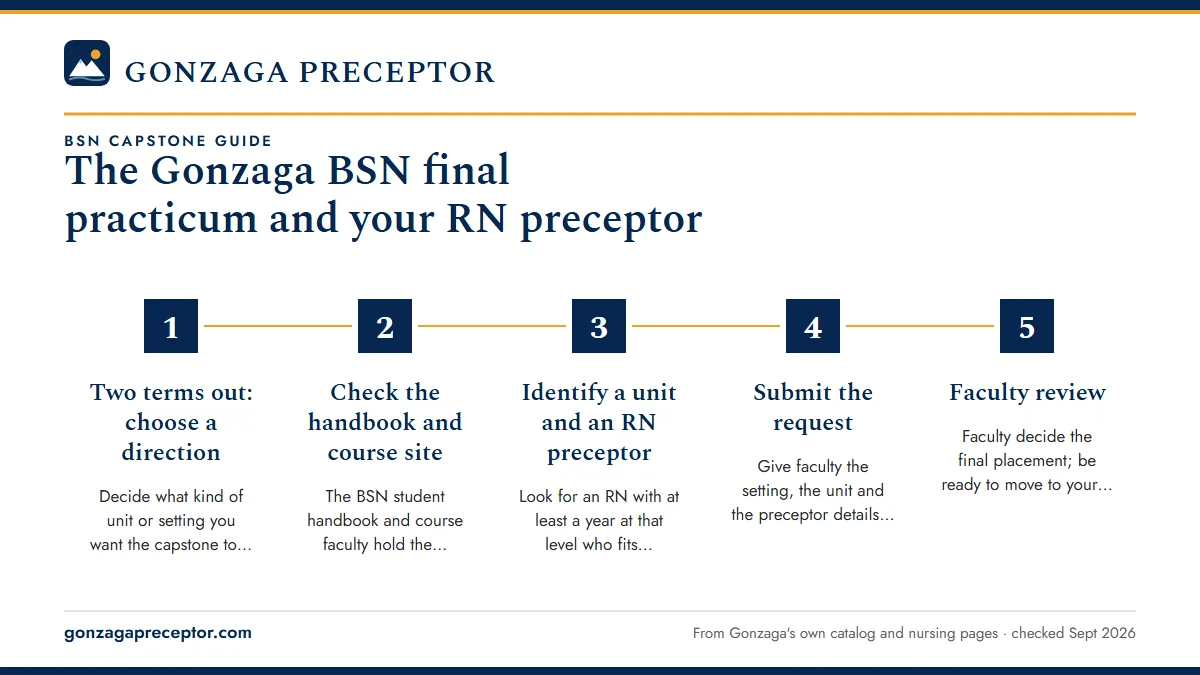
A planning timeline
Gonzaga publishes no public deadline for capstone requests, so work backward from the first day of your final term.
- Two terms out: choose a directionDecide what kind of unit or setting you want the capstone to prepare you for, and note a second option.
- Check the handbook and course siteThe BSN student handbook and course faculty hold the request window and any form the course uses.
- Identify a unit and an RN preceptorLook for an RN with at least a year at that level who fits Washington's relationship rules.
- Submit the requestGive faculty the setting, the unit and the preceptor details they need to judge fit.
- Faculty reviewFaculty decide the final placement; be ready to move to your alternative.
- Clear onboardingFinish CPNW or system onboarding and your immunization records by the dates the site sets.
Hospital onboarding deadlines can fall weeks before your first capstone shift, so a late request can cost you the setting you wanted.
How we help with your capstone
The capstone is the one Gonzaga BSN clinical where preparation changes the outcome, and it is where our placement advisors do their best work for pre-licensure students. We help you choose a setting that fits your goals, identify units and experienced RNs who match the course, check each preceptor against Washington's rule and assemble the details faculty review, early enough that onboarding windows stay open.
BSN and Accelerated BSN students use the service the same way. Gonzaga's faculty decide the final placement; we make sure the request they receive is complete and well matched. See how it works or tell us your final term in the form below.
Questions Gonzaga students ask
Can I choose where I do my Gonzaga BSN final practicum?
You can request a setting. The legacy NURS 468 description calls it a practicum in a clinical setting of the student's choice, with faculty review deciding the final placement. The current NURS 495 entry describes the capstone less specifically, so confirm with course faculty how requests work on the new plan and when they are due.
Who can be my NURS 495 preceptor?
An experienced registered nurse. Under Washington's preceptor rule for in-state programs, that nurse holds an active, unencumbered license at or above the level you are preparing for, has at least a year of experience, is oriented to the course objectives in advance and has no family or conflicting professional tie to you. Faculty approve the preceptor as part of the placement.
Is NURS 490 the BSN preceptorship?
No. NURS 490 Prof Practice 3: Leadership is a non-clinical course, even though an outdated catalog description still refers to a preceptorship, and the ABSN teaches its version online. The precepted final practicum in the current plan is NURS 495, and students on the legacy curriculum take NURS 468.
Does the Accelerated BSN have a final practicum?
Yes. ABSN students take NURS 495A Prof Practice 5: Final Practicum, a 3-credit course in the fourth semester, the final summer, alongside the obstetric and pediatric clinicals and NCLEX preparation. Because that term is crowded, decide on the setting you want to request well before it begins.
When should I start planning my Gonzaga BSN capstone?
Early in the term before your final one. Gonzaga publishes no public deadline, so check the BSN handbook and ask course faculty for the request window. Hospital onboarding adds its own lead time: Providence wants its onboarding packet at least four weeks before a start date, and Kootenai Health takes requests no more than 90 days ahead.
Related pages
Last checked 2026-09-25
We check these pages against Gonzaga's catalog, FAQs, preceptor packets and Department of Nursing pages. Your course, the Graduate Nursing Student Handbook and Gonzaga's Clinical Placement Team have the final word.
- Gonzaga University Undergraduate Catalog 2026-27, Nursing
- Gonzaga University Bachelor of Science in Nursing, About the Program
- Washington State Board of Nursing, Nursing Education Rules (WAC 246-840-533)
- Providence Sacred Heart Medical Center, Student and Instructor Portal
- Kootenai Health, Health Care Student Placement
Gonzaga asks you to find local preceptors first. Let us run that search.
Tell us your Gonzaga program, your practicum course and where you live and can travel. We find preceptors who fit the course and prepare the license, certification and site details your Practicum Site Placement Request needs, early in the semester before.
- Preceptors matched to the course: primary care across the lifespan for
NURS 661PtoNURS 664P, psychiatric care forNURS 661MtoNURS 663M, an agency liaison for the DNP - Credentials, license, board certification and site contact ready for your site request
- In Spokane, across Washington or wherever in the ten western states you are licensed
Start your placement plan
Your program, city and next practicum term is all we need to begin.