Gonzaga's BSN-to-DNP, Psychiatric-Mental Health NP option
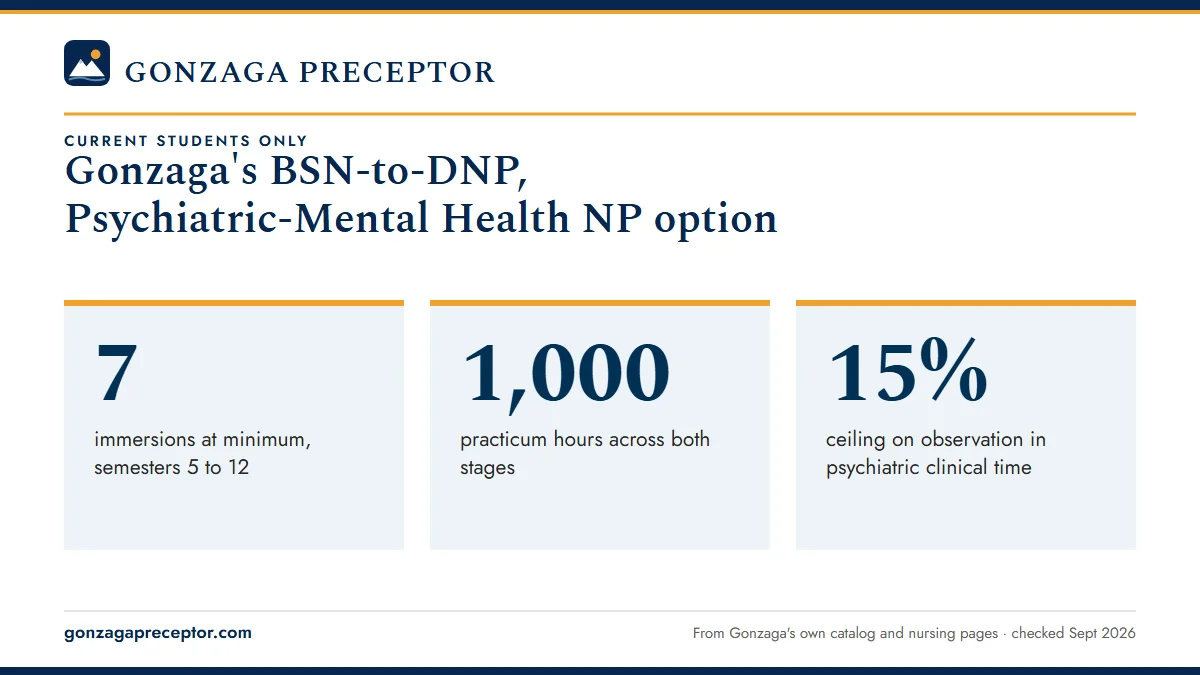
If you entered Gonzaga's Post-Baccalaureate DNP on the psychiatric track before it closed to new applicants, your path still runs in two stages. First come the MSN PMHNP clinicals, one primary care health assessment practicum and three psychiatric practicums; then come the doctoral practicums tied to your DNP project, all counting toward 1,000 hours. Seven immersions are spread across the later semesters.
Find your next psychiatric or DNP placement
Tell us your state and which practicum is next.
Current students only: what the closure means
Gonzaga has stopped admitting to its BSN-to-DNP, which it calls the Post-Baccalaureate DNP. A nurse starting out now enters the MSN Psychiatric-Mental Health NP track and, after graduating, can apply to the doctorate as a post-master's student. For those already admitted, Gonzaga keeps the PMHNP option page and FAQ online, and the psychiatric clinicals carry on.
Your plan is 78 credits over about five years on average, with 1,000 practicum hours. The graduate catalog starts your five-year completion clock at your first 700-level course. Washington's nursing board still names the program's PMHNP and FNP options among Gonzaga's approved in-state offerings on its August 2026 list.
Stage one: health assessment and the psychiatric sequence
The first clinical stage matches the MSN PMHNP track course for course. You open with NURS 601, sixty hours in primary care alongside Advanced Health Assessment, then move into psychiatric practicums once you have passed psychopharmacology (NURS 670) and both health assessment courses with a C or better.
| Practicum | Paired course | Population and focus | Hours |
|---|---|---|---|
| NURS 661M | NURS 652M | Psychiatric assessment and diagnosis | 60-180 |
| NURS 662M | NURS 653M | Adults: medication management, individual and group psychotherapy | 60-240 (2026 web page: 120-240) |
| NURS 663M | NURS 654M | Children and adolescents, and older adults | 60-240 |
| NURS 683M | None; taken after the sequence | Extension for remaining hours, repeatable | 60-180 |
Each psychiatric practicum carries a course fee listed in ZagWeb. Objectives, settings and preceptor fit for each course are covered in the PMHNP practicum courses guide.
Preceptors for the psychiatric stage
Gonzaga's PMHNP guidance opens the door to qualified mental health professionals: advanced practice nurses and psychiatrists, and also psychologists, social workers and licensed therapists. The catalog entry for the extension course is narrower, naming only a psychiatric NP or a psychiatrist, so confirm with course faculty before booking NURS 683M hours with anyone else.
Three limits catch people out. Observation is capped at 15 percent of clinical time. PMHNP hours cannot come from your own RN practice setting, though a different department of that employer is acceptable once faculty agree. And the PMHNP packet ties practicums to approved sites in your state of licensure. For where to look, see the PMHNP preceptors in the West guide.
Seven immersions and a visit each semester
The psychiatric stage brings five 2-day immersions in Spokane: a pair tied to NURS 600 and one beside each psychiatric concepts course, NURS 652M through NURS 654M. The doctoral stage adds two more under the older course list, attached to NURS 705 and NURS 760, which makes the seven that Gonzaga's FAQ places between semesters five and twelve.
Settle one question early. An older catalog page describes those two doctoral immersions as on campus, while Gonzaga's current Post-Master's DNP holds its immersions online, so ask your advisor which applies before booking flights. OSCEs and the psychiatric immersions are covered on the Spokane immersions page.
The option page also calls for a faculty site visit every semester of practicum. PMHNP clinical faculty may come in person or watch you with patients over telehealth. Gonzaga's MSN PMHNP page asks anyone whose home is not in Washington, Idaho, Oregon or Montana to schedule an extra Spokane day around an immersion for each practicum course's visit, so confirm with your advisor how your own visits are arranged.
Stage two: the doctoral practicums
After the psychiatric sequence, the program turns from seeing patients to leading a practice change. The older doctoral course set pairs NURS 701, NURS 702 and NURS 703 with the NURS 761 to NURS 763 project seminars, after NURS 705 and NURS 760 lay the groundwork. The catalog frames these courses around mentors and agency liaisons, carrying the project into a real organization, and a fresh individualized proposal with objectives each term.
The grade bar rises here. In the 2026-27 catalog, entry to NURS 701 depends on B grades in both NURS 708 and NURS 760, and entry to NURS 702 on B grades in both NURS 761 and NURS 701. Gonzaga's checklist has the liaison confirm there is no family or friendship tie and no reporting line between you, commit to at least three contacts per semester and complete a closing evaluation. The agency liaison guide walks through that checklist.
Counting to 1,000
Gonzaga states the program total and nothing finer. By the current program pages, your psychiatric stage produces 660 hours, 60 in health assessment and 600 across the psychiatric practicums, yet the PMHNP course objectives page describes 600 clock hours of clinical practice spread over at least three semesters. If all 660 count, about 340 remain for the doctoral practicums; if only the 600 psychiatric hours count, about 400 remain.
Neither remainder is published for this program, so settle it with course faculty while your plan still has room to add doctoral practicum time. The DNP practicum courses page explains how the current catalog handles extra doctoral hours.
Confirm your doctoral hour target with course faculty before NURS 701 begins, not in your final semester.
Why BSN-to-DNP PMHNP students choose us
Designated mental health shortage areas across the Northwest meet only part of their need, so psychiatric preceptors field many requests and the search rewards method. Our placement advisors look in your licensed state for mental health preceptors who match the population in front of you, from diagnostic work in NURS 661M to children, teens and older adults in NURS 663M, and confirm license and certification before anything goes to Gonzaga.
When the doctoral stage arrives, we find a practice setting that suits your project and a liaison who satisfies each item on Gonzaga's liaison checklist. We also keep your plan inside the observation cap and outside your own RN practice setting, and we line up a replacement quickly if a preceptor's schedule changes.
Course faculty approve each preceptor and setting, and Gonzaga's Clinical Placement Team completes the placement. Our part is making sure the file they receive is thorough and correct from the start. Tell us which course comes next in the form below.
Questions Gonzaga students ask
Is Gonzaga's BSN-to-DNP PMHNP still admitting students?
No. Gonzaga no longer offers the Post-Baccalaureate DNP to new applicants. Nurses who want a psychiatric NP doctorate from Gonzaga now start in the MSN PMHNP track, then apply to the Post-Master's DNP. Students admitted before the change continue on their progression plans, and the PMHNP option page stays online for them.
How many immersions does the Post-Baccalaureate DNP PMHNP include?
At least seven, spread over semesters five through twelve. Five are 2-day psychiatric-track immersions, two for health assessment and three paired with the psychiatric concepts courses. Two more attach to the older doctoral courses, Introduction to the DNP Role (NURS 705) and project readiness (NURS 760). Ask whether your cohort holds those two on campus or online.
Who supervises my hours after the psychiatric practicums?
An agency liaison, supported by mentors, takes the place of a clinical preceptor. In the doctoral practicums you carry out your DNP project inside a practice setting, and the liaison must be someone you are not related to, not friends with and not reporting to. Gonzaga also asks the liaison to accept regular contact during the semester and to evaluate you at the end.
Are the BSN-to-DNP psychiatric practicums the same as the MSN PMHNP?
Yes. The Post-Baccalaureate DNP contains the MSN PMHNP core and specialty sequence, so you take NURS 601 and then NURS 661M, NURS 662M and NURS 663M, with NURS 683M if you need more time. Preceptor rules, the observation cap and the course fees match. The difference is what follows: doctoral practicums instead of graduation.
What grade do I need to enter the DNP practicums?
A B. Graduate study at Gonzaga expects B work in general, and the doctoral practicums turn that into a gate: statistics and project readiness must both reach B before Practicum I, and Practicum I plus its seminar must both reach B before Practicum II. The psychiatric prerequisites are coded at C or better, and your GPA must stay at 3.00 or above.
Related pages
Last checked 2026-09-25
We check these pages against Gonzaga's catalog, FAQs, preceptor packets and Department of Nursing pages. Your course, the Graduate Nursing Student Handbook and Gonzaga's Clinical Placement Team have the final word.
- Gonzaga University Post-Baccalaureate DNP, Psychiatric-Mental Health Nurse Practitioner
- Gonzaga University Post-Baccalaureate DNP FAQs
- Gonzaga University Department of Nursing PMHNP Preceptor Guide
- Gonzaga University Graduate Catalog 2026-27, Doctor of Nursing Practice
- Gonzaga University Department of Nursing DNP Agency Liaison Checklist
Gonzaga asks you to find local preceptors first. Let us run that search.
Tell us your Gonzaga program, your practicum course and where you live and can travel. We find preceptors who fit the course and prepare the license, certification and site details your Practicum Site Placement Request needs, early in the semester before.
- Preceptors matched to the course: primary care across the lifespan for
NURS 661PtoNURS 664P, psychiatric care forNURS 661MtoNURS 663M, an agency liaison for the DNP - Credentials, license, board certification and site contact ready for your site request
- In Spokane, across Washington or wherever in the ten western states you are licensed
Start your placement plan
Your program, city and next practicum term is all we need to begin.