Gonzaga's BSN-to-DNP, Family Nurse Practitioner option
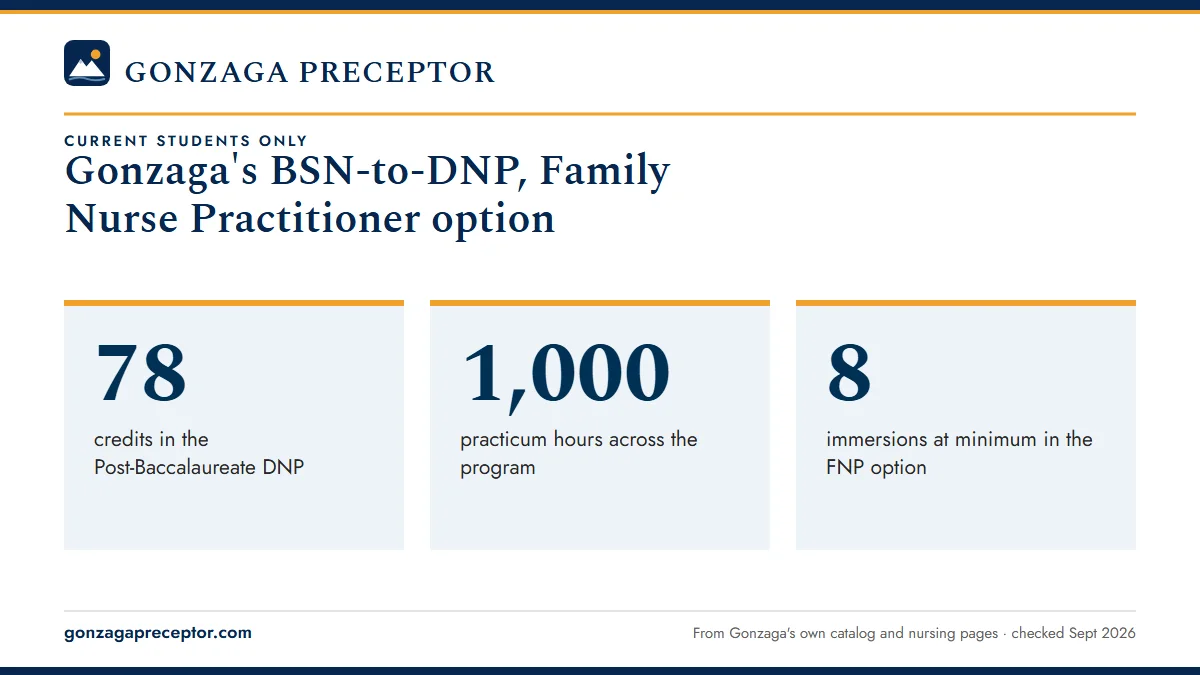
Gonzaga has closed its Post-Baccalaureate DNP to new applicants, but students already enrolled in the FNP option are still moving through clinicals. The program runs 78 credits and 1,000 practicum hours: first the full MSN FNP practicum sequence in primary care, then doctoral practicums built around your DNP project. This guide is written for those current students and sets out what each phase asks of your preceptors.
Find your next FNP or DNP placement
Tell us your state and the course coming up.
A closed program with students still in clinicals
Gonzaga's Post-Baccalaureate DNP page now states that the university "will no longer offer the Post-Baccalaureate to DNP program." Nurses applying today start with the MSN Family Nurse Practitioner track and can return for the Post-Master's DNP once they hold the master's. The closure concerns admissions: Gonzaga keeps the FNP and PMHNP option pages online for enrolled students, many of whom are still working through practicums.
Washington's nursing board still includes the program, with both NP options named, in its August 24, 2026 roster of approved in-state programs, and CCNE accreditation of Gonzaga's DNP runs through June 30, 2030. What changes for you is mostly practical. Fewer students share your exact course list, so confirm each step of your progression plan with your advisor instead of assuming that a newer MSN or DNP page describes your path.
The FNP option in figures
| Item | What Gonzaga publishes |
|---|---|
| Admission status | Closed to new applicants; current students only |
| Credits | 78 |
| Practicum hours | 1,000 across the program |
| Typical length | About five years |
| Time limit | Five years from your first 700-level course |
| Immersions | At least 8 on campus, about one a semester from semester 5 to semester 12 |
| Faculty site visits | At least three; outside Washington, Idaho, Oregon and Montana, an added Spokane day at an immersion in each practicum course |
Structurally, it is two programs joined end to end. The first stretch is the MSN FNP curriculum course for course, including every practicum and every immersion. The second is the older doctoral course set: NURS 705, inferential statistics in NURS 708 and five further doctoral courses, the NURS 760 to NURS 763 project seminars, and three DNP practicums.
Every clinical course in order
Each FNP practicum runs beside its didactic partner, and the pairs follow a set order: gender-based primary care, infant through adolescent care, then two adult and gerontology terms. Hour ranges for each course, and the places where the catalog and web page part ways, are laid out in the FNP practicum courses guide.
| Stage | Course | Who supervises | Hours Gonzaga publishes |
|---|---|---|---|
| Health assessment | NURS 601, with NURS 600 | NP or physician (the web page adds PA) | 60, in primary care |
| FNP specialty | NURS 661P, 662P, 663P, 664P | NP, physician or PA; at least half the hours with an NP | 600 across the block; per-course ranges differ by source |
| FNP extension | NURS 683P, if needed | As for the specialty block | Variable; may be repeated |
| Doctoral practicum | NURS 701, 702, 703 | Mentors and agency liaisons | No per-course figure published |
Preceptors for the primary care years
Your NP-phase preceptors follow the same rules as any Gonzaga FNP student's. The specialty practicums accept a nurse practitioner, physician or physician assistant, unless your state insists on an MD or NP. The FNP clinical faculty packet then requires that at least 50 percent of practicum hours be spent with a nurse practitioner, which shapes the mix you build each semester. The NP hours rule guide shows how to plan that split.
Each one needs a minimum of one year practicing in the relevant area, a clean, active license in your training state, and proof of licensure and national certification. Two approved preceptors per semester is the ceiling, and neither may be your direct supervisor. Hours start only after the semester begins, once your site is approved, you are following CPNW and an affiliation agreement is active.
How the 1,000 hours divide
Gonzaga publishes one figure for the whole program and no split by phase. The NP courses carry a known load: the current FNP pages count 660 hours, 60 from NURS 601 and 600 from the specialty block, while the catalog frames the 600 as ten practicum credits. If all 660 count toward the doctorate, the doctoral practicums would need to supply roughly 340, which happens to match the minimum Gonzaga sets inside its Post-Master's DNP.
Treat that 340 as arithmetic rather than a published rule, and confirm your own target with your advisor or course faculty. The doctoral hours are also a different kind of work. For its Post-Master's DNP, Gonzaga describes practicum time as indirect care completed through the DNP project, and the catalog frames NURS 701 to NURS 703 around mentors and agency liaisons, putting a project into practice inside an organization, and a new individualized proposal for each course. The DNP practicum courses guide covers that sequence and the older NURS 705 numbering.
Your plan follows the older doctoral course list, so check course numbers against your progression plan rather than the current DNP catalog page.
Eight immersions, and where the last two happen
Six of the eight immersions come from the FNP phase: two 2-day visits with NURS 600, then one 3-day visit with each of NURS 651P, NURS 652P, NURS 653P and NURS 654P, each built around OSCEs. The program FAQ places the full set between your fifth and twelfth semesters, roughly one a term.
The other two belong to the doctoral courses, NURS 705 and NURS 760 in the older course list, which an older catalog page describes as on campus. Gonzaga has since moved its Post-Master's DNP immersions online, so before booking travel for a doctoral immersion, ask your advisor which format your cohort follows. The Spokane immersions guide covers the FNP visits and travel planning.
Site visits add to the calendar. The program page lists at least three faculty site visits. For students whose home state is not Washington, Idaho, Oregon or Montana, those visits happen on an added Spokane day scheduled around an immersion, once per practicum course. The faculty site visits page explains how that day works.
Why current BSN-to-DNP FNP students choose us
With fewer students on your exact course list, there are fewer classmates to trade preceptor leads with. Our placement advisors close that gap with a direct search where you live and are licensed, looking for primary care preceptors matched to the next course, whether that means a practice with plenty of children for NURS 662P or an adult and older adult clinic for NURS 663P, while keeping at least half your hours with nurse practitioners.
What a current BSN-to-DNP FNP student gets
- Preceptors checked for a year in the clinical area, a license in your state and board certification
- Your Practicum Site Placement Request details collected well ahead: the preceptor's credentials, the site and its agreement contact, the schedule and how it fits the course
- A semester plan that stays within two preceptors
- For the doctoral phase, a practice setting and an agency liaison outside your reporting line
- A replacement search the moment a preceptor steps away
Final approval of every site and preceptor rests with Gonzaga's faculty, and the Clinical Placement Team closes out each placement. We hand them a request with nothing missing. Tell us which course is next in the form below.
Questions Gonzaga students ask
Can I still apply to Gonzaga's BSN-to-DNP FNP program?
No. Gonzaga has stopped admitting to the Post-Baccalaureate DNP and points new applicants to the MSN Family Nurse Practitioner track first. After the master's, the Post-Master's DNP is the route to the doctorate, with 1,000 practicum hours that count your MSN hours. The FNP option pages remain online only for students already enrolled.
How long do I have to finish Gonzaga's Post-Baccalaureate DNP?
The graduate catalog gives Post-Baccalaureate DNP students a five-year window that opens with the first 700-level course, a later starting point than the MSN's clock, which runs from acceptance. The program page puts average completion at about five years overall. If a missing preceptor pushes a practicum back, talk to your advisor about the progression plan early, before the clock gets tight.
Do all my FNP-phase hours have to be with nurse practitioners?
No, but at least half must be. The specialty practicums allow NPs, physicians and PAs, except in states that limit precepting to MDs or NPs, and the FNP clinical faculty packet sets the 50 percent nurse practitioner minimum. NURS 601, the health assessment practicum, is supervised by an NP or physician, with PAs added on the web page.
Do Post-Baccalaureate DNP FNP students log hours in Typhon or CORE?
Possibly both, depending on when your courses fall. Weekly Typhon logs belong to the older setup; Gonzaga set spring 2026 as the target for having every student on CORE, with CPNW continuing alongside. Evaluations for several practicums, including health assessment, three FNP courses and the doctoral NURS 760, NURS 701 and NURS 702, moved to CORE that spring. Your current syllabus names the platform.
Are the doctoral practicum hours patient care hours?
Expect project work instead. For its current DNP, Gonzaga calls practicum time indirect care completed through the DNP project, and the catalog's descriptions of the three doctoral practicums center on planning and carrying out a project with an agency liaison rather than on patient visits. Your syllabus confirms how your cohort's doctoral hours are defined and logged.
Related pages
Last checked 2026-09-25
We check these pages against Gonzaga's catalog, FAQs, preceptor packets and Department of Nursing pages. Your course, the Graduate Nursing Student Handbook and Gonzaga's Clinical Placement Team have the final word.
- Gonzaga University online Doctor of Nursing Practice, Post-Baccalaureate
- Gonzaga University Post-Baccalaureate DNP, Family Nurse Practitioner
- Gonzaga University Post-Baccalaureate DNP FAQs
- Gonzaga University Graduate Catalog 2026-27, Doctor of Nursing Practice
- Gonzaga University Graduate Catalog 2026-27, Master of Science in Nursing
Gonzaga asks you to find local preceptors first. Let us run that search.
Tell us your Gonzaga program, your practicum course and where you live and can travel. We find preceptors who fit the course and prepare the license, certification and site details your Practicum Site Placement Request needs, early in the semester before.
- Preceptors matched to the course: primary care across the lifespan for
NURS 661PtoNURS 664P, psychiatric care forNURS 661MtoNURS 663M, an agency liaison for the DNP - Credentials, license, board certification and site contact ready for your site request
- In Spokane, across Washington or wherever in the ten western states you are licensed
Start your placement plan
Your program, city and next practicum term is all we need to begin.